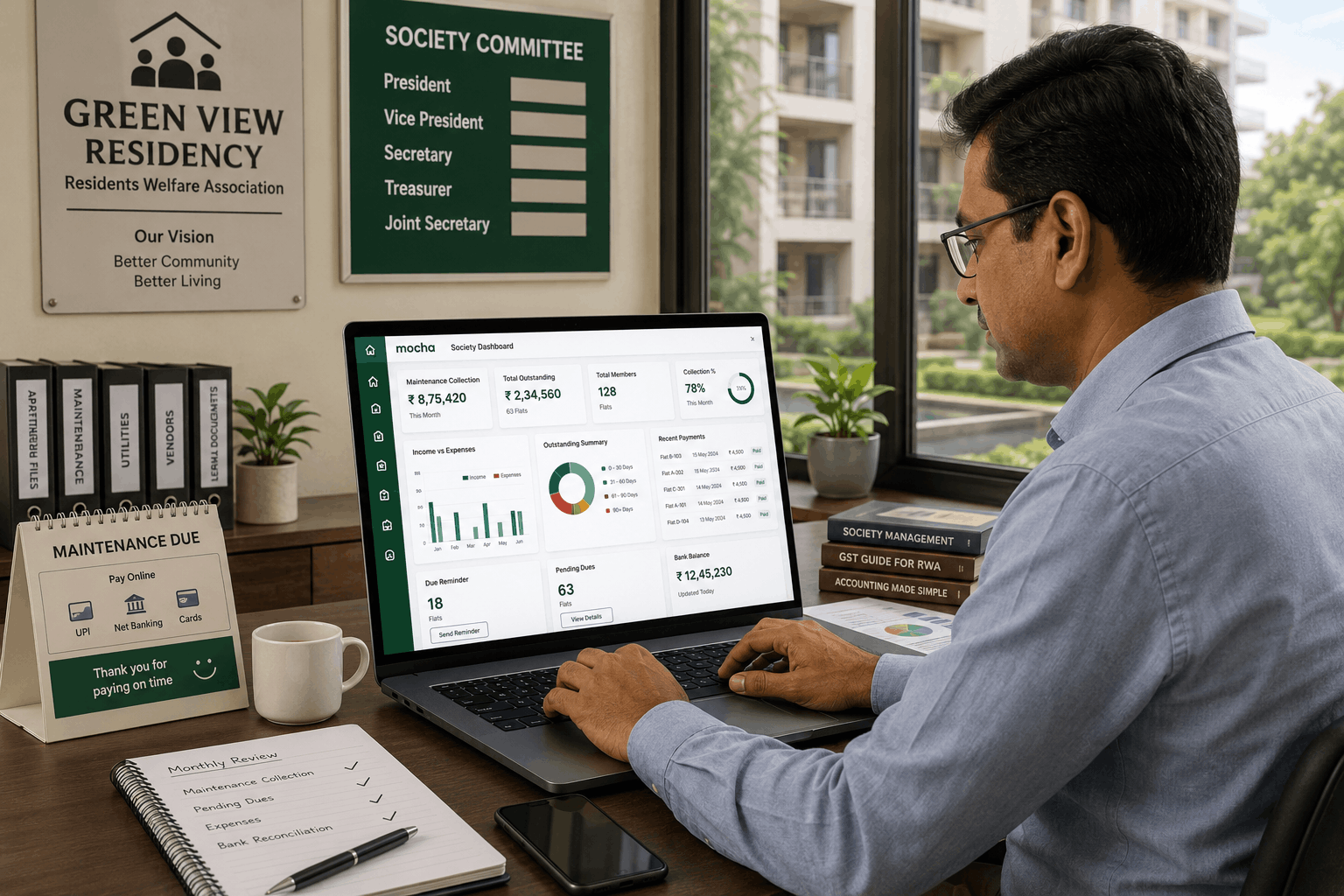
There are over 1.9 lakh housing societies in India, according to government data, responsible for the welfare of their residents. Running a society is a responsibility that falls to a committee of 5 to 19 members, depending on the society’s size and location. It is a complex task that involves the uninterrupted provision of utilities, maintenance of amenities, and management of funds. The financial management involved in running a society often starts off running on a manual ledger or spreadsheet, but it quickly spirals out of control, especially when societies appoint a third party to oversee operations.
Society billing software gives RWAs and housing societies a better way to manage this complexity. It helps committee members reduce routine work while giving residents transparent access to their dues and payment history. In this blog, we will discuss what society billing software does, why manual billing puts pressure on societies, which features are most helpful, and how Mocha Accounting helps societies manage billing with less effort and better financial control.
What is society billing software?
Society billing software is a specialised billing system made for housing societies, apartment associations, gated communities, and residents’ welfare associations. It helps committees create recurring monthly or quarterly bills for maintenance, sinking fund, repair fund, utility charges, parking fees, and other society collections. Unlike retail billing, which is built around SKUs, society billing is built around member-wise accounts. Here are the ways in which society billing differs from retail billing:
| Billing area | Retail billing | Society billing |
| Main account | Customer sale | Member-wise flat account |
| Billing pattern | Single sale at the counter | Monthly or quarterly recurring invoice |
| Charges | Product price and tax | Maintenance, sinking fund, arrears, penalty, utility charges |
| Payment tracking | Bill paid or pending | Flat-wise dues, past receipts, and ageing of arrears |
| Record use | Sales history | Committee review, resident queries, and audit-ready ledger |
| User group | Shop staff and customers | Committee members, residents, the accountant, and the auditor |
The headache of manual society billing
Manual society billing creates pressure because it depends on many small calculations, all of which can introduce errors when performed manually. Other issues that crop up due to manual billing include:
- Arrear calculations can differ from one sheet to another when entries are copied manually.
- Penalty interest can get missed when late payment rules vary by month.
- Email reminders can reach some residents and miss others. Also, the rigour of follow-up relaxes over time, which then starts hampering cash flow.
- Paper receipts can get misplaced during handovers.
- Bank entries can take time to match with resident payments.
- Flat-wise ledgers can become hard to read when residents make partial payments.
- New committee members can struggle to understand past records.
- Resident questions can take hours to answer when history is scattered.
Key features of modern housing society billing software
Modern housing society billing software, such as Mocha Accounting, consolidates the main billing tasks into a single system. It helps committees create invoices, calculate interest, track arrears, collect payments, send reminders, and share receipts with residents. Here are some of the key features of modern housing billing software:
| Feature | What it does | Problem it solves |
| Automated invoice generation | Creates recurring bills for all members on a set date | Treasurers avoid rebuilding monthly bills by hand |
| Smart penalty calculation | Applies simple or compound interest on late payments | Committees reduce arguments over late fees |
| Payment gateway connection | Allows residents to pay through UPI or net banking | Residents get easier payment options |
| Auto reconciliation | Matches online payments with member accounts | Accountants spend less time checking bank entries |
| Arrears tracking | Shows who owes money and for how long | Committees can focus on collection work |
| Member portal | Lets residents view invoices and receipts | Residents can check past bills without asking the treasurer |
| Utility billing | Adds water, electricity, or other charges to member bills | Societies handle varied charges in the same billing cycle |
How software improves billing precision and resident trust
Society billing software improves billing precision by applying rules uniformly to every member account. Here’s how software like Mocha Accounting improves the quality of financial records for housing societies:
| Area | Manual method | Software-based method |
| Maintenance billing | Bill amount typed for each flat | Charges applied through saved rules |
| Arrears | Past dues checked from old sheets | Pending amount shown in the member ledger |
| Penalty interest | Calculated by hand | Added through saved late fee rules |
| Receipts | Paper receipt book used | Digital receipt issued after payment |
| GST split | Worked out separately | Tax split added through billing setup |
| Fund allocation | Manual entry into different heads | Amounts mapped to maintenance, sinking fund, and other heads |
| Resident queries | Treasurer checks old files | Resident or committee views history in the portal |
| Audit-ready ledger | Records compiled at year’s end | Income and receipt entries stay stored throughout the year |
Benefits for committee members
Committee members handle society finances alongside their personal and professional responsibilities. Being a committee member is typically not a remunerative job; hence, efficiency and the elimination of repetitive work are paramount. Here are the ways in which society billing tools like Mocha Accounting help committee members:
- It reduces billing tasks by automating workflows and leveraging saved recurring billing rules.
- It sends payment reminders to residents, so the committee spends less time making calls.
- It offers online/POS payment options that allow residents to pay conveniently via UPI, net banking, and credit/debit cards.
- It issues digital receipts, so residents get payment proof immediately.
- It stores past invoices, receipts, and ledgers, so handovers become easier.
- It provides member-wise outstanding reports, so the committee can quickly review unpaid dues.
- It gives residents access to their payment history, reducing the need for repeated queries.
Transforming your society with Mocha Accounting
Mocha Accounting helps housing societies manage billing, member dues, receipts, GST-ready invoices, reports, and records through a simple, integrated interface. Here’s how Mocha Accounting’s features help housing societies:
| Mocha Accounting feature | Utility | Problem it solves |
| Recurring billing | Creates monthly or quarterly maintenance bills | Reduces manual bill creation for every flat |
| Member’s outstanding report | Shows pending dues by member | Helps treasurers review arrears faster |
| GST-ready invoicing | Adds tax details where society billing needs GST | Helps accountants prepare billing records |
| Digital receipts | Records payment and receipt details | Residents get proof of payment faster |
| Bank transaction rules | Categorises society receipts and payments | Accountants match bank entries with less manual work |
| Expense tracking | Records vendor bills, staff payments, and repairs | Committees see where society’s money goes |
| Document records | Stores invoices, receipts, and related files | Handover becomes easier for future committees |
| Reports dashboard | Shows income, expenses, bank balance, and dues | Committee members review finances with better control |
How housing societies can move from manual billing to software
Moving from manual billing to software is most effective when done in phases. Here are the steps to be followed:
| Step | Data that needs to be fed into the system |
| Member list | Flat number, flat holder name, tenant name, contact details |
| Charge rules | Maintenance rate, parking charge, fund charges, utility charges |
| Opening dues | Pending amount by member |
| Bank details | Society bank account and recent statements |
| Document records | Past receipts, bills, and ledgers |
| Test billing | Sample invoices for a few flats |
| Resident notice | Message explaining digital billing and payment options |
Conclusion
Society billing is a complex task that involves several moving parts. When a society manages all this through manual entries and spreadsheets, errors can creep in and choke the little time committee members have to spare for society work. Society billing software like Mocha Accounting solves this by giving RWAs and housing societies a better system for recurring billing and payment tracking.
Some of the most powerful features that Mocha Accounting brings to the table include:
- Recurring billing helps societies prepare maintenance bills without having to start from scratch every month.
- The member outstanding report gives committee members a simplified, up-to-date view of pending dues, enabling prompt follow-up.
- Online and in-office payment methods allow residents to pay via a range of payment options, including UPI, netbanking and credit/debit cards, which enhance the seamlessness of the billing experience and help manage cash flow better
- Expense tracking helps committees record vendor bills, repairs, staff payments, and other society costs, ensuring expenses stay within budget.
For a small apartment society, Mocha Accounting reduces billing work and helps collect dues on time. For a large RWA, it helps manage member accounts, arrears, payment reminders, and reports with better control. For committee members with limited software experience, the simple interface helps them handle billing without heavy training. For residents, digital invoices, payment history, and receipts create a better payment experience. A society runs better when its finances are easy to review, payments come on time, and residents can trust the billing process. Mocha Accounting delivers all this and more, so committee members can spend less time on operational tasks and more time on managing the community, building relationships with fellow residents and planning ways to improve resident welfare.
FAQs
How does society billing software handle different flat sizes?
Society billing software can apply different billing rules for different flat sizes. The committee can set charges based on parameters such as square footage, flat type, tower, parking slot, or a fixed monthly amount. Each member receives a bill based on the rule assigned to that flat.
Can the software automatically calculate interest on late payments?
Yes. The software can calculate late-payment interest in accordance with the society’s rules. The committee can choose between simple and compound interest if that is part of the society’s policy.
Does it send automated payment reminders to residents?
Yes. Society billing software can send payment reminders to residents before or after the due date. This helps the committee collect maintenance charges faster. Automated reminders also reduce phone calls and WhatsApp follow-ups. Residents receive timely reminders initiated by the system to pay their dues.
Can the software help with GST requirements for housing societies?
Yes. Society billing software can help add GST details where a housing society needs to charge GST. It can show tax split and income heads in the billing record.
Can residents view their payment history on their mobile phones?
Yes. Residents can view invoices, receipts, and payment history through a member portal or mobile access, depending on the setup. This helps them download past records when needed.
Leave a Reply