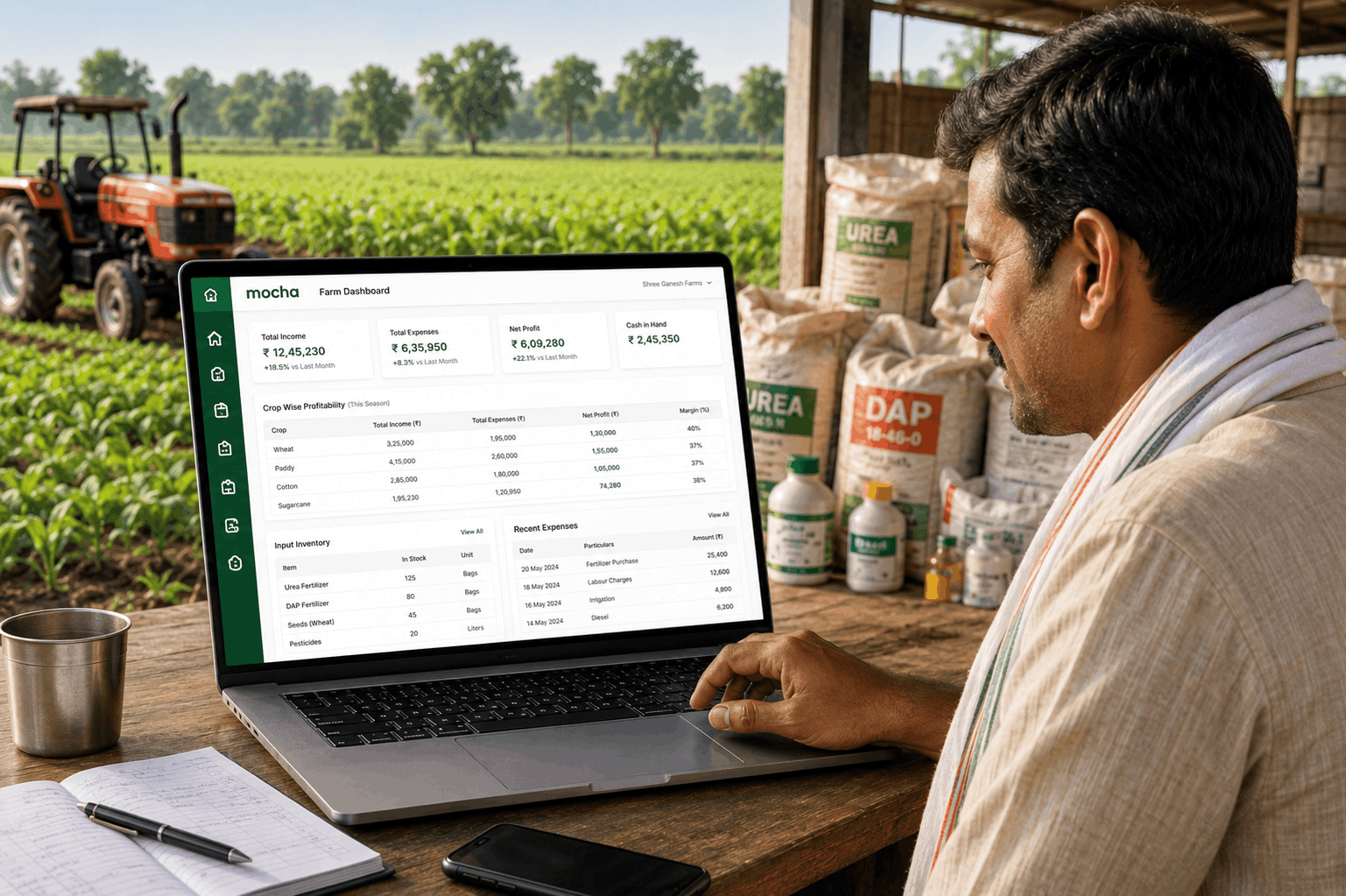
Agriculture, together with its adjacent sectors, is the predominant source of livelihood in India. Data from the United Nations indicates that 70% of rural households in India depend on agriculture for their income. However, farming businesses have multiple moving parts and are a complex operation, particularly due to the lack of formalised business knowledge among farmers.
For Indian farm owners, agri-entrepreneurs, dairy units, poultry farms, food crop growers, orchard owners and farm managers, accounting is a critical input for better business operations. This blog will take you through common farm accounting problems, their solutions, and how Mocha Accounting can help agriculture businesses manage their finances better.
Why accounting is crucial for farming businesses
Farm accounting helps agri-businesses track key business metrics such as income, expenses, assets, loans, stock, and profit, across seasons. Here’s how farm accounting helps different kinds of agricultural businesses/processes in India:
| Farm area | What needs to be tracked | Outcome on business understanding |
| Crop farming | Stocks of inputs such as seeds and fertilisers, labour, and machinery | Shows crop-wise cost before harvest |
| Dairy farming | Feed, medicines, milk sales, animal purchases | Shows daily cost and income per animal |
| Poultry farming | Chickens, feed, vaccines, labour, electricity, sales | Shows batch-wise profit |
| Orchard farming | Saplings, fertiliser, pesticide, harvest labour, water | Shows long-term crop cost |
| Fish farming | Feed, infrastructure, oxygen, sales, water | Shows cycle-wise earnings |
| Farm equipment | Tractor fuel, service, repairs, maintenance, and loans | Shows the machine cost over a year |
Common farm accounting problems
Farm accounting is complex as it involves several moving parts. This complexity only increases when accounting is done manually rather than using specialised farm accounting software like Mocha Accounting. Here are some of the common problems faced by farming businesses when it comes to accounting:
- Manual recordkeeping takes time and cash expenses can be missed during busy time periods.
- Expenses are hard to make sense of when bills are entered without segregation into cost heads.
- Teams are not specialised in accounting or lack formalised accounting training, hence errors creep in when systems lack validation features.
- Incomes vary by season and harvest income often lags behind expenses, putting cash flow under pressure.
- Loan repayments are difficult to manage, especially when they are tracked offline or on physical registers with no scheduled reminders.
- When inventory records are not integrated with consumption, manual reconciliation is required, leaving business owners/managers without a comprehensive understanding.
- Inventory records suffer when seed, fertiliser, feed, spare parts and packaging material are counted only at the end of the month.
- Bank reconciliation is complex as invoices in this domain are often cleared in multiple small parts.
Smart solutions to farm accounting problems
The best way to handle farm accounts is to record each activity precisely. This is the base solution that resolves a lot of these issues and farm accounting software like Mocha Accounting plays a key role in enabling this:
| Problem | Solution | Benefit |
| Cash expenses get missed | Enter daily expenses through the software | Cost can be viewed accurately throughout the season |
| Crop costs get mixed | Use crop-wise categories when plotting income and expenses | Profitability can be computed by crop, allowing for more efficient business decisions |
| Seasonal income varies | Prepare cash flow reports | Purchases and repayments can be planned, ensuring the business does not run short of cash at critical junctures |
| Tax work is complex and time-consuming | Finances are tax-ready and accurate, with a lower risk of regulatory issues | |
| Input stock gets overused / it is hard to track inputs | Track seeds, fertiliser, and feed inventory in real-time with software | Purchase planning improves and costs get optimised |
How Mocha Accounting helps agriculture businesses
Mocha Accounting helps agricultural businesses manage income, expenses, inventory, banking, invoicing, reports and documentation in a single system. It is a great tool for farmers who want better cost tracking across crops, animal batches, equipment and seasonal activities. Here are a few of its key features that add value to farming operations:
| Feature of Mocha Accounting | Application to farming operations | Business impact |
| Expense tracking | Records expenses for labour, diesel, fertiliser, feed, repairs and transport | The owner sees where funds are consumed and can optimise costs |
| Income management | Records sales across crops/animal types that the farm produces | It becomes easy to understand sales by buyers, so that planning can be done accordingly |
| Inventory management | Tracks inputs such as seeds, fertilisers, feed, spare parts and packaging | Stock available is known at all times leading to better purchasing decisions |
| GST-ready invoicing | Creates invoices with accurate tax details | Billing records are precise and do not require rework at tax-computation time |
| Online payment functionality | Money goes straight to the bank account, reducing the need for banking operations. Cash flow management is simplified as barriers to payment are removed | |
| Dashboards | Shows key business metrics such as cash position, expenses, income and stock levels | The owner/manager of the farm can easily understand where the business is headed, allowing for corrective action to be taken whenever required |
To get a deeper understanding of the features of Mocha Accounting and how much these would cost your business, have a look at the tiered pricing plans before deciding which one to go ahead with.
Better farm accounting habits
Software works best when the farm maintains consistent record-keeping habits. These include:
- Maintain a daily expense log for labour, fuel, fertiliser, feed, repairs, transport and hired machines.
- Track seeds, fertilisers, feed, packaging material, medicines and spare parts through inventory records.
- Match bank statements with buyer receipts, vendor payments, loan instalments and subsidy receipts on a weekly basis.
- Use cloud-based software so the owner, accountant and farm manager can access records when needed.
- Review crop-wise and batch-wise reports before buying fresh inputs.
- Keep purchase bills, sale invoices, transport slips and bank proof attached to entries.
- Separate household expenses from farm expenses.
How farms can set up crop-wise costing
Crop-wise costing helps farmers understand profit by crop instead of only total farm profit. It provides a clearer view of which crop deserves more land, which crops need cost control, and which crops may need to be dropped altogether.
Cost head Example entry Why track it Seeds or saplings Paddy seed, tomato sapling, mango graft Shows starting input cost Fertiliser and manure Urea, DAP, compost, organic manure Shows soil input spent Crop protection Pesticide, fungicide, traps Shows pest and disease cost Labour Sowing, weeding, harvesting, packing Shows people cost Irrigation Pump fuel, electricity, and water charges Shows water-related cost Machine hire Tractor, harvester, sprayer Shows equipment use cost Transport Field to market (mandi), farm to buyer Shows the sale movement cost Sale income Trader receipt, mandi sale, processor payment Shows crop earnings Conclusion
Accounting for farming enables agricultural businesses to better control their finances. Farming has a unique cashflow cycle, with income largely lagging behind costs. This means that if expense recording is missed, a farmer is likely to have a grossly overstated understanding of profit.
Farm accounting software like Mocha Accounting helps solve these issues and more by providing a deep understanding of income and costs enabling better decision-making. Key features include:
- Expense tracking that helps track expenses head-wise, allowing cost optimisation
- Income management with integrated invoicing and payment functionality, which allows customers to make payments via convenient online payment modes, including UPI, credit/debit cards and netbanking, enhancing the customer experience and improving cash flow.
- Inventory management ensures that inventory records are in sync with business operations and ensures reordering happens in a timely manner.
- Reports and dashboards help farmers/farming business owners understand their business’s financial health in detail and create financial statements that accounting teams and CAs can easily review.
Better farm accounting starts with small daily habits and best practices such as same-day expense recording, precise expense tagging, inventory tracking and report review. When these habits work together with a farming accounting tool like Mocha Accounting, agriculture businesses gain a simpler way to manage finances and plan growth. Schedule a demo today, and explore how Mocha Accounting can add value to your farming business.
FAQ section
What is accounting for farming and why is it important?
Accounting for farming means recording farm income, expenses, stock, loans, assets and profit. It helps farmers understand crop cost, animal batch cost, cash flow, and seasonal earnings. It is important because farming has heavy expenses before the sale income comes in. Proper accounts help farmers plan input buying, loan repayment and future crop choices.
How can farmers track expenses effectively?
Farmers can track expenses by recording each cost on the same day and tagging it to a crop, herd, batch, equipment item or farm activity. Using software makes this easier by helping store bills, sort expenses, match bank payments, and generate reports for review.
Can farm accounting software handle multiple crops or animal batches?
Yes. Farm accounting software can track income and expenses across multiple crops, seasons, animal groups and batches. This helps compare activity-wise profit and helps managers plan future input purchases and sales targets.
How does Mocha Accounting simplify agricultural financial management?
Mocha Accounting helps farmers record expenses, track income, manage inventory, create GST-ready invoices, connect bank entries, use custom tags and generate reports. It gives owners a better view of cash position, stock levels, crop cost and buyer receipts.
What habits should farmers follow for precise accounting?
Accounting habits that farmers should follow include recording expenses daily, tracking inputs and consumables, reconciling bank accounts regularly and using data to inform business decisions. Another important habit to follow is separating household spending from business spending.
Leave a Reply