Key Takeaways
- Bank reconciliation for property managers can be tricky, and there’s much to watch for. Property managers need to reconcile multiple bank accounts every month: operating accounts, trust accounts, and (in many states) separate security deposit accounts.
- Trust accounts require three-way reconciliation, where the bank balance, your general ledger balance, and the sum of all individual client ledgers must match exactly. Operating accounts use standard two-way reconciliation.
- Most state real estate commissions require monthly trust account reconciliation with a signed worksheet retained on file. Missing or unsigned worksheets are among the most commonly cited findings in audits.
- The biggest reconciliation mistakes are negative client ledger balances, skipped reconciliations, and bank fees being deducted from trust accounts instead of operating accounts.
- Property management software with native bank reconciliation eliminates the spreadsheet workarounds that cause most reconciliation errors and audit findings.
If you don’t reconcile your property accounts, you don’t actually know what your books say.
You have a guess. A reasonable estimate based on the transactions you remember. But until your bank statement, your general ledger, and your client ledgers all match exactly, you’re operating on assumptions.
For most businesses, that’s bad practice.
For property managers, it’s a license risk. And owners? You’re risking your hard-earned profits.
Most state real estate commissions require monthly bank reconciliation for trust accounts. Failing to reconcile (or doing it wrong) is one of the most common reasons property managers face audit findings, fines, and disciplinary action. The work itself isn’t difficult once you understand the process. But the discipline of doing it correctly every month, across every account, is where most operations break down.
This guide walks through how property management bank reconciliation works, the difference between two-way and three-way reconciliation, the accounts you need to reconcile, and the mistakes to avoid.
Bank Reconciliation for Property Managers: What Is Bank Reconciliation?
Bank reconciliation is the process of comparing your internal accounting records against your bank statement to confirm they match.
You probably do this in your personal life without thinking about it. You check your bank balance, look at recent transactions, and notice if something looks off. That’s reconciliation in its simplest form.
For a business, the process is more structured. You compare every transaction on the bank statement against the corresponding entry in your accounting records, identify any differences (called reconciling items), and adjust your books or flag bank errors as needed.
The goal is simple: confirm that your records reflect reality.
When the records and the bank statement don’t agree, you have a problem to investigate. It might be an outstanding check that hasn’t cleared, a deposit in transit, a bank fee you didn’t record, or something more serious.
The Bank Accounts Property Managers Need to Reconcile
Property managers don’t have just one bank account. They typically run several, each with different reconciliation requirements.
Here’s how the accounts typically break down.
| Account Type | What It Holds | Reconciliation Type |
|---|---|---|
| Operating account | Management company revenue and expenses | Two-way |
| Trust account (operating) | Rent collected on behalf of owners, owner reserves | Three-way |
| Security deposit trust account | Tenant security deposits | Three-way |
| Escrow accounts | Funds held for specific purposes (insurance, taxes) | Two-way |
Operating Account
This is your business’s primary checking account. It holds your management fee revenue, business expenses, payroll, and other operating cash flow.
Reconciliation here is straightforward. You’re matching your bank statement against your check register or general ledger. This is two-way reconciliation.
Trust Account (Operating)
This is where rent collected on behalf of owners lives. Owner distributions flow out of this account. Reserves held for property maintenance live here too.
Trust accounts require three-way reconciliation because the money belongs to multiple parties (each property owner). You need to confirm that the bank balance matches both your general ledger and the sum of all individual owner ledgers.
Security Deposit Trust Account
Some states require security deposits to be held in a separate trust account from operating trust funds. Where required, you reconcile this account independently using the same three-way process.
Escrow Accounts
If you hold funds for specific purposes (property tax escrow, insurance escrow, capital improvement reserves), each one needs its own reconciliation.
Two-Way vs. Three-Way Reconciliation
The difference between two-way and three-way reconciliation comes down to whether the money in the account belongs entirely to your business or to multiple clients.
Two-Way Reconciliation
Used for accounts where all the money is yours (operating accounts, business savings, etc.).
You match two numbers:
- The bank statement balance (adjusted for outstanding checks and deposits in transit)
- Your general ledger balance for that account
If the two numbers match, you’re reconciled.
Three-Way Reconciliation
Required for trust accounts where you’re holding money on behalf of multiple clients.
You match three numbers:
- The bank statement balance (adjusted)
- Your general ledger balance
- The sum of all individual client ledgers
All three must match exactly. The third number (the sum of client ledgers) is what separates trust account reconciliation from regular reconciliation. It’s also what most property managers either skip entirely or get wrong.
If your bank balance and general ledger match but the sum of client ledgers doesn’t, you have a misallocation problem. Money is in the account, but it’s been recorded against the wrong client. That’s a fixable issue, but you have to know about it to fix it.
Step-by-Step: Three-Way Trust Account Reconciliation
This is the process most state commissions expect property managers to follow every month for every trust account. The steps are the same whether you’re using property management software or working in spreadsheets.
Here’s how to do it.

Step 1: Gather Your Records
Pull three things:
- The bank statement (or downloaded transaction file) for the period
- Your check register or general ledger for the trust account
- The owner ledgers and (if applicable) tenant ledgers from your property management software
If any of these aren’t readily available, that’s the first problem to solve.
Step 2: Reconcile the Bank Statement to Your Books
Start with two-way reconciliation between the bank statement and your general ledger.
Mark every cleared transaction on both sides. Anything unmarked is a reconciling item:
- Outstanding checks (checks you wrote that haven’t cleared)
- Deposits in transit (deposits you recorded that the bank hasn’t processed)
- Bank fees you haven’t recorded
- Interest earned you haven’t recorded
- Bank errors (rare but possible)
Apply the formula:
Ending Bank Balance + Deposits in Transit – Outstanding Checks = Your Book Balance
If those numbers match, you’ve completed step one.
Step 3: Verify the Sum of Client Ledgers
Now pull a property trial balance (a report listing every owner ledger and tenant ledger with their month-end balance).
Add up all the individual balances. The total should equal your general ledger balance and your reconciled bank balance.
If it does, you’re done. All three numbers match. The trust account is reconciled.
If it doesn’t, you have a misallocation issue to investigate.
Step 4: Investigate Discrepancies
If the three numbers don’t match, work backward to find where the difference came from.
Common causes:
- A transaction was posted to the wrong owner ledger
- A transaction was recorded twice on one ledger and missed on another
- A deposit was made to the trust account but never assigned to a client
- A disbursement was paid out but never deducted from the corresponding client ledger
Having said that, the longer a discrepancy sits unresolved, the harder it gets to find. A discrepancy from the current month is usually traceable in an hour. A discrepancy from six months ago can take days.
Step 5: Document and Sign
Most state commissions require a signed reconciliation worksheet for every monthly reconciliation. Even if your state doesn’t formally require the signature, retain a worksheet showing the three balances and any reconciling items.
Keep these worksheets for at least the period required by your state (typically three to seven years). They’re the documentation auditors will ask for first.
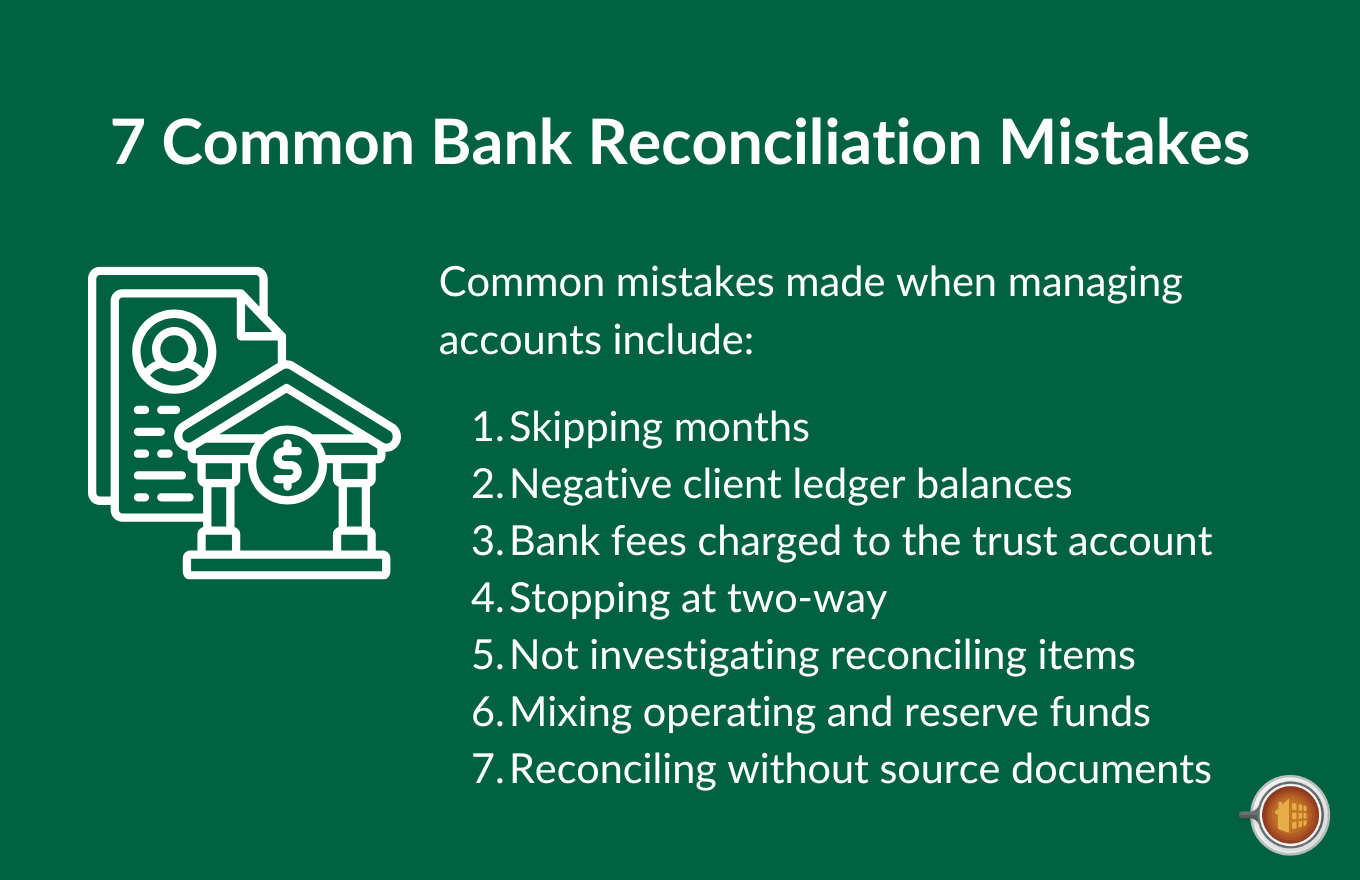
7 Common Bank Reconciliation Mistakes
Most reconciliation problems come from a small handful of mistakes. They’re easy to avoid once you know what to watch for.
Here are the ones that come up most often.

1. Skipping Months
The biggest mistake. A small discrepancy in March becomes an unfindable mystery by December. Reconcile every month, ideally within a week of receiving the bank statement.
2. Negative Client Ledger Balances
If any individual owner or tenant ledger goes negative, that’s a deficiency. You’ve effectively used another client’s funds to cover a shortfall. State commissions specifically prohibit this. Your software should alert you before a disbursement creates a negative balance.
3. Bank Fees Charged to the Trust Account
Bank fees should never come out of a trust account. If your bank charges a monthly service fee on the trust account, those fees need to be reimbursed from your operating account immediately. Most states allow you to keep a small amount of your own money in the trust account ($100-$200) specifically to absorb fees, but you have to maintain a separate ledger for it.
4. Stopping at Two-Way
This is the one auditors flag most often. The bank balance and general ledger match, but the property manager never adds up the individual client ledgers. That’s a two-way reconciliation, not a three-way. Trust accounts require all three.
5. Not Investigating Reconciling Items
A reconciling item that’s been “outstanding” for six months isn’t really outstanding. It’s an error. Outstanding checks should clear within 30-60 days. Deposits in transit should clear within a few days. Anything older needs investigation.
6. Mixing Operating and Reserve Funds
For HOA managers, this is the equivalent mistake. Operating fund expenses paid from reserve fund accounts (or vice versa) make reconciliation impossible because the funds are supposed to be tracked separately.
7. Reconciling Without Source Documents
Reconciling against your accounting software without pulling the actual bank statement misses bank errors and unauthorized transactions. Always reconcile against the bank’s source document.
Why Monthly Matters
Most state real estate commissions require monthly reconciliation.
The North Carolina Real Estate Commission’s Rule 21 NCAC 58A .0117(e) explicitly requires brokers to reconcile trust accounts monthly and retain a worksheet showing the bank statement balance, journal balance, and trial balance in agreement.
Oregon’s OAR 863-025-0028 requires property managers to reconcile each clients’ trust account within 30 days of the bank statement date using a three-component reconciliation, with the property manager required to sign and date the document.
But beyond compliance, monthly reconciliation matters for practical reasons.
The truth is, fraud and errors are easier to catch when you find them quickly. A misappropriation that gets caught within 30 days can usually be reversed and corrected. The same misappropriation discovered six months later may already have grown into a larger problem with more entries to untangle.
Vendor relationships also depend on accurate reconciliation. If your records say you paid a vendor but they say you didn’t, the only way to resolve it is by going back to the bank statement.
For property managers serious about scaling, monthly reconciliation is the discipline that keeps everything else working.
How Mocha Manage Handles Bank Reconciliation
If you’re reconciling trust accounts in spreadsheets or general accounting software, you already know how the process goes. Pull the bank statement. Export transactions from your software. Build a worksheet. Cross-check every transaction. Add up the client ledgers. Hope they match.
That manual process is exactly the kind of work that causes the reconciliation mistakes we just covered.
Mocha Manage was built by CPAs who understand bank reconciliation at a compliance level. Our integrated accounting and banking features connect directly to your bank accounts and help avoid many of the errors encountered when done manually.
No longer do you need to locate accounts, gather information, or run manual calculations. With Mocha, you can pull directly from your chart of accounts to reconcile accounts in seconds:

Then simply select your statement date, input your ending balance, and hit “Start Reconciling”:

With Mocha, you can also do:
- Bank account connection as the foundational benefit (no more spreadsheet exports)
- Three-way reconciliation as a real capability rather than a checklist item (“see your bank balance, book balance, and the sum of all client ledgers side by side”)
- Negative ledger balance prevention called out specifically as the most common deficiency, which ties back to the “Common Mistakes” section earlier in the article
- Separate reconciliation per account type addresses the operating trust vs. security deposit trust distinction that earlier sections set up
- Signed worksheets explicitly ties to the NC and Oregon requirements we just sourced
- Audit-ready reports on demand closes the loop with the “What documentation do I need to keep” question that surfaces in the FAQ
Bank transactions feed directly into the platform. Your general ledger updates automatically. Client ledgers reconcile against the trust account balance in real time. And the three-way reconciliation reports your auditor or state commission expects are generated within the platform, not assembled from exported spreadsheets.
For property managers who’ve spent hours every month on manual reconciliation (or worse, discovered a discrepancy during an audit), the difference between a general accounting tool and a platform built for trust accounting is the difference between hoping you’re compliant and knowing you are.
Try Mocha Manage free to see what bank reconciliation looks like when it’s built into the accounting from day one.
Frequently Asked Questions
How often should property managers reconcile bank accounts?
Monthly, ideally within a week of receiving the bank statement. Most state real estate commissions require monthly reconciliation for trust accounts.
What’s the difference between two-way and three-way reconciliation?
Two-way reconciliation matches your bank statement against your general ledger. Three-way reconciliation adds a third check: the sum of all individual client ledgers must also match. Trust accounts require three-way.
Do I need a separate bank account for security deposits?
Depends on your state. Some states require separate trust accounts for security deposits. Others allow a single trust account as long as your records clearly separate the funds. Check your state real estate commission’s rules.
What if my reconciliation doesn’t balance?
Investigate immediately. Common causes include transactions posted to the wrong client ledger, missing entries, or bank errors. The longer a discrepancy sits, the harder it is to fix.
Can I deduct bank fees from a trust account?
No. Bank fees on trust accounts should be reimbursed from your operating account. Most states allow you to keep a small amount of your own funds in the trust account to absorb fees, but you must maintain a separate ledger for it.
What documentation do I need to keep?
A signed reconciliation worksheet for every month, retained for the period your state requires (typically 3-7 years). Auditors will ask for these first when they review your trust account compliance.
Disclosure: Mocha Manage publishes this blog. This guide is for informational purposes only and does not constitute legal or accounting advice. Trust accounting and reconciliation laws vary by state. Consult an attorney or CPA for advice specific to your situation.
Leave a Reply