Key Takeaways:
- Proper HOA reserve fund accounting requires tracking contributions, expenditures, and percent funded against reserve study projections
- Reserve funds must be kept in separate accounts from operating funds to maintain IRS compliance and prevent misuse
- Most states recommend HOAs maintain 70-100% reserve funding to avoid costly special assessments
- Reserve studies should be updated every 3-5 years to reflect current replacement costs and asset conditions
- Fund accounting methods (not equity methods) provide the clearest financial picture for HOA reserves
__
Your HOA’s reserve fund is the difference between planned maintenance and financial crisis.
So, is your accounting on point?
Improper reserve fund accounting turns what should be a safety net into a liability:
- Commingled funds trigger IRS penalties
- Missing documentation fails audits
- And underfunded reserves force special assessments that devastate homeowner trust
The good news?
Reserve fund accounting isn’t complicated when you understand the requirements and follow proven best practices.
So, let’s jump in and get your reserve fund accounting on point.
What Is a Reserve Fund?
A reserve fund is a dedicated savings account where HOAs set aside money for major repairs and replacements that occur infrequently but carry significant costs.

Think of it as your association’s long-term emergency fund (sort of).
Operating funds cover day-to-day expenses like:
- Landscaping
- Utilities
- and routine maintenance
Reserve funds handle the big-ticket items:
- Roof replacement
- Parking lot resurfacing
- Elevator modernization
- Pool resurfacing
- And HVAC replacement
Every HOA needs both fund types because each serves a distinct purpose.
When a homeowner pays their monthly assessment, a portion goes to operating expenses and another portion goes to reserves. A typical split might be $300 to operating and $50 to reserves from a $350 monthly assessment.
The key difference:
- Operating funds get spent regularly on recurring expenses, while
- Reserve funds accumulate over years for major capital expenditures.
Without adequate reserves, HOAs face two terrible options when major repairs become necessary:
- Delay critical maintenance until the association saves enough money (risking property damage and declining values), or
- Levy special assessments forcing homeowners to pay thousands of dollars with little notice
Both options destroy homeowner satisfaction and board credibility (among other even worse things).
Why Reserve Fund Accounting Requires Special Attention
Reserve fund accounting differs from general HOA accounting because the stakes are higher and the requirements are stricter.

Here’s exactly what that means:
1. Legal and Tax Compliance Requirements
The IRS requires HOAs to maintain separate reserve fund accounts to preserve tax-exempt status on assessment income.
When operating and reserve funds commingle, the IRS can reclassify reserve contributions as taxable income. This means your association pays federal income taxes on money earmarked for future capital expenses.
According to the Community Associations Institute, many states mandate reserve fund separation by law. California Civil Code 5500-5515 requires condominium associations to maintain reserves and conduct regular reserve studies. Florida Statutes 718.112 mandates reserve funding for major components.
Violating these requirements exposes board members to personal liability claims from homeowners.
2. Audit and Transparency Obligations
HOA audits scrutinize reserve fund accounting more closely than operating fund accounting.
CPAs conducting annual reviews or audits examine whether reserve funds remain properly segregated, whether expenditures from reserves match board-approved capital projects, and whether reserve balances align with reserve study projections.
Financial transparency laws in most states require HOAs to disclose reserve fund status to homeowners.
Homeowners buying into associations want to see healthy reserve funding before purchasing.
Poor reserve fund accounting creates red flags for:
- Prospective buyers reviewing association finances
- Mortgage lenders evaluating association stability (FHA, Fannie Mae, Freddie Mac all have reserve requirements)
- CPAs conducting annual audits
- State regulators investigating homeowner complaints
Fund Accounting vs. Equity Method: Which Is Right for Reserves?
The simple answer: The fund accounting method provides clarity for HOA reserve management compared to the equity method.
With that said, let’s go into detail on why that is:
1. Fund Accounting Method (Recommended)
Fund accounting maintains completely separate columns for operating funds and reserve funds on your balance sheet.
Each fund shows its own:
- Assets (cash, investments)
- Liabilities (bills owed)
- Fund balance (net position)
When you run a balance sheet, you see three columns: Operating Fund, Reserve Fund, and Total. This instant visual separation shows exactly how much money sits in each fund without any calculation required.
The income statement (P&L) also separates into fund-specific reports. Operating fund income and expenses appear on one statement. Reserve fund contributions and expenditures appear on another.
Benefits for reserve management:
- Board members instantly understand reserve fund status
- Treasurers can’t accidentally pay operating expenses from reserves
- Auditors clearly see fund separation
- Homeowners viewing financials understand where their money goes
According to the American Institute of CPAs guidelines, fund accounting is the preferred method for HOA financial reporting because it provides maximum transparency.
2. Equity Method (Not Recommended for Most HOAs)
The equity method shows everything in a single column with reserve funds appearing as “designated” equity rather than separate funds.
Your balance sheet lists total assets and total liabilities, then breaks Members’ Equity into:
- Undesignated (operating)
- Designated for Reserves
- Designated for Special Projects
This creates problems for reserve management.
Board members must calculate reserve balances by reading equity designations instead of seeing separate fund balances clearly.
The method makes it easier to accidentally use reserve money for operations because everything appears in one pool.
Homeowners reviewing financial statements can’t quickly understand reserve fund status. They see total association money but must dig into equity sections to find reserves.
Use equity method only if: Your CPA specifically requires it for regulatory reasons in your state, or your association is extremely small (under 20 units) with minimal reserves.
Otherwise, fund accounting provides clearer financial management for reserves.
How to Set Up Your Reserve Fund Accounting
Proper setup prevents years of accounting headaches.
That might sound like a slogan, but it’s true.
This may just be the set up process, but by ensuring you set things up properly in the beginning will set you on the right track with a strong foundation.
Here are the two steps to take:
1. Opening Separate Bank Accounts
Open a dedicated savings or money market account for reserve funds separate from your operating checking account.
Many HOAs use:
- Operating funds: Checking account for paying bills and collecting assessments
- Reserve funds: High-yield savings account or money market account earning interest
Some banks offer FDIC-insured sweep accounts that maximize insurance coverage for large reserve balances. According to First Citizens Bank, associations should prioritize accounts offering FDIC protection, especially for reserve funds:
“When managing their investments, HOAs should look for ways to grow their funds without compromising safety. One way to do that is to keep funds in bank accounts with FDIC protection. Likewise, look for an institution that specializes in HOA banking.”
Account access and controls:
Require dual signatures for withdrawals from reserve accounts. This prevents unauthorized use of reserve funds and creates accountability.
Limit who can access reserve accounts. Typically only the treasurer and one board officer should have withdrawal authority.
Document every reserve fund withdrawal with board meeting minutes showing approval. When you spend $45,000 from reserves for parking lot resurfacing, the minutes should show the board voted to approve using reserves for this specific project.
2. Configuring Your Accounting Software
Set up separate general ledgers for each fund type in your accounting software.
Most HOA-specific accounting software includes built-in fund accounting capabilities.
However, some of this needs to be configured. Let’s talk about what you need to have set up:

First: Chart of accounts with fund designations
- All operating revenue and expense accounts tagged as “Operating Fund”
- Reserve contribution revenue tagged as “Reserve Fund”
- Reserve expenditure accounts tagged as “Reserve Fund”
Second: Automated allocation rules for assessments
When homeowners pay assessments, the software automatically splits payments.
A $350 assessment automatically posts $300 to operating revenue and $50 to reserve contributions without manual intervention.
Finally: Restricted fund transfers
Configure the software to require special authorization for transfers between funds.
If the treasurer tries to pay an operating expense from reserves, the system should flag it and require board approval to proceed.
Understanding Reserve Studies
Reserve studies form the foundation of effective reserve fund accounting.
A reserve study is a professional assessment conducted every 3-5 years evaluating your association’s major components, estimating their remaining useful life, and calculating required reserve contributions.
Components of a Reserve Study
A reserve study includes a few key components. Think of this as the fundamental data you’ll use to maintain the health of your association.
Those components are:
Physical inspection and inventory
A reserve specialist walks your property documenting every major component requiring eventual replacement. Roofs, HVAC systems, parking lots, pool equipment, elevators, siding, decks, fencing—everything with a finite lifespan gets catalogued.
The specialist photographs current conditions, notes any deterioration, and estimates remaining useful life based on age, maintenance history, and environmental factors.
Financial analysis
The study calculates replacement costs for each component at today’s prices, then adjusts for inflation to project costs when replacement will actually occur.
If your roof needs replacement in 8 years and costs $75,000 today, the study might project $92,000 in 8 years assuming 3% annual inflation.
Funding recommendations
Based on component replacement schedules and costs, the study calculates how much the association should contribute to reserves annually.
The calculation considers your current reserve balance, projected contributions, anticipated expenditures, and desired funding level (typically 70-100% of projected needs).
Reserve Study Funding Methods
Next, let’s go over the methods commonly used for reserve study funding:
Full funding method:
Maintain reserves at 100% of projected needs at all times. If the study says you need $500,000 in reserves to cover all upcoming replacements over 30 years, you fund to reach and maintain that level.
This method provides maximum financial security but requires the highest monthly contributions from homeowners.
Baseline funding method:
Maintain reserves at a minimum threshold (often 70%) of projected needs. This balances financial security with affordable assessments.
Most associations using this method aim for 70-80% funding, providing adequate reserves while keeping assessments reasonable.
Threshold funding (not recommended):
Fund reserves at the minimum level needed to avoid special assessments. This risky approach often leads to underfunding and forces special assessments when multiple components need replacement simultaneously.
According to Reserve Advisors, associations maintaining 70%+ funding rarely need special assessments, while those below 50% frequently face unexpected assessments.
Reserve Fund Contribution Strategies
Now, let’s talk about how you can choose to fund your reserve.
How you fund matters as much as how much you fund, so don’t overlook this step.
Let’s start with the math behind doing this properly:
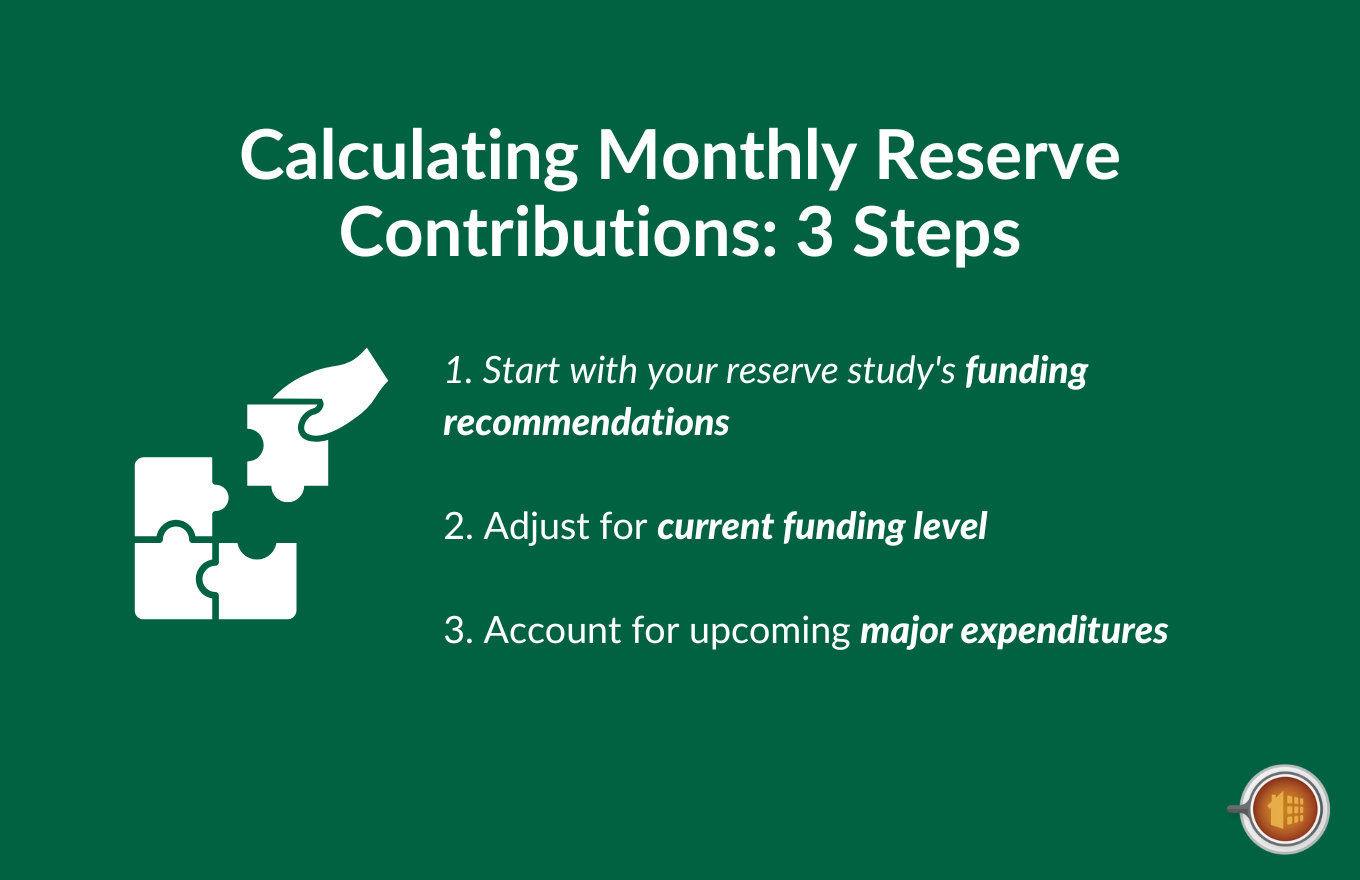
Calculating Monthly Reserve Contributions
Here’s how to calculate your monthly reserve contributions:

1. Start with your reserve study’s funding recommendations.
If the study recommends $120,000 annual reserve contributions and you have 200 units, each unit contributes $600 annually or $50 monthly.
2 Adjust for current funding level:
If your reserves are currently underfunded at 50% but you need to reach 70%, increase contributions temporarily to catch up, then reduce to maintenance levels once you reach target funding.
3. Account for upcoming major expenditures:
When your reserve study shows roof replacement in 2 years costing $85,000, verify your reserve balance will cover it. If not, increase contributions now to avoid shortfalls.
Special Considerations for Reserve Contributions
Knowing how to calculate reserve contributions is just the beginning. You’ll also need to understand how various factors impact those contributions.
Here are three of those factors to keep in mind:
1. Inflation adjustments
Building costs increase 3-5% annually on average. Build inflation into your contribution calculations or you’ll fall progressively further behind.
That $85,000 roof in 2 years might cost $90,000 when replacement actually occurs. Budget accordingly.
2. Interest earnings
Reserve savings accounts earn interest. Factor this into contribution calculations. If your reserve account earns 2% annually on a $400,000 balance, that’s $8,000 in “free” contributions from interest.
3. Variable vs. fixed contributions
Some associations use variable contributions, adjusting reserve amounts annually based on the updated reserve study. Others prefer fixed contributions for predictability, adjusting only when reserve studies reveal major changes.
Fixed contributions create predictable budgets for homeowners. Variable contributions provide better alignment with actual reserve needs.
Tracking Reserve Fund Expenditures
What good is a plan for how you’ll contribute if you aren’t tracking how you’re spending?
That’s where this step comes from.
Here’s the key: Spending from reserves requires different controls than operating expenditures.
They’re not the same thing and shouldn’t be treated as such.
So, what do you need in place to track this properly? These three protections should be put in place:
1. Board Approval Requirements
Establish clear policies for reserve fund expenditures.
Most associations require:
- Full board vote for any reserve expenditure over a threshold (commonly $5,000-$10,000)
- Emergency expenditures approved by treasurer with notification to board within 48 hours
- All reserve expenditures documented in meeting minutes
When spending $47,000 from reserves for elevator modernization, the minutes should document the board vote, the amount approved, and the specific project funded.
2. Matching Expenditures to Reserve Components
Every reserve expenditure should match a line item in your reserve study.
If your reserve study includes “$75,000 for roof replacement in 2026,” the actual roof replacement expense in 2026 should post to that specific reserve component.
This matching allows you to:
- Compare actual costs to projected costs (was the roof actually $75,000 or $82,000?)
- Track which reserve components have been addressed and which remain
- Identify components consistently running over budget for future study adjustments
Accounting software designed for HOA reserve management tracks expenditures by reserve component automatically, showing remaining balances for each component after expenditures.
3. Emergency vs. Planned Reserve Expenditures
Distinguish between planned and unplanned reserve usage.
Planned expenditures follow the reserve study schedule. You knew the parking lot needed resurfacing in 2026, budgeted for it, and executed the project as planned.
Unplanned expenditures happen when components fail prematurely. The HVAC system projected to last until 2027 dies in 2024, forcing early replacement.
Track both categories separately. High rates of unplanned expenditures indicate:
- Reserve study projections are too optimistic
- Maintenance practices need improvement
- Component quality choices should be reconsidered
Closely related to all this are reporting requirements for reserve funds. Let’s talk about that now.
Reserve Fund Reporting Requirements
Reporting is critical as it ensures that the board and homeowner members are constantly updated.
This kind of transparency is essential as it creates a kind of accountability, which shouldn’t be overlooked.
Mismanaging money is a thing that happens, even on a large scale like an association.
It’s impossible for one person to stay on top of all matters related to even a medium-sized association, and reporting helps create checks and balances that ensure funds are properly managed.
Here’s specifically how to do it:

1. Monthly Reserve Fund Reports
Generate monthly reports showing:
Current reserve fund balance compared to last month. Simple but essential tracking of whether reserves are growing or shrinking.
Year-to-date reserve contributions versus budget. If you budgeted $10,000 monthly contributions and actual contributions are $8,500, you’re falling behind.
Year-to-date reserve expenditures versus budget. Planned parking lot resurfacing for $50,000 that actually cost $54,000 creates a $4,000 variance requiring explanation.
Percent funded based on most recent reserve study. If the study says you need $850,000 and you have $680,000, you’re 80% funded.
2. Annual Reserve Fund Status Reports
Comprehensive annual reports should include:
- Beginning balance
- Total contributions
- Total expenditures
- Interest earned
- and ending balance
Complete year-over-year comparison showing reserve fund growth.
Comparison of actual expenditures to reserve study projections. Did predicted costs match reality? Are adjustments needed?
Updated percent funded calculation. As component costs change and your balance grows, your funding percentage changes.
Recommendations for next year’s reserve contributions. Should contributions increase, decrease, or stay flat based on current funding status?
3. Homeowner Communications About Reserves
Transparency builds trust and prevents special assessment shock.
Share reserve fund status at annual meetings. Show homeowners current funding levels, upcoming major projects, and long-term financial health.
Explain why reserve contributions increase when they do. Homeowners accept assessment increases more readily when they understand reserves prevent $5,000 special assessments later.
Provide reserve study summaries (not full technical reports) to homeowners. They need to understand what components will need replacement and when.
Avoiding Common Reserve Fund Accounting Mistakes
Now, let’s talk about some very common- and very costly- accounting mistakes related to reserve fund accounting.
These aren’t just mistakes that can create liability issues, they can jeopardize your entire reserve fund.
Some of these are honest mistakes, but no less costly, and every one should be avoided:
Mistake #1: Using Reserve Funds for Operating Expenses
The most common and most serious mistake HOAs make.
When operating funds run short, desperate treasurers “borrow” from reserves to cover utility bills, landscaping invoices, or insurance premiums.
This violates IRS requirements, fails audits, and depletes reserves for their intended purpose. When the roof needs replacement and reserves are gone because you used them for landscaping, you’re forcing a special assessment.
How to prevent it: Strict board policies prohibiting reserve fund use for operating expenses under any circumstances. If operating expenses exceed revenue, cut operating costs or increase operating assessments—don’t raid reserves.
Mistake #2: Failing to Update Reserve Studies
Reserve studies become obsolete quickly.
Component costs change. Replacement timelines shift based on actual conditions. Inflation affects projections. Using a 7-year-old reserve study produces terrible funding decisions.
CAI guidelines recommend updating reserve studies every 3-5 years with full physical inspections, and updating financial projections annually without full inspections:
“A reserve study isn’t a one-and-done process. It should be reviewed on a regular basis and updated every 3-5 years to assess whether the condition of the assets is deteriorating faster or slower than anticipated, to adjust for external macroeconomic factors, and to review the funding strategy to stay on track with your community’s financial goals.
Review the reserve study annually during budget preparation to assess progress against the plan, identify emerging issues, and begin preparations for projects scheduled to be completed in the upcoming 12-24-month cycles.”
How to prevent it: Budget for reserve study updates. A $3,000 reserve study update every 3 years ($1,000 annually) prevents costly funding mistakes.
Mistake #3: Inadequate Documentation
Poor documentation fails audits and creates disputes.
When reserve fund withdrawals lack proper documentation—no board meeting minutes approving the expenditure, no invoices attached to payments, no explanation of why reserves were used—auditors flag these as potential misuse.
How to prevent it: Require complete documentation for every reserve transaction. Board minutes approving expenditure, detailed vendor invoice, payment confirmation, and photos of completed work all get filed together.
Mistake #4: Ignoring Percent Funded
Many boards track absolute reserve balance but ignore percent funded.
Having $400,000 in reserves sounds impressive until you realize your reserve study says you need $700,000 (only 57% funded). You’re dramatically underfunded despite the large balance.
How to prevent it: Calculate and report percent funded monthly. This metric shows whether reserves are adequate, not just whether the balance is growing.
Mistake #5: Waiving Reserve Contributions
Some boards waive reserve contributions to keep assessments low.
This short-term thinking creates long-term disasters. Each year without contributions pushes the association closer to special assessments.
According to Ohio HOA law, if an association waives the 10% minimum reserve requirement, it must vote annually and fully disclose the risks to homeowners. Most states allow waiving but strongly discourage it.
How to prevent it: Maintain consistent reserve contributions even in financially tight years. Reducing contributions temporarily is acceptable; eliminating them entirely creates future crises.
HOA Accounting Software for Reserve Management
Modern property accounting software automates reserve fund accounting and eliminates manual tracking headaches.
If you’re looking for something the pulls most of what we’ve discussed so far together and packages it into a tool that allows you to execute on it effectively, this is it.
Not every property management tool is created equal (check out Mocha’s features specifically for associations and mixed portfolios).
With that said, here are some of the things you should look for in a good property accounting tool as it relates to properly managing your reserve fund:
1. Automatic fund separation
Software automatically separates operating and reserve fund transactions. When assessments come in, the system allocates portions to each fund instantly.
2. Reserve component tracking
The best platforms let you track balances by specific reserve components. You see separate balances for “Roof Replacement,” “Parking Lot,” “Pool Equipment,” and every other component in your reserve study.
When you spend $23,000 from the Parking Lot component, the software reduces that component’s balance while leaving other components unchanged.
3. Reserve study integration
Import your reserve study data directly into the accounting software. Projected replacement dates, estimated costs, and funding requirements all flow into your financial system.
The software then generates reports comparing actual reserve balances to reserve study projections, highlighting funding shortfalls automatically.
4. Percent funded calculations
Software calculates percent funded automatically based on current balances and reserve study requirements. You don’t manually calculate this critical metric each month—the system does it.
5. Automated reserve fund reporting
Generate reserve fund status reports with one click. Current balance, contributions year-to-date, expenditures year-to-date, percent funded, and upcoming major expenditures all appear in board-ready format.
How Mocha Manage Handles Reserve Accounting

Mocha Manage’s integrated platform simplifies reserve fund management while providing full HOA accounting tools.
Built-in fund separation keeps operating and reserve funds completely separate with automatic allocation of homeowner payments. Configure your assessment split once, and the system handles allocation forever.
Work order integration connects reserve expenditures to actual maintenance projects. When you pay the roofing contractor $78,000, that payment links to the roof replacement work order, creating complete documentation.
Dashboard visibility gives board members real-time access to reserve fund balances and percent funded. No waiting for month-end reports to understand reserve status.
Bank account integration imports transactions daily from both operating and reserve accounts. Reconciliation happens automatically with discrepancies flagged for review.
Reserve Fund Accounting Checklist
Before you go, we’ve got a handy checklist you can use to ensure you’ve got all your T’s crossed and i’s dotted:

Use this checklist quarterly to verify proper reserve fund management:
Account separation:
- ☐ Operating and reserve funds in separate bank accounts
- ☐ No transfers between funds without board approval
- ☐ All reserve account withdrawals require dual signatures
Contribution tracking:
- ☐ Monthly reserve contributions match budget
- ☐ All homeowner payments properly allocated between funds
- ☐ Reserve contribution revenue posts to reserve fund only
Expenditure documentation:
- ☐ Board minutes document approval for all reserve expenditures
- ☐ Vendor invoices attached to all reserve fund payments
- ☐ Reserve expenditures matched to specific reserve components
Reporting:
- ☐ Monthly reserve fund balance reports generated
- ☐ Percent funded calculated and reported
- ☐ Variance reports comparing actual to budget reviewed
Compliance:
- ☐ Reserve study current (updated within last 3-5 years)
- ☐ Financial statements show clear fund separation
- ☐ Reserve fund status disclosed to homeowners annually
Click here for a printable version of the HOA Reserve Fund Accounting checklist.
Master Reserve Fund Accounting with the Right Tools
Proper reserve fund accounting protects your association from financial crisis while building homeowner confidence.
But you can’t do that effectively without the help of a great property accounting tool.
Mocha Manage’s integrated platform handles:
- Reserve fund separation
- Contribution tracking
- Expenditure documentation
- and percent funded calculations automatically
Taken together, it gives boards and treasurers complete visibility into reserve status without manual spreadsheets or complicated reconciliations.
From automated fund allocation to reserve study integration to one-click reserve fund status reports, everything works together seamlessly.
See how Mocha Manage simplifies HOA accounting by clicking here.
Frequently Asked Questions
What percentage of HOA assessments should go to reserves?
Most reserve studies recommend 15-40% of total assessments go to reserves, depending on property age, component conditions, and current funding level.
Newer associations with newer components might contribute 15-20% to reserves. Older associations with aging infrastructure might need 30-40% contributions.
Can HOAs invest reserve funds?
Yes, but with restrictions. Reserve funds can be invested in low-risk vehicles like CDs, money market accounts, and U.S. Treasury securities.
Prioritize liquidity and safety over returns. You need reserve money available when the roof needs replacement, not locked in long-term investments.
What happens if reserve funds are insufficient for a major repair?
You have three options, all less-than-pleasant:
- Special assessments levy one-time charges on homeowners to cover the shortfall. If the roof costs $85,000 but reserves contain only $40,000, you assess homeowners $45,000 divided by unit count.
- Loans let the association borrow money for the project, then pay it back through increased assessments over time. This avoids one large special assessment but adds interest costs.
- Deferred maintenance delays the project until reserves rebuild. Only viable for non-critical items, never for safety or structural issues.
How does reserve fund accounting affect property values?
Healthy reserve funding increases property values; poor funding decreases them.
Prospective buyers review HOA reserve fund status before purchasing. Well-funded reserves (70%+ of needs) signal responsible financial management and reduce risk of future special assessments.
Underfunded reserves (below 50%) create red flags for buyers and mortgage lenders. FHA and conventional loan programs often deny financing for properties in associations with inadequate reserves.
Do all states require HOAs to maintain reserve funds?
Requirements vary by state, but most states either mandate or strongly encourage reserve funding.
California, Florida, Washington, and Nevada have specific statutory requirements for reserve funding and reserve studies. Other states allow associations to waive reserves but require homeowner votes and disclosure of risks.
Leave a Reply