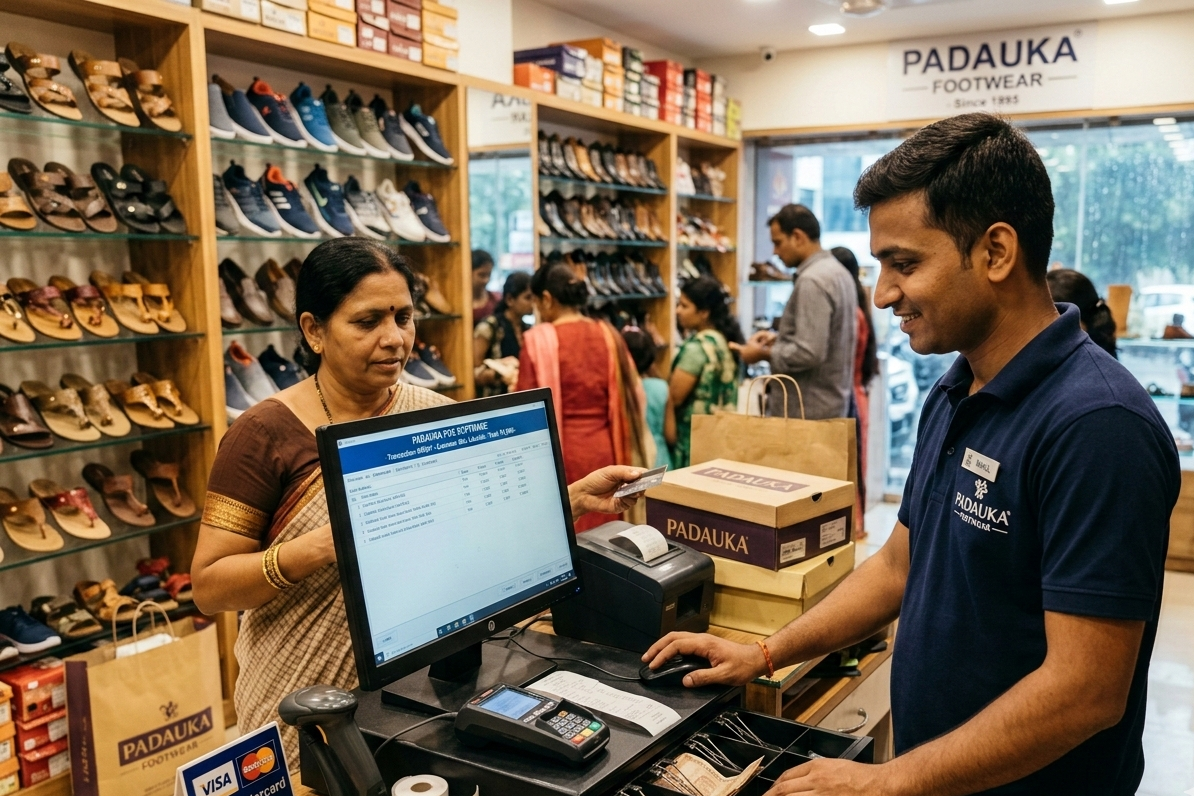
Footwear shop billing software is likely to become indispensable to retailers as the footwear market in India continues to expand rapidly, forecast to reach USD 26 billion by 2030, driven by the urban population ageing, boosting demand, and the expansion of organised retail. Digital billing tools can streamline store operations, as each store handles dozens of brands, sizes, and product types every day.
The old-fashioned billing system usually delays checkout and complicates stock tracking. Modern footwear shop billing software enables retailers to automate invoicing, maintain stock records, and keep GST-compliant records. These systems enable footwear retailers to handle day-to-day operations and provide a better shopping experience for customers by improving the speed and accuracy of their billing systems.
Why every retailer needs footwear shop billing software
There are hundreds of product variants that footwear retail stores work with daily. One design can be available in various sizes and colour variations, and therefore, e-tracking inventory is complex when handled manually. Footwear shop billing software can help the retailer store product details effectively and minimise operational errors.
Automated billing is one of the principal advantages of footwear shop billing software. The system also produces invoices immediately, rather than having one manually calculate prices and taxes. This will assist sales personnel in clearing transactions quickly and lessening the risk of erroneous pricing. Incorporated with footwear POS software, retail shop staff can scan barcodes to automatically recognise products at the point of checkout.
Retailers use the software for footwear shop billing as another reason to ensure correct inventory management. The system automatically resets stock levels after every product sale. The point is that retailers who use footwear POS software can reliably observe the exact number of units available in a given size or colour.
The real benefits of automation are:
- Reduced billing errors
- Faster checkout process
- Greater precision of inventory.
- Better sales tracking
- Simplified GST compliance
Following the implementation of footwear shop billing software, footwear retailers would be able to run their daily operations more efficiently, keeping their financial records on track.
How footwear shop billing software improves billing accuracy and checkout speed
Customer experience is significant in retail success. Customers will be frustrated by long queues in the billing area, and manual computation will slow down store operations. Introducing footwear shop billing software will also enable retailers to speed up transactions while keeping control over billing accuracy.
Automated invoice generation is a major strength of footwear shop billing software. The software calculates the product price, discount, and GST with a single click. The retailers simply enter the item’s barcode into the scanner or look it up in the electronic catalogue. This minimises the time required to complete a transaction.
Integrated payment systems also offer advantages for retailers. Footwear POS software enables stores to handle various payment methods, including UPI, debit cards, credit cards, and digital wallets. This flexibility improves the checkout experience, allowing customers to pay in their preferred method.
Other benefits of operations are:
- Tax and discounts are automatically calculated.
- Product identification based on quick barcodes.
- Less dependence on manual data entry.
- Documentation of all transactions.
Essential features every footwear shop billing software should offer
When deciding which footwear shop billing program to license, it is necessary to understand the features that facilitate footwear retail operations. As there are too many product options for footwear stores, the system should provide tools to help them manage catalogues and track inventory.
A good footwear shop billing software package enables retailers to group merchandise by size, colour, brand, and category. It is a structured catalogue that allows staff to search for products more easily when attending to bills. When combined with the footwear POS software, the system links the product catalogue to the billing interface.
Another important characteristic is the barcode-enabled billing. Barcode scanning will eliminate manual product entry and accelerate delayed checkout. Distinct footwear shopping invoices software considers automatic connections between every barcode and the appropriate product information.
Capabilities that retailers can be interested in are:
- Product catalogues in sizes and colours.
- Billings that were based on barcodes.
- Generation of invoices that are GST compliant.
- Real-time inventory update.
- Sales and performance detailed reports.
These features assist footwear retailers in operating efficiently when supplemented by footwear POS software, ensuring proper billing and stock records.

How footwear POS software helps control footwear inventory effectively
Footwear stores face difficult inventory management because each product is available in a variety of sizes. Without automation, it will be hard to keep track of available sizes and which ones require replenishment.
Contemporary footwear POS software tracks product variants separately. Retailers can track stock levels for a specific size or colour without manual checks. The system automatically updates inventory after each sale when linked to the footwear shop’s selling software.
Live inventory tracking prevents poor stock levels among retailers. If a certain size or design is moving quickly, store owners can replenish it before it goes out of stock. Retailers can also view historical sales data through footwear shop billing software to identify high-demand and in-demand footwear categories.
The main benefits of inventory are:
- Automatic stock updates occur after every transaction.
- Monitoring of different product versions.
- Alerts for low stock levels/misplaced items
- This involves the ability to view inventory in various locations within the stores.
Footwear retailers can now have full control over their inventory operations through the integration of footwear POS software and effective footwear shop billing software.
Major advantages of footwear POS software for small retailers.
Small footwear sellers spend time manually billing and managing stock because they often have limited staff and resources. Footwear POS software strengthens daily operations and increases store productivity.
Major benefits include:
- Quicker billing system – Employees save time by using the footwear POS software to scan barcodes and create invoices in real time, reducing checkout time.
- Record Sales: Once combined with the shoe shop billing software, the system can record sales, and the inventory is automatically updated.
- Better customer experience: Reduced turnaround time through billing, and delivers a fast and accurate customer experience during shopping.
- More productive staff: Employees do not waste time performing manual calculations; instead, they spend more time helping customers.
- Fewer operational mistakes: The system will be integrated with the other footwear shop’s billing software, eliminating billing errors and ensuring accurate records.
- Scalability for expansion: Footwear supports additional billing counters and stock capacity as stores expand.
Through both operational efficiency and custom footwear shop billing software, small footwear retailers can create scalable, organised retail operations.
Role of footwear shop billing software in improving sales insights
When business owners can access accurate sales data, retail decision-making becomes easier. Footwear shop billing software captures all transactions, allowing retailers to view business trends and customer preferences.
Footwear shop billing software generates sales reports that provide revenue details on both a daily and a monthly basis. Retailers can identify the highest-selling shoe categories or brands in the shortest possible time. Using footwear POS software, store owners will have access to in-depth analytics to help improve inventory planning.
With sales analysis, the retailers can know the following:
- Rapidly moving shoe models.
- Fashionable dimensions and colour options
- Seasonal buying trends
- Slow-performing products
Retailers can optimise their purchasing strategies with these insights. With footwear shop billing software backing the case, business owners can plan their inventory with consideration not only of guesswork but also of real demand. The software also assists with reporting on profit margins and the business’s overall performance.
How Mocha Accounting simplifies footwear shop billing and inventory management
The retail operations of the footwear business would benefit from software to automate billing and simplify inventory management. Mocha Accounting enhances the capabilities of footwear shop billing software, enabling retailers to handle multiple product variants, including size, colour, and type. The system enables smart billing automation, creating invoices immediately and calculating taxes and discounts automatically.
This minimises billing mistakes and speeds up checkout. Integration with footwear provides software that enables fast product identification via barcode scanning, speeding up transactions. With every sale, inventory gets updated automatically with accurate information.
The site also provides specific retailer sales reports, which can be used to evaluate performance and analyse retailer-specific trends. Mocha Accounting improves the efficiency and dependability of footwear shop billing software by integrating automated billing, organised inventory control, and data insights to modern-day footwear retailers.
How footwear shop billing software supports business growth
Footwear businesses are becoming more complex as they manage higher sales volumes and larger inventories. The use of footwear shop billing software enables retailers to simplify business processes and ensure precise record-keeping. It offers scalability, allowing several billing counters to run smoothly. When combined with footwear POS software, retailers can track sales across multiple locations and use insights to make more informed purchasing and inventory decisions.
The main advantages for business are:
- Better stock planning.
- Improved working capital planning.
- Better financial records maintenance.
- Greater operational openness.
- Effective management of a multi-store retail business.
Footwear retailers can grow and maintain their billing and inventory systems with footwear shop billing software.
Choosing the right footwear POS software for your store
The right footwear software selection is vital for retailers with digitised operations. It must blend well with the billing software of footwear shops, yet must not be too complex for people to use, even at the busiest times. Powerful inventory services, such as tracking of size and colour variants, are essential. When implemented correctly, the system automatically updates stock after a sale, ensuring accurate records.
Other features to be taken into consideration by retailers include:
- Real-time sales reporting.
- Digital records safekeeping.
- Easy integration of payments.
- Scalability with business growth.
The right combination of footwear POS and billing software enables retailers to simplify operations and deliver a better shopping experience.
Choosing the right footwear POS software
The choice of the correct footwear POS software plays a major role when the retailer intends to computerise the store. The system ought to be well-integrated with footwear shop billing software and easy for staff to use, even when dealing with a large crowd. Powerful inventory features, such as tracking size and colour variations, enable retailers to maintain accurate inventory. However, when the system is linked to footwear shop billing software, its inventory is updated automatically after each sale, thereby ensuring efficient billing, improved stock control, and the smooth running of the retail business without hassle.

Frequently Asked Questions
1. What does footwear shop billing software mean?
The footwear shop billing software assists retailers in handling sales transactions, producing GST-compliant invoices, and tracking footwear inventory, including sizes and colours. It automates billing, reduces calculation errors, and increases checkout. Retailers also benefit from sales reports and stock visibility to support day-to-day store operations.
2. What are the characteristics of the footwear POS software?
The good footwear POS software must include barcode-based billing, variant inventory tracking, GST invoicing, multiple payment options, and detailed sales reporting. These can assist the retailer in maintaining efficient management of shoe sizes, colours, and brands, and the billing software for footwear stores ensures transaction accuracy and maintains stock on sale after each purchase.
3. What is the benefit of footwear shop billing software on inventory?
Footwear shop billing software makes inventory management more effective by automatically tracking each product variant, such as size, colour, and style. When a sale occurs, the system is immediately updated with the inventory. Retailers can easily monitor low stock levels, review sales performance, and re-order footwear at the appropriate time.
4. Does POS software in footwear work well with small footwear stores?
The shoemaker POS system is quite handy for scaling back shoe stores, as it automates billing, inventory tracking, and all transactions are made electronically. The footwear shop billing software used by retailers will help minimise errors in manual processes, provide faster checkout times, and track sales performance and manage inventory without the need for complex spreadsheets or registers.
5. Can the footwear shop billing software support GST billing in India?
Footwear shop billing software supports GST-compliant invoicing, which is essential for footwear retailers in India. It automatically calculates applicable tax amounts, generates structured invoices, and maintains digital transaction records. This helps retailers comply with taxation regulations, simplify accounting, and prepare financial reports for GST filings.
Leave a Reply