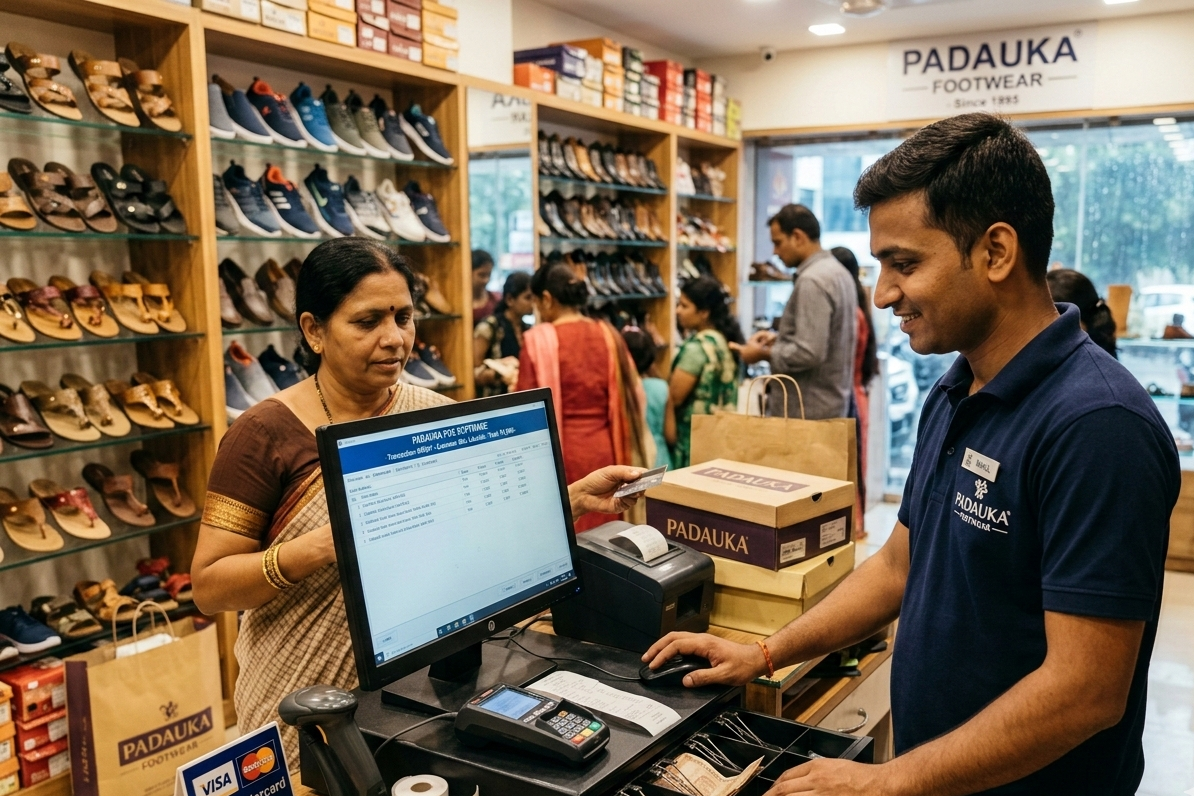
Ask any footwear retailer what the most exhausting part of their day is and the answer rarely has anything to do with customers or sales. It is the back office. The manual price lookups, the billing errors that only surface at closing, the stock counts that never quite match the sales records and the end-of-day reports that take an hour to piece together from three different places.
Why Footwear Shops Struggle with Billing & Operations?
• High Product Variety:
Footwear stores typically carry multiple sizes, styles, and brands for each product. Managing this level of variation manually can lead to billing errors and stock mismatches. It also makes tracking fast-moving and slow-moving items more difficult.
• Inventory Management Issues:
Without a proper system, it’s hard to maintain accurate stock levels across products. Overstocking or stockouts can directly impact sales and customer satisfaction. Manual tracking often leads to inconsistencies in inventory records.
• Slow Billing Process:
Manual billing or outdated systems can increase checkout time, especially during peak hours. This affects customer experience and may lead to lost sales. Faster billing is essential for handling higher footfall efficiently.
• Limited Sales Visibility:
Tracking daily sales, best-selling products, and revenue trends is difficult without centralized reporting. Business owners may lack clarity on performance across categories or time periods. This limits their ability to make data-driven decisions.
What Footwear Shop Billing Software Actually Solves?
The core function of footwear billing software is to connect the point of sale to every other part of your operation — inventory, accounting, reporting, and compliance — so that a transaction at the counter triggers the right update in every system simultaneously.
When a customer purchases a pair of shoes, the billing software generates the GST-compliant invoice in a single click, adjusts the inventory for that exact SKU, records the sale against the correct product category and revenue line, and updates your daily sales report in real time. None of that requires any manual action from your staff after the barcode is scanned.
For a footwear store managing hundreds of product variants, this is the operational difference between running on data and running on guesswork.

What are the Key Capabilities to Look for in a Footwear Billing Software?
• Barcode-Based Billing and Product Catalogue:
Every footwear item — by size, color, brand, and category — should live in a structured product catalogue linked directly to the billing interface. When a staff member scans a barcode, the correct product details, price, applicable GST rate, and any active discount should populate instantly. This eliminates manual lookup, removes pricing errors, and speeds up every transaction at the counter.
• Real-Time Inventory Tracking by Variant:
Footwear inventory is variant-intensive. A size 8 and a size 10 of the same shoe are different products from a stock management perspective. The billing software needs to track inventory at the variant level — size, color, and type — and update those counts automatically with every sale and every purchase order received. Low-stock alerts at the variant level mean you reorder before a size runs out, not after a customer asks for it and you cannot fulfil the order.
• Multiple Payment Modes:
Customers at a footwear store pay by cash, UPI, debit card, credit card, and digital wallet. The POS system needs to handle all of these without switching screens and needs to record each payment mode separately, so your end-of-day reconciliation is accurate and your reports reflect actual payment method split.
• GST-Compliant Invoicing:
Footwear carries varying GST rates depending on price bracket. A footwear billing software that handles this automatically — calculating the correct CGST, SGST, or IGST rate for each item, printing it correctly on the invoice, and maintaining the transaction records needed for GSTR filing — removes a significant compliance burden from the accounting team.
• Sales Analytics and Reporting:
Which sizes are moving fastest? Which brands are underperforming? What is your busiest hour on a Saturday? A good footwear billing system surfaces this data without a manual report-building exercise. Daily, weekly, and monthly views of revenue, top-selling categories, and outstanding stock should be available from the dashboard without exporting to a spreadsheet.
Why Mocha Accounting Works for Footwear Retailers?
Mocha Accounting’s invoicing and billing module is built for exactly the complexity that footwear retail demands. The product catalogue supports full variant tracking by size, color, and type, linked directly to the billing interface through barcode scanning. Every sale updates inventory automatically. GST is calculated per item, per applicable rate, and the invoice is generated in a single click.
Because Mocha is a complete accounting platform and not just a billing tool, every transaction flows directly into your financial records. Sales link to your revenue reports. Purchases link to your stock and payables. Your end-of-day, end-of-week, and end-of-month reports are built from live data, not assembled manually. Retailer-specific sales reports show you performance by product category, brand, and location, giving you the purchasing intelligence to stock smarter and waste less.
Making the Switch: Getting Started
The transition to automated billing is simpler than most footwear retailers expect. Your product catalogue — with sizes, colors, prices, and GST rates — can be imported from a spreadsheet. Barcode integration is set up during onboarding. From the first transaction through the new system, your inventory, billing, and reporting are connected.
Most retailers report that the visible change is immediate: faster checkout, accurate invoices, and a stock count that actually matches what is on the shelves. The financial impact — fewer billing errors, cleaner GST records, better purchasing decisions — compounds over the following months.
NOTE: Please update the above message to “Run Your Footwear Shop Like A Pro.”

Frequently Asked Questions
1. What makes footwear billing software different from generic billing software?
Generic billing software handles basic invoicing and payments. Footwear-specific billing software manages the variant complexity of the product — size, color, type — at the inventory and billing level simultaneously. It tracks stock at the SKU level, applies GST by product category, and gives you analytics by style and brand. Generic software does not have the structure to handle this without significant manual workarounds.
2. How does the billing software help with late payments?
Automated reminders go out before, on, and after a payment due date by email without any manual action. This reduces late payments significantly and eliminates the need for staff to chase members individually.
3. Does the footwear billing software integrate with inventory?
Yes. When you sell merchandise through your POS, Mocha Accounting will automatically adjust your inventory count. Low-stock alerts can trigger reordering before items run out.
4. How does the software handle GST on footwear?
Footwear carries different GST rates depending on the price of the item. Mocha Accounting applies the correct rate automatically based on the product’s price and category, calculates CGST and SGST or IGST as applicable, and generates a fully GST-compliant invoice. Your transaction records are structured for GSTR filing from day one.
5. Is Mocha Accounting suitable for a small footwear shop?
Yes absolutely. Mocha Accounting is designed to scale from a single-counter footwear shop to a multi-location retail chain. The product catalogue, barcode billing, GST compliance, and reporting features are available from the start, regardless of store size. Smaller stores benefit from the same automation that larger ones do, without the overhead of enterprise software.
Leave a Reply