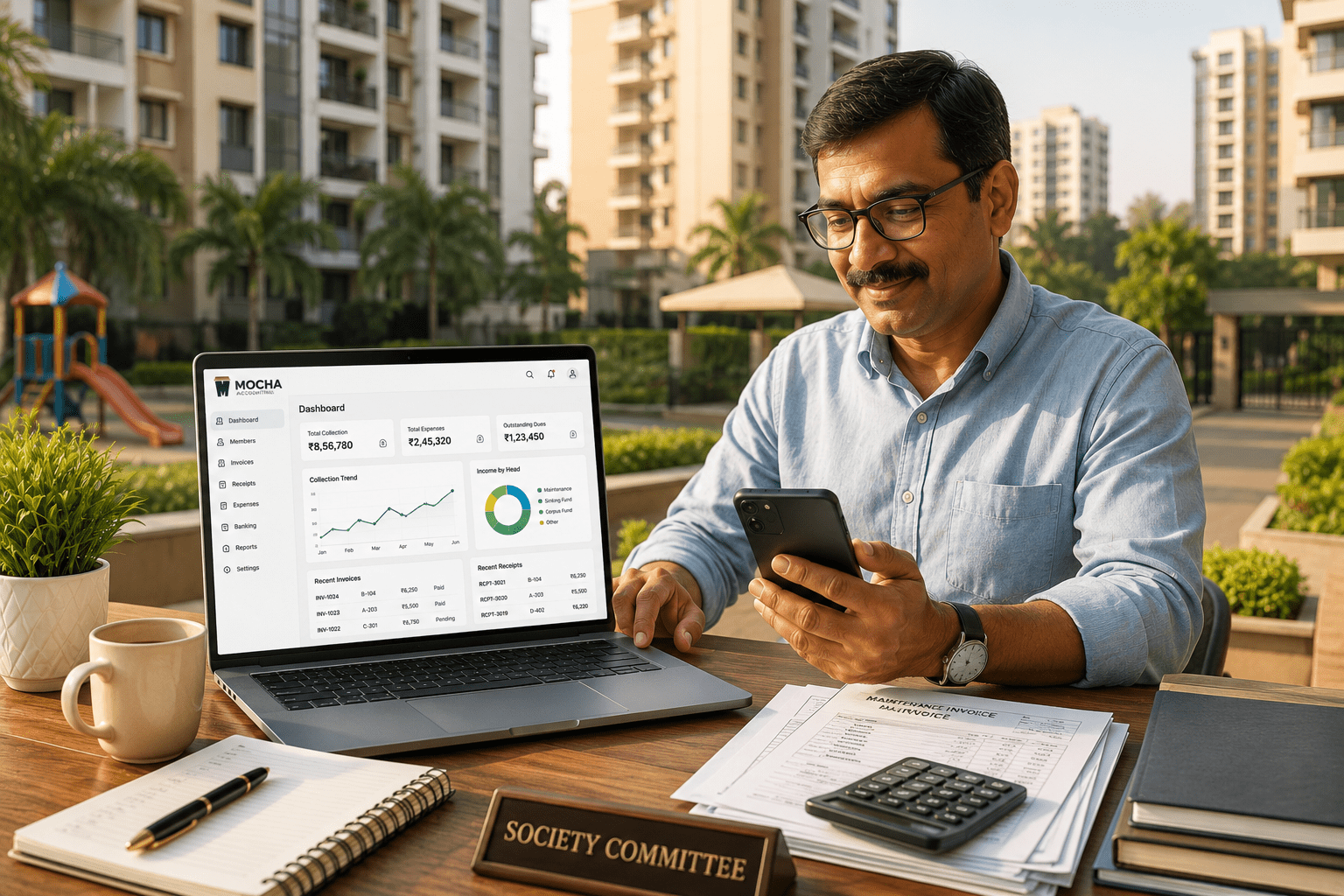
Managing a housing society looks simple to an external observer, while the fact of the matter is that it is anything but. Over 1.9 lakh societies in India exist to look after the welfare of their residents, according to government data. These societies are run by committees of 5 to 19 members, which are required to ensure uninterrupted service across security, housekeeping, amenities, and, often, utilities. This service is paid for through monthly maintenance and other charges, and the financial management related to this can get cumbersome pretty quickly, especially when handled on physical registers or spreadsheets, or when outsourced to a third party.
In this blog, we will look at what society accounting software does, why manual accounting and spreadsheet use can strain housing society accounts, which features of society management software are most helpful, and how Mocha Accounting can help societies better manage their finances.
What is accounting software for society?
Accounting software for society is a specialised financial tool built for residential communities, apartment complexes, and gated housing associations. It helps societies manage maintenance billing, sinking fund, corpus fund, utility collections, late fees, vendor payments, resident receipts, and yearly reports. Compared to traditional accounting tools, society accounting requires a member-wise approach; hence, the required accounting tool must also be specialised. Here is how traditional accounting tools differ from specialised software like Mocha Accounting:
| Parameter | Traditional accounting tools | Society accounting |
| Main record | Customer and vendor accounts | Member and flat accounts |
| Billing type | Product or service sale | Recurring maintenance and fund billing |
| Receipts | Customer payments | Resident payments and flat-wise dues |
| Funds | Business income heads | Maintenance, sinking fund, corpus fund, repair fund |
| Reports | Profit and loss, balance sheet | Income and expenditure, balance sheet, member dues |
| Users | Owner, accountant, sales team | Treasurer, secretary, committee, residents, auditor |
| Records | Bills and payment entries | Invoices, receipts, ledgers, member history, vendor bills |
Why manual accounting and spreadsheets strain housing society accounts
Spreadsheets help many societies manage their books during the early years. However, as the community evolves and expectations change, pressure increases. Here are the ways in which manual accounting and the use of spreadsheets can create problems:
- Flat-wise dues can vary when past payments are missed during monthly updates.
- Late fees can be calculated differently when monthly computations are done each month afresh.
- Members can question dues when they cannot see past invoices and receipts.
- Vendor payments can become harder to trace when bills are stored away from payment entries.
- Committee handovers can take longer when old files stay with different people.
- Bank receipts can take hours to match with resident names.
- Repair fund and sinking fund entries can mix with general maintenance income.
- Audit preparation can take many days when records must be collected from multiple locations.
- Manual spreadsheets often make societies dependent on one individual for records and calculations. Many societies depend on the treasurer or accountant to remember where each file is stored. This creates risk when that person changes, travels, or leaves the committee.
Core features of modern society accounting software
Society accounting software integrates features such as member billing, expenses, receipts, payments, and reports into a central system. The core features that modern society accounting tools, such as Mocha Accounting, offer are:
| Feature | What it does | Problem it solves |
| Automated maintenance billing | Schedules and sends bills digitally through email and shared links | Reduces monthly bill preparation work |
| Expense tracking | Groups spending under heads like security, plumbing, lift, and electricity | Helps committees see where money goes |
| Member management | Maintains owner, tenant, flat, and contact records | Keeps resident data in one organised system |
| Instant reports | Generates a balance sheet and an income and expenditure statement | Helps committees prepare meeting and audit records |
| Online and in-office payment options | Lets members pay through convenient payment modes such as UPI, cards, or net banking | Makes payment easier for residents and helps the society committee collect maintenance dues faster |
| Bank matching | Links bank entries with member receipts | Reduces time spent checking payment details |
| Digital receipts | Issues receipts after payment entry | Gives members payment proof faster |
How RWA accounting software solves common financial challenges for housing societies
RWAs and housing societies face financial problems primarily due to delayed payments, scattered records, limited resident access, and plenty of manual work. Software addresses these issues by automating workflows, easing access, simplifying reporting and centralised record-keeping. Here are specific issues that committees/RWAs face and how modern society accounting software, such as Mocha Accounting, solves them:
| Problem society committees / RWAs face | Effect on society | Software-based solution |
| Defaulter tracking takes too much time | Treasurer checks each flat manually | The arrears report shows pending dues by the member |
| Late fee calculation varies | Residents dispute interest amounts | Late fee calculations can be standardised based on society policy |
| Residents ask for old receipts | Committee searches files and emails | Residents can access payment records and invoices digitally |
| Funds appear mixed | Members question the use of money | Income heads separate maintenance, sinking fund, and corpus fund |
| Bank entries take time to match | Payment posting gets delayed | Bank transaction tracking helps reconcile payments faster |
| The new committee lacks past records | Handover slows down | Cloud storage keeps invoices, receipts, and reports together |
| Meeting reports take too long | Committee reviews get delayed | Reports are generated from recorded entries |
The benefits of going digital for housing societies
Going digital gives housing societies better control over billing, payments, expenses, records, and reports. The following list explains the main benefits of using online society management tools like Mocha Accounting for various stakeholders:
- Better visibility: Members can view invoices, receipts, and dues without having to ask the treasurer each time.
- Lower workload: Time spent on executing tasks is reduced when workflows are automated.
- Faster collections: Payment reminders and online options help residents pay sooner.
- Safer records: Cloud backups protect financial records during committee changes.
- Easier audit work: Ledgers, receipts, invoices, and reports stay ready for review.
- Better expense control: Committees can view spending by category, vendor, and period.
- Faster handovers: New committee members can access past records from the same system.
- Improved resident trust: Members can access payment history and fund-use summaries.
How to choose the best accounting software for your society
Choosing the right accounting software for society needs careful review. The committee should look for a system such as Mocha Accounting that is easy for first time users, useful for residents, and strong enough for accounting work. Key consideration parameters include:
| Parameter | Why it matters | Who benefits |
| Easy interface | Committee members can learn it faster | Treasurer and secretary |
| Mobile access | Residents can view dues and receipts on phones | Members and tenants |
| Automated billing | Recurring charges can be created on schedule | Treasurer |
| Bank matching | Payments can be linked to member accounts | Accountant |
| Online payments | Residents can pay through UPI, cards, or net banking | Residents |
| Reports | Committees can generate statements and arrears lists | Committee and auditor |
| Cloud backup | Records stay protected during handovers | Current and future committees |
| Digital resident access | Residents can access past bills and receipts | Residents |
How Mocha Accounting helps societies manage accounts better
Mocha Accounting helps societies manage billing, expenses, member dues, receipts, banking, reports, and documents in a single, integrated platform. Here are its key features and how they help manage societies better:
| Mocha Accounting feature | Society use | Problem it solves |
| GST-ready invoicing | Creates maintenance and other society bills with tax details | Helps societies prepare proper billing records |
| Recurring invoices | Handles repeat maintenance bills | Reduces monthly billing work |
| Online/in-office payments | Provides an alternative for residents to pay maintenance dues/other society payments via convenient payment alternatives, including UPI, debit/credit cards and netbanking | Makes the resident experience seamless and collects dues faster |
| Bank transaction rules | Sorts receipts and payments based on saved rules | Helps accountants match entries faster |
| Expense tracking | Records vendor bills, repairs, staff payments, and utilities | Gives committees clearer visibility into spending categories |
| Reports dashboard | Shows income, expenses, bank balances, and dues | Gives committees data for meetings |
| Document records | Stores bills, receipts, and related files | Makes handovers easier |
| Credit notes | Records adjustments and reversals | Helps handle corrections or member adjustments |
| Shareable reports | Sends reports through links or email | Helps committee members review data faster |
Conclusion
Society accounts feature several moving parts, including maintenance, sinking fund, utility changes, GST, vendor payments, and yearly reporting. Managing all this through spreadsheets and paper files places heavy pressure on committee members. Accounting software for society helps RWAs, apartment associations, and residential communities manage society money with better control.
Mocha Accounting adds significant value by combining several useful features into a single system:
- GST-ready invoicing helps create accurate invoices with applicable tax details.
- The recurring invoice feature helps committees handle monthly or quarterly maintenance billing with less repetitive work.
- Online and in-office payment functionality enables residents to pay via UPI, net banking, and credit/debit cards, enhancing the resident experience and improving cash flow.
- Expense tracking helps record payments to vendors, such as security, housekeeping, and third-party contractors.
- A chart-of-accounts-based smart transaction classification helps categorise receipts and payments faster.
A society runs better when its finances are easy to review, and residents can trust the billing process. With Mocha Accounting, societies can move from scattered spreadsheets to a more dependable financial system that helps committees manage funds, answer resident queries, and plan community expenses with greater ease.
FAQs
Is accounting software for society different from regular business software?
Society accounting software is built around member-based accounting, whereas regular business software uses SKU-based accounting. In addition, society accounting software requires recurring time-based billing functionality rather than sale-based accounting.
How does society management software help in tracking maintenance defaulters?
Society management software creates arrears reports that show which members have pending dues. It can also show how long the amount has been unpaid. This helps the treasurer / larger committee team focus on the right members.
Can the software generate GST-ready invoices for societies?
Yes. Society accounting software can generate GST-ready invoices where tax applies. This helps committees share error-free invoices with residents and reduces compliance risks.
Is it possible for residents to view their payment history online?
Yes. Residents can view invoices, receipts, dues, and past payment through digital access features or mobile access, depending on the system. This reduces the need for repeated requests for information to the treasurer.
How safe is society financial data on a cloud-based platform?
Cloud-based systems use controlled access and backups to protect records. Authorised users can access data based on their role. A great advantage of cloud-based platforms, however, is the ease with which access rights can be transferred while records are maintained online. This helps greatly when the committee’s office bearers change.
Leave a Reply