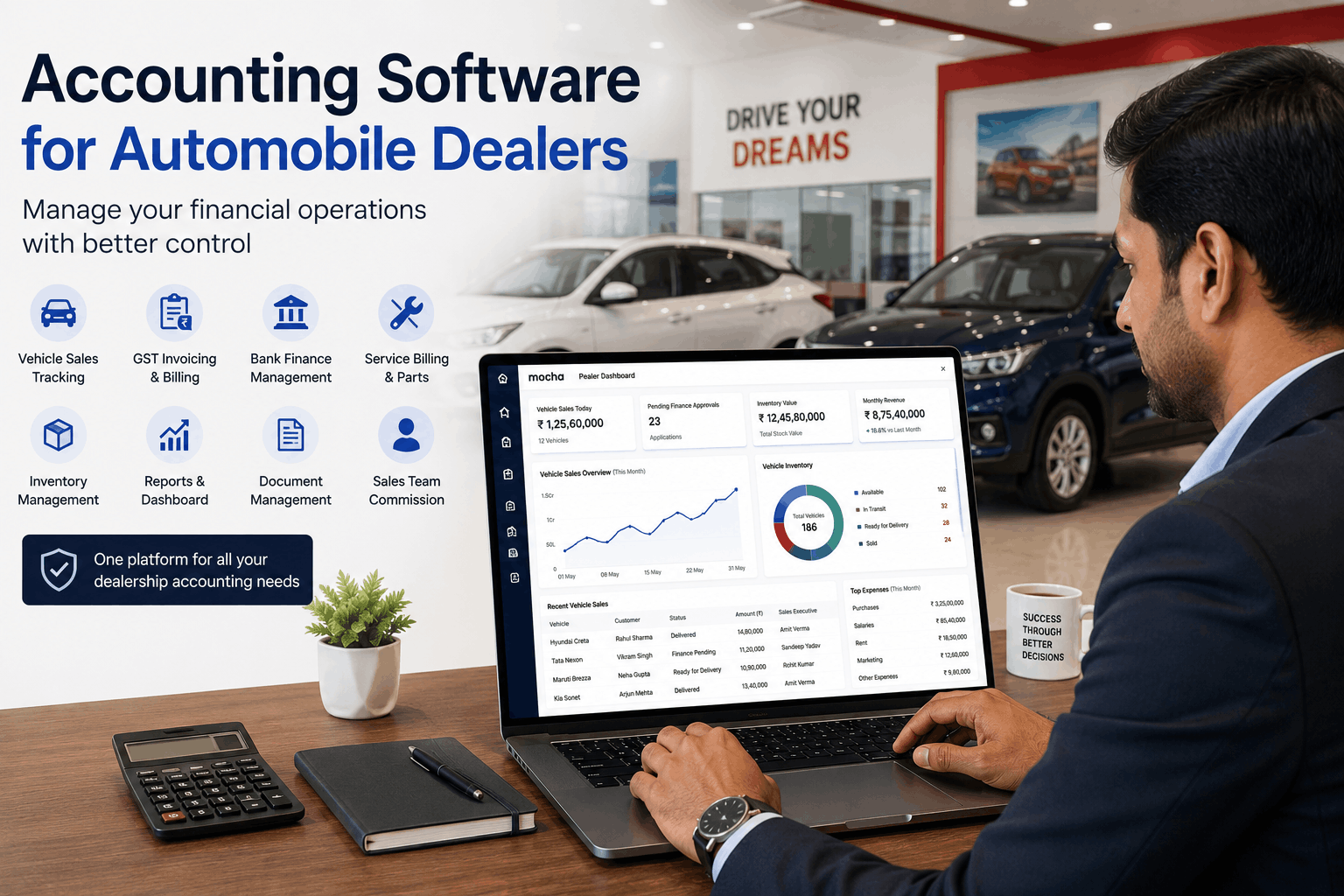
Automobile dealerships are burgeoning in India, with the national body of automobile retailers, the Federation of Automobile Dealers Associations (FADA), putting the number of registered dealers at 15,000 and the total number of outlets at 30,000. These dealerships combined to set a record, selling over 28 million vehicles in 2025. However, running an automobile dealership is no easy task, thanks to a blend of high ticket sizes and multiple moving parts, both at the time of sale as well as service, which many dealerships also offer as an add-on to customers. With this complexity, it is often easy for automobile dealership owners to lose control of where their business is heading.
This is where accounting software for automobile dealers becomes useful. It gives automobile businesses a better way to record sales, track vehicles, manage cash flow, store documents, raise GST-ready with HSN/SAC codes invoices, and understand profit by unit, branch, or service activity. In this blog, we will discuss what such software is, why dealership finance is complex, which features are most helpful, and how Mocha Accounting can help automobile businesses manage high-value transactions with greater control.
What is accounting software for automobile dealers?
Accounting software for automobile dealers is a financial system built for vehicle sales, workshop billing, spare parts purchases, service work, customer payments, bank finance, and inventory tracking. It is more detailed than generic accounting software because automotive businesses handle high-value assets, numerous documents, multiple parties, and varied payment flows. Here is how accounting software for automobile dealers, such as Mocha Accounting, adds value to automobile dealer operations:
| Business area | Automobile-specific need | Business problem it solves |
| Vehicle sales | Chassis number and engine number tracking | Prevents mix-ups between similar models and colours |
| Inventory | Stock by model, variant, colour, yard, and showroom | Helps managers know which units are unsold |
| Payments | Reduces follow-ups across the sales desk and accounts team | |
| Documents | RC copies, insurance papers, ID proofs, and finance letters | Keeps sale records ready for review at any time |
| Service billing | Parts, labour, taxes, discounts, and job card value | Helps workshops check job level margin |
| Reports | Unit-wise sales, branch-wise profit, and stock ageing | Helps leaders take faster pricing and purchase calls |
The complexity of dealership financial management
Automobile dealership finance has many moving parts. Here are the finance-related challenges that automobile businesses encounter regularly:
- Booking amounts get collected before final delivery, so the accounts team needs a way to track advance receipts by customer and vehicle.
- Bank finance payouts are disbursed to the dealer after approval, so tracking pending disbursements is important for cash planning.
- Trade-ins require valuation records, exchange bonus entries, and resale tracking so the dealer can see the profit on the used vehicle.
- RTO and insurance payments involve third parties, so the ledger must show which amounts were paid by the customer and which were paid to the service provider.
- Accessories and add-ons can raise deal margin, so the sales and accounts team need a shared view of billed and unbilled items.
- Sales executive incentives depend on deal value, margin, and target slabs, so manual calculations can take hours at month’s end.
- Workshop repair jobs involve parts and labour, so service centre managers need job-wise cost and revenue tracking.
- Fleet maintenance teams need vehicle-specific cost history to decide whether to repair, replace, or sell a unit.
Key features of car dealership accounting software
The right car dealership accounting software should manage sales, inventory, billing, payments, commissions, and reports within a single platform. Here are the core features of software such as Mocha Accounting, which streamline automobile dealership operations:
| Feature | What it does | Example problem solved |
| Vehicle inventory tracking | Tracks stock across showrooms, stockyards, and branches | A dealer can see which vehicles are ready for delivery and which ones are still in the yard |
| Sales and billing | A sales team can bill the full deal value from a single record | |
| Commission management | Calculates sales incentives based on deal margin and target rules | A showroom manager can reduce month-end incentive disputes |
| Payment management | Tracks customer receipts, bank finance payouts, and pending balances | An accounts executive can spot deals waiting for loan disbursement |
| Financial reports | Builds balance sheet, profit and loss statement, and unit-level reports | A dealer principal can view branch-wise profit without manual sheet work |
| Service cost tracking | Records parts, labour, discounts, and customer payments | A workshop manager can see which repair jobs gave a better margin |
| Document management | Stores sales and service documents with entries | A service centre can keep customer papers linked to the billing record |
How software improves precision and decision-making
Automobile finance requires precision because it involves high-value transactions (purchases and sales) or multiple moving parts (servicing). Software such as Mocha accounting integrates various operations to provide business owners with an integrated view of finances and, therefore, the entire business. Here’s a summary of how accounting software for automobile dealers improves decision-making.
| Stakeholder | Decision that needs better data | How software helps |
| Standalone repair shop leader | Which services bring a better margin? | Compares labour income, parts cost, and discounts by job |
| Authorised service centre manager | Which warranty jobs need follow-up? | Tracks billing status, documents, and pending receipts |
| Multi-brand workshop entrepreneur | Which parts move fastest? | Shows purchase history, stock use, and reorder needs |
| Car dealership manager | Which vehicles need a sales push? | Shows stock ageing by model, colour, and branch |
| Bike dealership manager | Which finance cases are pending? | Tracks booking, loan approval, bank payout, and delivery status |
| Fleet maintenance manager | Which vehicle costs too much to maintain? | Shows repair spend and service history by vehicle |
Driving growth in your automobile dealership business with Mocha Accounting
Mocha Accounting helps automobile businesses manage high-value transactions, detailed inventory, GST-ready billing, banking, expenses, purchases, and reports in one system. Here are some of its features, together with the value they bring to the business:
| Feature | Use in automobile businesses | Benefit to stakeholders |
| GST-ready invoicing | Accounts teams spend less time preparing invoice details | |
| Inventory tracking | Tracks spare parts, accessories, and vehicle-related stock | Managers see stock value and movement faster |
| Purchase orders and bills | Records vendor orders, parts purchases, and returns | Workshop teams track part cost with greater control |
| Bank transaction rules | Categorises receipts and payments | Finance teams match customer and bank entries faster |
| Document management | Stores RC copies, insurance papers, ID proofs, and loan files | Showroom and service teams find papers quickly |
| Reporting dashboard | Shows revenue, expenses, bank balances, and business reports | Business leaders view performance by branch or activity |
| Credit notes | Records returns and future adjustments | Dealers handle cancelled items or returned parts with a proper record |
Why cost tracking is important for automobile businesses
Cost tracking is critical because it helps automotive businesses understand where money is blocked, which jobs deliver better margins, and which activities require closer review. Here are the cost areas that automobile businesses need to watch:
- Vehicle stock value, because unsold vehicles block capital and yard space.
- Spare parts purchase cost, because small price changes can affect the service job margin.
- Labour billing, because repair time must connect with the customer invoice value.
- Insurance and RTO pass-through amounts must match customer collections and vendor payments.
- Sales commission: incentives must align with margin and collections.
- Vendor credits: returned parts must be reflected in the purchase records.
- Customer advances because booking money must be linked to the correct vehicle or job card.
- Bank charges and loan payouts, because finance-led sales depend on timely receipts.
Automobile accounting tools such as Mocha Accounting make it easy to keep tabs on costs, ensuring bottom lines are maintained.
Conclusion
Automobile businesses deal with more financial detail than many other trades. Vehicle sales include a booking amount, bank finance, customer-paid balance, insurance premium, RTO registration fee, accessories, commission, delivery documents, and later service visits. A workshop job can include spare parts, labour, consumables, discounts, vendor bills, partial payments, and service history. A fleet maintenance record can affect repair budgets, vehicle replacement plans, and monthly cost reports.
This is why accounting software for automobile dealers has become important for Indian dealerships, service centres, multi-brand workshops, and fleet maintenance teams. It gives the business a better way to track high-value transactions, manage stock, record GST-ready invoices, follow customer and bank payments, and view reports that guide daily decisions. It also helps teams reduce repetitive manual work across the sales desk, service desk, purchasing team, and accounts office.
Mocha Accounting adds value by bringing many useful features into a single financial system, with features such as:
- GST-ready invoicing, which helps dealers and workshops bill vehicle sales, accessories, parts, and service charges with the required tax details.
- In-store and online payment options, with softPOS integration allowing payment via a range of modes, including netbanking, cards, and UPI, making the customer experience seamless and improving cash flow.
- Inventory tracking, which helps teams monitor spare parts, accessories, and stock movements
- Purchase order, expense tracking, and vendor credit features help workshops track parts bought from different vendors and handle returns with proper records.
- Easy to set up chart of accounts, which helps the accounts team categorise customer receipts, finance payouts, vendor payments, and expense entries faster.
- Integrated document management so the team can access them when handling customer queries, internal reviews, or month-end checks.
- An easy-to-understand reporting dashboard which lets business leaders view revenue, expenses, bank balances, and business performance.
In a business where every vehicle, part, invoice, and payment affects cash flow, better accounting offers a tangible business advantage. Mocha Accounting gives automotive businesses the tools to manage cash, inventory, documents, and reports with care, so managers can focus on selling vehicles, completing service jobs, and growing with control.
FAQs
Can auto dealer accounting software track vehicles by chassis number?
Yes. A dealer-focused accounting system can track vehicles by Chassis Number and Engine Number. This helps the team connect stock, invoice, insurance, registration, finance, and delivery records to the same vehicle.
How does the software handle bank financing and loan payouts?
The software can record customer advances, bank finance approvals, loan payouts, final customer balances, and delivery statuses. This helps the accounts team see which deals have received payment and which still need follow-up.
Can I manage my service centre and showroom accounts in one place?
Yes. A system like Mocha Accounting can help track showroom sales, service billing, spare parts purchases, expenses, bank entries, and reports in one place. This helps managers view sales and workshop activity together, rather than checking separate books.
Does it help with commission tracking for sales staff?
Yes. Commission management can calculate sales staff incentives based on deal value, margin, accessory sales, finance conversion, or target rules. This reduces manual work during the month-end salary and incentive processing.
Is it possible to generate GST-ready invoices for vehicle sales?
Yes. Automobile accounting software can create GST-ready invoices for vehicle sales, accessories, parts, and service work. This helps the accounts team include required tax details, customer details, and add-on charges in the invoice.
Leave a Reply