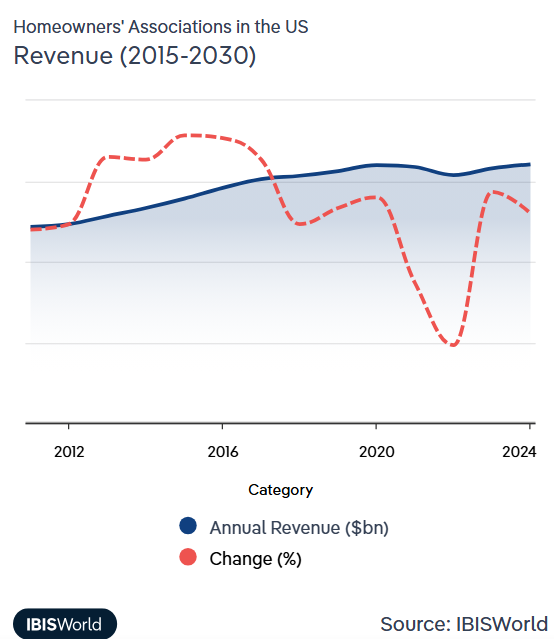
Managing an HOA’s finances is a big job.
The job only gets bigger, too, with HOA boards managing more funds on average than ever before, according to a study by IBIS World:

With that said, it’s also a job that’s easy to get wrong, potentially leading to legal repercussions and a whole lot of trouble.
Despite this, board members are often not certified accountants. Maybe that’s you.
The good news: HOA accounting follows clear principles that anyone can learn.
The bad news: mistakes can lead to budget shortfalls, compliance violations, special assessments, and angry homeowners questioning where their dues went.
So, let’s jump in together and make sure you have the tools you need to get this right.
The guide below walks you through everything you need to know about HOA accounting, from basic concepts to advanced best practices.
Whether you’re a new board member trying to understand your treasurer’s reports or an experienced president looking to improve your association’s financial management, you’ll find actionable guidance here.
What Makes HOA Accounting Different
HOA accounting isn’t the same as managing your personal finances or running a small business.
Homeowners associations operate under unique rules that combine non-profit accounting principles with real estate management requirements.
Here’s what makes HOA accounting distinct:
- You’re managing other people’s money. Every dollar in your HOA’s accounts belongs to the homeowners collectively. Board members are fiduciaries—legally obligated to manage these funds responsibly and in the best interest of the community.
- You budget based on assessments, not revenue. Unlike businesses that sell products or services, HOAs determine how much money they need each year, then assess homeowners accordingly. This means budgeting is the foundation of everything else.
- You maintain separate funds with different purposes. Most HOAs keep at least two distinct funds: an operating fund for day-to-day expenses and a reserve fund for major repairs and replacements. These must be tracked separately.
- You must comply with state-specific regulations. Every state has laws governing HOA finances, from how assessments can be increased to how often you must provide financial reports to homeowners. Violating these rules can result in fines or legal liability.
- Transparency is mandatory. Homeowners have the right to review financial records and receive regular financial statements. Your accounting must be clear enough that non-experts can understand it.
Accounting Methods: Cash vs. Accrual vs. Modified Accrual
The first decision your HOA needs to make is which accounting method to use.
This choice affects how you record income and expenses, what your financial statements show, and whether you’re following Generally Accepted Accounting Principles (GAAP).
Cash Basis Accounting

With cash basis accounting, you record income when money actually comes in and expenses when you actually pay them.
If homeowner dues are technically owed in January but the payment arrives in February, you record it in February. If you receive an invoice in December but don’t pay until January, it shows up in January.
Advantages
- Simple and straightforward
- Easy for board members without accounting backgrounds to understand
- Matches the way most people manage personal finances
Disadvantages
- Doesn’t show a complete financial picture
- Can make it look like you have more cash than you actually do if homeowners are behind on dues
- Doesn’t conform to GAAP, which some states require
Best for
Very small HOAs with simple finances and minimal reserve requirements.
Accrual Basis Accounting

With accrual basis accounting, you record income when it’s earned (regardless of when payment arrives) and expenses when they’re incurred (regardless of when you pay).
If homeowner dues are assessed in January, they show up as income in January even if payments trickle in over the next few months. If a contractor completes work in December, the expense appears in December even if you don’t pay the invoice until January.
Advantages
- Provides a complete picture of your HOA’s financial health
- Matches expenses to the period they belong to, making budgets more accurate
- Conforms to GAAP requirements
- Shows accounts receivable (unpaid dues) and accounts payable (unpaid bills)
Disadvantages
- More complex to maintain
- Requires understanding of accounting principles
- May show less cash on hand than actually exists if many homeowners are current on assessments
Best for
Medium to large HOAs, associations with significant reserve funds, and those required by state law to use GAAP.
Modified Accrual Basis

Modified accrual accounting is a hybrid approach that records revenue on an accrual basis but expenses on a cash basis.
You recognize assessment income when it’s billed to homeowners (accrual), but you only record expenses when you actually pay them (cash).
Advantages
- Easier than full accrual accounting
- Provides better information than pure cash basis
- Practical compromise for many HOAs
Disadvantages
- Not fully GAAP compliant
- Can still create timing mismatches in financial statements
- Some accountants advise against mixing methods
Best for
Medium-sized HOAs that want better financial visibility than cash basis but aren’t ready for full accrual accounting.
Which should your HOA use?
Most accounting experts recommend accrual basis accounting for HOAs. It provides the most accurate financial picture and is considered the proper method under GAAP.
However, if your HOA is very small (under 20 units), has simple finances, and no state regulations requiring GAAP, cash basis or modified accrual can work.
Check your state’s requirements and your association’s governing documents. Some bylaws specify which accounting method must be used.
Essential Financial Statements Every HOA Needs
Your HOA should produce four core financial statements on a regular basis—typically monthly or quarterly for board review, and annually for all homeowners.
Balance Sheet
The balance sheet is a snapshot of your HOA’s financial position at a specific moment in time.
It shows what the association owns (assets), what it owes (liabilities), and what’s left over (fund balance or equity).
Assets typically include
- Cash in checking and savings accounts
- Investments
- Accounts receivable (unpaid homeowner assessments)
- Property and equipment owned by the HOA
- Prepaid expenses
Liabilities typically include
- Accounts payable (unpaid vendor bills)
- Accrued expenses (services used but not yet billed)
- Loans or mortgages
- Deferred revenue (assessments collected in advance)
Fund balance is the difference between assets and liabilities. For HOAs, this is typically separated into operating fund balance and reserve fund balance.
A healthy HOA balance sheet shows adequate cash reserves, minimal accounts receivable (most homeowners are current), and a strong reserve fund balance relative to future capital needs.
Income Statement (Profit & Loss)
The income statement shows all income and expenses over a specific time period—usually a month, quarter, or year.
Unlike the balance sheet (which is a snapshot), the income statement shows financial activity over time.
Income typically includes
- Homeowner assessments (regular monthly or quarterly dues)
- Special assessments
- Late fees and interest on delinquent accounts
- Rental income from common facilities
- Interest earned on bank accounts
Expenses typically include
- Landscape and grounds maintenance
- Utilities for common areas
- Insurance premiums
- Management company fees
- Repairs and maintenance
- Legal and professional fees
- Administrative expenses
For HOAs, the income statement should separate operating fund activity from reserve fund activity. You want to see operating income and operating expenses separately from reserve contributions and capital expenditures.
A healthy income statement shows income meeting or exceeding expenses (you’re not operating at a loss) and reserve contributions happening as planned.
Cash Flow Statement
The cash flow statement tracks the actual movement of money in and out of your HOA’s bank accounts.
Even if your HOA is profitable on paper (income statement shows more income than expenses), you could still have cash flow problems if homeowners are slow to pay or if you have large expenses concentrated in certain months.
The cash flow statement reconciles your income statement with your actual bank account balance changes.
It typically breaks down into three categories:
1. Operating activities
Cash from assessments and payments to vendors
2. Investing activities
Purchases or sales of investments, major capital improvements
3. Financing activities
Loan proceeds or repayments
This statement helps your board understand whether the association can pay its bills on time and identifies months when cash might be tight.
General Ledger
The general ledger is the detailed transaction record behind all your other financial statements.
Every check written, every assessment collected, every expense categorized—it’s all recorded in the general ledger.
Think of the general ledger as your complete financial history. The other statements (balance sheet, income statement, cash flow) are summaries derived from this detailed record.
Board members don’t typically review the general ledger line by line every month, but it should be available for review when questions arise about specific transactions.
Chart of Accounts: Organizing Your HOA’s Finances
Your chart of accounts is the framework that organizes all your financial transactions.
It’s a list of all the categories (accounts) where income and expenses get recorded. Every transaction gets assigned to one of these accounts.
Setting Up Your Chart of Accounts
A well-organized chart of accounts makes it easy to track where money is coming from and going to.
Most HOAs organize accounts into these major categories:
Assets (1000-1999)
- 1000: Operating checking account
- 1010: Operating savings account
- 1020: Reserve checking account
- 1030: Reserve savings/investments
- 1200: Accounts receivable
- 1500: Property and equipment
Liabilities (2000-2999)
- 2000: Accounts payable
- 2010: Accrued expenses
- 2100: Security deposits held
- 2500: Loans payable
Fund Balance (3000-3999)
- 3000: Operating fund balance
- 3100: Reserve fund balance
Income (4000-4999)
- 4000: Homeowner assessments
- 4010: Special assessments
- 4020: Late fees
- 4030: Interest income
- 4040: Common area rental income
Operating Expenses (5000-6999)
- 5000: Landscaping and grounds
- 5100: Utilities
- 5200: Insurance
- 5300: Management fees
- 5400: Repairs and maintenance
- 5500: Administrative expenses
- 5600: Legal and professional fees
- 5700: Reserve contributions
Reserve Expenses (7000-7999)
- 7000: Roof replacement
- 7100: Exterior painting
- 7200: Pavement/asphalt
- 7300: Pool equipment
- 7400: Elevator repairs
The key is to be specific enough to track meaningful categories but not so detailed that you have dozens of accounts with minimal activity.
Common Chart of Accounts Mistakes
Let’s finish by covering a few common mistakes made when it comes to setting up your chart of accounts.
Some of these are basic, but they’re all vital to get right, so they’re worth mentioning:
Mistake #1: Using generic account names
Don’t have a single account called “Repairs.” Break it down: Pool Repairs, Building Repairs, Landscape Repairs. This makes it easier to identify trends and budget accurately.
Mistake #2: Confusing operating and reserve expenses
Regular ongoing maintenance (pool cleaning, lawn care) goes in operating expenses. Major repairs and replacements go in reserve expenses. Keep them separate.
Mistake #3: Not tracking different types of income
Don’t lump all income into “Assessments.” Separate regular assessments, special assessments, late fees, and other income sources so you can see exactly where money is coming from.
Managing HOA Assessments and Collections
Homeowner assessments are the lifeblood of your HOA’s finances.
Most of your income comes from these regular dues, so collecting them efficiently and handling delinquencies properly is critical.
Setting Assessment Amounts
Your annual budget determines how much you need to collect in assessments.
Here’s the basic formula:
Total annual operating expenses + Reserve contributions = Total assessment income needed
Divide that total by the number of units and the number of assessment periods (monthly, quarterly, etc.) to get the per-unit assessment amount.
Example:
- Annual operating expenses: $120,000
- Reserve contribution: $30,000
- Total needed: $150,000
- Number of units: 100
- Assessment per unit per year: $1,500
- Monthly assessment per unit: $125
Increasing Assessments
Most HOAs need to increase assessments periodically to keep pace with rising costs.
Check your governing documents and state law for restrictions on assessment increases. Some states limit how much you can raise assessments without homeowner approval (typically 5-20% per year).
When raising assessments, communicate clearly with homeowners:
- Explain why the increase is necessary
- Show specific cost increases (insurance went up X%, landscape contract increased Y%)
- Demonstrate how the increase keeps the association financially healthy
- Give plenty of advance notice
Collecting Assessments
Make it easy for homeowners to pay by offering multiple payment methods:
- Online payment portals
- Automatic bank draft (ACH)
- Check by mail
- In-person payment (if you have a management office)
The easier you make it to pay, the better your collection rate will be.
Handling Delinquencies
When homeowners don’t pay on time, you need a consistent collection process:
Day 1-15 after due date
Send a friendly reminder notice. Sometimes homeowners simply forget.
Day 16-30
Send a more formal notice indicating the account is past due. Include any late fees or interest charges per your governing documents.
Day 31-60
Send a final notice before legal action. Make it clear what will happen next if payment isn’t received.
Day 61+
Turn the account over to your HOA attorney for collection. This may include filing a lien against the property.
Apply your collection policy consistently. Don’t make exceptions for some homeowners but not others—that creates legal liability and resentment in the community.
Tracking Accounts Receivable
Your accounting system should clearly show which homeowners are current and which are behind.
Run an aged receivables report monthly to see:
- Total amount owed
- How long each debt has been outstanding (30 days, 60 days, 90+)
- Which accounts need collection action
Don’t let receivables pile up. The longer an account goes unpaid, the harder it is to collect.
Reserve Fund Accounting: Planning for the Future
Reserve funds are the HOA equivalent of a savings account—money set aside today to pay for major repairs and replacements tomorrow.
Proper reserve fund accounting is critical to your association’s long-term financial health and property values.
What Are Reserve Funds?

Reserve funds are savings designated for major capital expenditures—repairs and replacements with useful lives longer than one year.
Think of the difference between changing a light bulb (operating expense) and replacing the entire lighting system (reserve expense).
Common reserve fund expenses include
- Roof replacement
- Exterior painting and siding
- Asphalt/concrete replacement
- Pool resurfacing and equipment replacement
- Elevator repair and modernization
- HVAC systems for common areas
- Building structural repairs
The key distinction: operating expenses are routine and predictable (landscaping, utilities, insurance). Reserve expenses are major, infrequent, and significant.
The Reserve Study: Your Long-Term Financial Plan
A reserve study is a professional analysis that tells you:
- What major components your HOA is responsible for maintaining
- The current condition of each component
- How long each component will last before needing replacement
- How much each replacement will cost
- How much you need to save annually to cover these future costs
Most experts recommend updating your reserve study every 3-5 years, with annual reviews to adjust for inflation and changing conditions.
Without a reserve study, you’re guessing. With one, you’re planning.
How Much Should You Contribute to Reserves?
The ideal reserve contribution amount comes from your reserve study.
The study calculates how much you need to save each year to build adequate reserves without running a deficit.
Most HOAs aim for 70-100% funded reserves, meaning if all major components needed replacement today, you’d have 70-100% of the money required.
Underfunded reserves are dangerous
- You may need special assessments when major repairs arise
- Property values can decline if buyers see inadequate reserves
- You can’t maintain the property properly
- You may be forced to defer needed maintenance
Example reserve calculation
If your reserve study shows you need $50,000 per year to adequately fund reserves based on projected future expenses, then $50,000 should be included in your annual budget and allocated to the reserve fund.
This might mean each homeowner pays $40/month in regular assessments plus $15/month for reserve contributions.
Tracking Reserve Fund Activity
Reserve funds must be tracked separately from operating funds.
Your accounting system should clearly show:
- Reserve fund balance
- Reserve contributions received
- Reserve expenditures made
- Interest earned on reserve investments
- Percentage funded (actual balance vs. fully funded balance)
When you spend money from reserves for a major project, it should be recorded as a reserve expense, not an operating expense.
Can You Borrow from Reserves?
Some HOAs face cash flow crunches and consider “borrowing” from reserves to cover operating shortfalls.
This is almost always a bad idea and may be prohibited by your governing documents or state law.
Reserve funds exist for a specific purpose. Using them for operating expenses means you won’t have the money when major repairs are needed.
If your operating fund is consistently short, the solution is to increase assessments, cut expenses, or both—not to raid reserves.
For a more detailed look at reserve fund accounting, including best practices for reserve studies, funding strategies, and compliance requirements, see our complete Reserve Fund Accounting Guide.
Bank Reconciliation: Catching Errors Before They Become Problems
Bank reconciliation is the process of comparing your HOA’s internal accounting records to your bank statements to ensure they match.
It sounds simple, but it’s one of the most important internal controls an HOA can implement.
Why Bank Reconciliation Matters
Without regular reconciliation, you won’t catch:
- Checks that were written but never cashed
- Duplicate payments to vendors
- Bank errors or unauthorized transactions
- Automatic payments that didn’t process correctly
- Deposits that didn’t clear
These errors don’t fix themselves. The longer they go unnoticed, the harder they are to correct.
How to Reconcile Your HOA Bank Accounts
Bank reconciliation should be done monthly, ideally by someone other than the person who writes checks or makes deposits.
Step 1: Gather your materials
- Bank statement for the month
- Your HOA’s accounting records (check register, ledger)
- Previous month’s reconciliation
Step 2: Compare deposits
- Mark off each deposit shown on the bank statement against your accounting records
- Identify any deposits in your records that aren’t on the bank statement (deposits in transit)
- Identify any deposits on the bank statement that aren’t in your records (investigate these)
Step 3: Compare withdrawals
- Mark off each check, ACH payment, or debit that appears on both the bank statement and your records
- Identify outstanding checks (written but not yet cashed)
- Identify any bank withdrawals not in your records (again, investigate)
Step 4: Adjust for bank fees and interest
- Add any interest earned to your records
- Subtract any bank fees from your records
Step 5: Verify the ending balance
- Take your accounting records’ ending balance
- Add deposits in transit
- Subtract outstanding checks
- Adjust for bank fees and interest
- This adjusted balance should match your bank statement ending balance
If they don’t match, find the discrepancy. Don’t move forward until the accounts reconcile.
Internal Controls for Bank Reconciliation
To prevent fraud and errors:
- The person reconciling accounts should be different from the person handling deposits and writing checks
- Require at least one board member (typically the Treasurer) to review and approve reconciliations
- Set up dual signatures for checks over a certain amount ($500-$1,000)
- Review bank statements monthly at board meetings
- Don’t give one person complete control over all financial functions
How to Create Your Annual Budget
Your annual budget is the most important financial document your HOA produces.
It determines assessment amounts, guides spending decisions, and provides a benchmark for measuring financial performance throughout the year.
Most HOAs begin budget preparation 3-4 months before the fiscal year starts.
A lot goes into creating an annual budget, but here are the major items you’ll need to ensure you cover:

Step 1: Review last year’s performance
Pull up the prior year’s budget vs. actual reports. Where did you overspend? Where did you save money? Were there unexpected expenses?
Use this data to make more accurate projections for next year.
Step 2: Identify known cost increases
Contact your vendors and service providers to get quotes for next year. Have insurance premiums increased? Is the landscape company raising rates?
Don’t assume costs will stay flat. Budget for realistic increases.
Step 3: Plan for major projects
Review your reserve study. Are any major projects scheduled for next year? Make sure reserve contributions and reserve expenditures are included in the budget.
Step 4: Get board input
Are there projects or improvements the board wants to tackle? New amenities? Deferred maintenance that needs attention?
These need to be budgeted for.
Step 5: Calculate required assessments
Once you have the total projected expenses, divide by the number of units to determine assessment amounts.
If the required assessment represents a significant increase, the board needs to decide: cut expenses, proceed with the increase, or find alternative funding sources.
Step 6: Present the budget to homeowners
Most HOAs are required to distribute the proposed budget to all homeowners before it’s finalized, often 30-60 days in advance.
This gives homeowners a chance to review and provide feedback. Some states require homeowner approval for the budget; others only require board approval.
Budget vs. Actual Reporting
Once your budget is approved, track actual performance against it monthly.
A budget vs. actual report shows:
- Budgeted amount for each line item
- Actual amount spent or received
- Variance (difference between budgeted and actual)
- Percentage variance
This report helps you spot problems early. If you’re 3 months into the year and landscape expenses are already at 60% of the annual budget, you know you have a problem.
Adjusting Budgets Mid-Year
Budgets aren’t set in stone.
If circumstances change—a major unexpected expense, a significant cost increase, or a windfall of extra income—the board can amend the budget mid-year.
Some HOAs do formal budget revisions quarterly to keep projections realistic.
How to Set Up Internal Controls (Protecting Against Fraud and Mismanagement)
HOA board members are volunteers, often managing hundreds of thousands of dollars with minimal oversight.
Strong internal controls reduce the risk of fraud, errors, and mismanagement.
Segregation of Duties
Don’t let one person control every aspect of your HOA’s finances.
The person who collects money should be different from the person who records it. The person who writes checks should be different from the person who reconciles bank accounts.
Ideal segregation of duties:
- Person A collects money and makes deposits
- Person B records transactions in the accounting system
- Person C reconciles bank accounts
- Person D (board member) reviews reconciliations and approves financial reports
In small HOAs where this isn’t possible, have multiple board members review financial statements monthly and require dual signatures on large checks.
Approval Requirements
Require board approval for:
- Expenses over a certain dollar amount (often $500-$2,500)
- Unbudgeted expenses
- Vendor contracts
- Changes to the budget
Document these approvals in meeting minutes.
Regular Financial Reporting
The board should review financial statements at every meeting.
As a minimum, review:
- Balance sheet
- Income statement
- Bank reconciliations
- Accounts receivable aging report
- Budget vs. actual comparison
Don’t just accept these reports without questions. If something doesn’t make sense, ask about it.
Annual Audits or Reviews
Many HOAs are required by governing documents or state law to have their finances audited or reviewed annually.
- Audit: A CPA examines your financial records in detail and provides an opinion on whether they fairly represent your financial position. This is the most comprehensive and expensive option.
- Review: A CPA reviews your financial statements and procedures but doesn’t verify every transaction. Less expensive than an audit but still provides some assurance.
- Compilation: A CPA simply takes your financial data and puts it into standard financial statement format. No verification or assurance is provided. Least expensive option.
Check your governing documents and state law to see which level is required. Even if not legally required, annual reviews provide accountability and catch errors before they become serious problems.
Tax Compliance for HOAs
Homeowners associations have unique tax requirements that combine elements of non-profit and business taxation.
Do HOAs Pay Taxes?
Yes—most HOAs are subject to federal income tax.
However, HOAs have two filing options:
Option 1: File as a corporation (Form 1120)
Under this method, the HOA functions like a regular corporation and pays tax on all income that doesn’t come from member assessments.
Investment income, rental income from facilities, and other non-member income is taxable.
Option 2: File under IRS Section 528 (Form 1120-H)
Section 528 allows HOAs to file a simpler tax return and pay a flat 30% tax on certain types of income.
To qualify, at least 60% of gross income must come from member assessments, and at least 90% of expenditures must be for managing and maintaining the association.
This is usually the more favorable option for typical residential HOAs.
Important Tax Deadlines
- Form 1120-H due date: March 15 (if your tax year ends December 31)
- Form 1099 filing: January 31 to vendors/contractors who received $600+ during the year
- State tax returns: Varies by state
Missing these deadlines can result in penalties and interest charges.
Common Tax Mistakes
Similar to your chart of accounts, taxes are complex and easy to get wrong. Here are a few costly mistakes often made the watch for:
- Not filing at all: Some HOA boards don’t realize the association must file tax returns. Even if you owe no tax, you’re required to file.
- Not issuing 1099 forms: If you pay contractors or service providers $600 or more during the year, you must issue a 1099 form and file it with the IRS.
- Confusing tax-exempt with tax-free: HOAs are not tax-exempt like charities. You’re subject to tax on certain types of income.
- Not keeping proper records: The IRS can audit your HOA. Maintain detailed records of all income and expenses, including receipts and invoices.
Working with a Tax Professional
Given the complexity of HOA taxation, most associations hire a CPA to prepare annual tax returns.
The cost is minimal compared to the risk of errors or missed deductions.
HOA Accounting Best Practices
Following these best practices will keep your HOA’s finances healthy and transparent.
1. Use Purpose-Built HOA Accounting Software
Spreadsheets and generic accounting software aren’t designed for HOAs.
Purpose-built HOA accounting software handles:
- Separate operating and reserve funds
- Homeowner assessment tracking and collections
- Property-specific chart of accounts
- Owner reporting and communication
- Budget tracking and variance analysis
Good software reduces errors, saves time, and makes financial reporting easier.
2. Document Everything
Keep detailed records of all financial transactions.
Every invoice, receipt, check, deposit slip, contract—save it all. Organize records by fiscal year and keep them for at least 7 years (many states require longer retention).
Digital recordkeeping is fine, but make sure you have backups.
3. Communicate Financial Information Clearly
Financial transparency builds trust with homeowners.
Provide regular updates:
- Monthly or quarterly financial summaries to all homeowners
- Annual budget distributed well in advance of the new fiscal year
- Major expenditure explanations
- Reserve study summaries
Use plain language. Not everyone understands accounting terminology, but everyone should be able to see where their assessment money is going.
4. Plan for the Unexpected
Build a contingency line item into your operating budget (typically 5-10% of total expenses).
This gives you flexibility when unexpected costs arise without needing special assessments or budget amendments.
5. Keep Reserve Funding a Priority
Don’t skip reserve contributions to keep assessments low.
Deferred maintenance and underfunded reserves eventually catch up with you—usually in the form of special assessments or declining property values.
6. Review and Update Vendor Contracts Regularly
Don’t automatically renew contracts year after year.
Solicit competitive bids every 3-5 years for major services (landscape, pool, management). You might find better pricing or service quality.
7. Invest Idle Cash Wisely
Money sitting in checking accounts earns almost nothing.
Move excess operating funds to high-yield savings accounts. Invest reserve funds in safe, liquid investments that earn returns while remaining accessible when needed.
Consult with a financial advisor familiar with HOA requirements before making investment decisions.
8. Train New Board Members on Financial Responsibilities
When new board members join, provide financial orientation:
- How to read HOA financial statements
- The association’s fiscal calendar and key deadlines
- Your chart of accounts and what the categories mean
- The budget process and approval requirements
- Internal controls and approval authorities
Don’t assume new volunteers understand HOA finances. Invest time in training.
7 HOA Accounting Mistakes and How to Avoid Them
So far, we’ve touched on a few mistakes in creating your chart of accounts and taxes.
However, there are quite a few more HOA-specific accounting mistakes commonly made that are important to know if you’re looking to do things right.
Let’s cover them now:
Mistake #1: Mixing Operating and Reserve Funds
Keep operating and reserve funds in separate bank accounts and track them separately in your accounting system.
Don’t “borrow” from reserves to cover operating shortfalls.
Mistake #2: Inadequate Reserve Funding
Skipping reserve contributions or contributing less than your reserve study recommends is a recipe for special assessments and deferred maintenance.
Fund reserves fully every year.
Mistake #3: Poor Collections Procedures
Letting delinquent accounts pile up creates cash flow problems and sends a message that paying on time doesn’t matter.
Enforce your collection policy consistently and promptly.
Mistake #4: Not Reconciling Bank Accounts Monthly
Skipping reconciliations means errors and discrepancies go unnoticed for months.
Reconcile every account, every month, without exception.
Mistake #5: Ignoring Budget Variances
If actual expenses significantly exceed budget in certain categories, investigate why.
Don’t wait until year-end to discover you’re overspending.
Mistake #6: Failing to Get Competitive Bids
Automatically renewing vendor contracts or hiring friends and neighbors without competitive bidding can lead to overpaying.
Get at least three quotes for any major expenditure.
Mistake #7: No Financial Review or Audit
Without independent verification, errors and fraud can go undetected for years.
Have your finances reviewed or audited annually, even if not legally required.
When to Hire Professional Help
HOA board members are volunteers, and there’s a limit to how much time and expertise they can contribute.
Here’s when professional help makes sense:
Hire a CPA or Accountant When:
- Your HOA has complex finances with significant reserves and investments
- State law requires professional financial reviews or audits
- Board members lack accounting experience
- Tax filing requirements are complicated
- You need help setting up accounting systems and procedures
A CPA can handle tax filings, annual audits, and provide guidance on accounting best practices.
Hire an HOA Management Company When:
- Your association is large enough that financial management is becoming overwhelming
- Collections and delinquencies are a persistent problem
- Board members don’t have time to handle day-to-day accounting
- You need professional expertise in HOA operations
Management companies typically handle assessment collection, bill payment, vendor management, financial reporting, and board support.
Use HOA Accounting Software When:
- You’re currently using spreadsheets or generic business software
- Financial reporting is time-consuming and error-prone
- You need better tools for budget tracking and variance analysis
- You want to provide homeowners with online access to financial information
Purpose-built HOA accounting software streamlines financial management and provides transparency.
Mocha Manage is an HOA accounting software designed by real CPAs for community managers.

If you’re looking for an easy-to-use tool that simplifies the entire process of managing your HOA accounting, you can try it out for free (or schedule a demo for a walkthrough) by clicking here.
Take Control of Your HOA’s Financial Management
The right accounting approach transforms how your association operates.
You avoid special assessments. You maintain property values. You build trust with homeowners who see exactly where their money goes.
But many HOA boards struggle with spreadsheets that don’t scale, generic business software that wasn’t designed for community associations, and fragmented systems that create more work than they solve.
Mocha Manage offers a comprehensive solution built specifically for HOAs and community associations.
Purpose-built accounting tools combined with homeowner management in one integrated platform. Clean interface. Powerful features. No QuickBooks workarounds needed.
- Say goodbye to scattered systems. No more juggling QuickBooks for accounting, one app for assessment collection, another for maintenance tracking, and spreadsheets to tie it all together. Mocha Manage is your all-in-one integrated platform designed specifically for HOA boards and community associations.
- Get a 360° view of your association’s finances. Real-time dashboards show exactly where your finances stand—operating funds, reserve funds, and homeowner account balances. Make informed, data-backed decisions with intuitive reporting tools that actually make sense for HOAs.
- Built for HOAs, not adapted from business tools. Native assessment tracking with automated billing. Trust accounting compliance built in. Reserve fund management integrated with your reserve study. Automated homeowner communications. Everything HOA boards actually need, without the workarounds.
- Designed to save time and boost productivity for associations of all sizes—whether you’re managing 20 units or 500+, condos or single-family homes, self-managed or professionally managed.
Try Mocha Manage for free to see how it can simplify your HOA’s financial management.
Leave a Reply