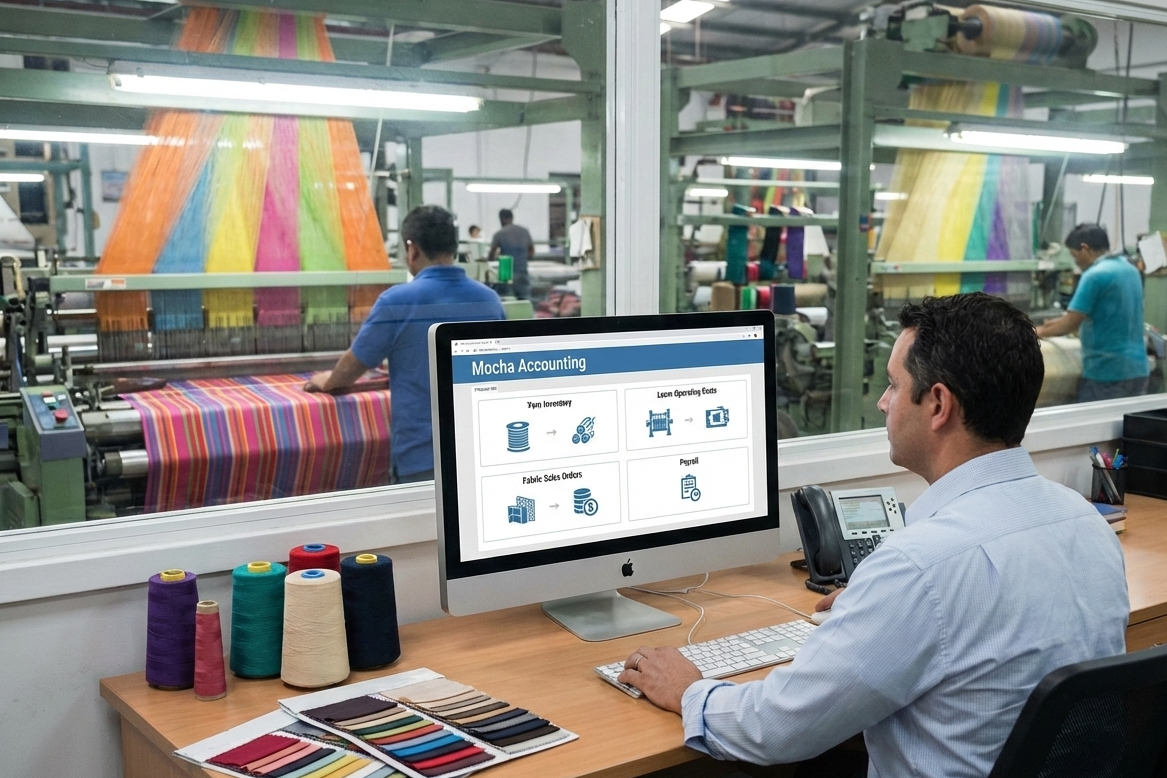
The textile industry in India is growing rapidly, driven by rising exports, domestic demand, and stronger norms of GST compliance. Nevertheless, the control of complex inventory systems, multi-location operations, and large volumes of transactions has complicated financial control as never before. Generic tools and manual systems are not always able to meet textile-specific needs, such as colour-wise stock, batch tracking, and multi-unit measurements. Hence, the need for textile accounting software has arisen.
This blog discusses the use of textile accounting software to simplify financial, inventory, and GST processes. We also look at the major features, advantages, and why the appropriate solution is beneficial in promoting sustainable growth.
The causes of the need for specialised accounting solutions in Indian textile businesses
The Indian textile ecosystem is multi-layered, encompassing spinning, weaving, processing, manufacturing, wholesale distribution, and retail. The layers generate large volumes of transactions and complex stock flows. The textile industry is linked to size, colour, design, GSM, lot numbers, and fabrication, unlike other industries. Following them manually exposes them to the risk of errors and inventory discrepancies.
GST has also raised compliance requirements. There are several GST rates for textile products, depending on the product’s nature and value. IGST is applied to interstate sales, and CGST and SGST are applied to intrastate sales. To submit GSTR-1 and GSTR-3B on a regular basis, invoice details must be correct. Without organised systems, the reconciliation process is risky and time-consuming.
That is why accounting software in the textile industry is specifically designed to address the industry’s challenges. It combines financial control with advanced inventory monitoring, enabling real-time visibility into stock positions and automatic tax calculation. The textile business requires appropriate accounting software that reduces human errors, ensures compliance, and enhances overall effectiveness. To build the business, the best way to enhance decision-making and long-term stability is to adopt the best textile accounting software.
What is textile accounting software, and how does it work?
Textile accounting software is an electronic tool used to manage accounting, inventory, billing, GST compliance, and reporting for textile traders and manufacturers. It can understand textile-specific parameters, including generic tools such as fabric rolls, yarn batches, dye lots, and various unit measurements.
Textile accounting software is a combination of:
- Books of accounts and entries.
- Stock control in both raw materials and finished products.
- GST-enabled invoicing
- Purchase and sales tracking
- Reporting and analytics
The difference between textile accounting software and generic systems
Financial transactions are given more attention by generic accounting systems. Nevertheless, textile companies need elaborate inventory logic. For example, one fabric design may be available in a variety of colours and sizes. Following up on every variation is confusing when done manually. The most suitable accounting software for the textile industry will enable categorisation of products by attributes such as shade, length, weight, and batch number.
Moreover, cost determination in the textile manufacturing process is typically linked to monitoring raw material consumption. The most effective textile accounting software links stock movements to financial entries, ensuring accurate cost of goods sold and profitability analysis.
Basic modules in accounting software for the textile business.
An effective accounting package of a textile company usually has:
- Sales and purchase management.
- Multi-unit measurement of inventory tracking.
- GST compliance automation
- Tracking of accounts receivable and payable.
- Creation of financial statements.
This combined system means the business owners do not need to use separate tools to manage stock and accounts.
The advantages of automation to the textile businesses
Repetitive manual work is minimised by automation. In textile accounting software, invoice creation, tax calculation, and stock updates occur in real time. This eliminates duplication and improves accuracy. In the long run, operational efficiency is enhanced.
The reasons why textile accounting software is vital to contemporary textile businesses
Contemporary textile companies are in competitive markets with narrow margins. Profitability can be directly impacted by delayed payments, surplus stock, or GST fines. Such environments can be made clear and controlled through textile accounting software.
Multi-location inventory and warehousing management
Many textile traders work at multiple warehouses or branches. The absence of integrated systems makes it difficult to reconcile stock balances. Textile accounting software provides centralised stock visibility. This avoids excess orders and out-of-stock situations.
The most suitable accounting software for the textile industry provides proper record-keeping and representation of inter-branch transfers in the financial reports.
Managing GST, e-invoicing, and tax compliance
Blocked input tax credit may result from GST compliance errors. Textile accounting software automates the application of tax rates and ensures invoices are accurate at the invoice level. This minimises reliance on manual reconciliation.
Scalability and business development
Manual systems fail to keep up with the pressure of increasing transaction volumes. The textile accounting software grows with the business. It can be more billing or more product lines, but the system can be modified without losing accuracy.

The main characteristics of the most appropriate accounting software in the textile industry
Selecting the most suitable accounting software for the textile industry will involve considering industry-specific features rather than general accounting features.
Colour, size, GSM, and lot inventory tracking
The most suitable textile accounting software enables companies to categorise inventory by properties applicable to textiles. This will avoid confusion caused by similar products and maintain correct stock levels.
Multi-unit measurement management
Textile companies usually buy in kilograms and sell in metres or by the piece. The accounting software for textiles automatically transfers units and maintains valuation consistency.
Automated billing and GST
Textile business accounting software must be able to generate GST-compliant invoices immediately. The automated calculations minimise errors and save time in filing the returns.
Live analytics and dashboard data
The most suitable accounting software for the textile industry provides dashboards that show sales trends, stock levels, and outstanding payments. These observations allow for informed decisions.
Textile accounting software, inventory, and financial control
Working capital is directly affected by inventory mismanagement. Stockpiling causes a blockage of funds, and stock shortages interfere with sales. Textile accounting software provides a systematic approach to inventory management.
Finished goods and raw material management
Textile accounting software follows all movements from the purchase of yarns to the delivery of finished fabrics. This guarantees transparency between production cycles.
Optimisation of working capital
The accounting software for the textile business provides accurate profit margins by linking stock valuation to the financial records. Business owners can also identify slow-moving stock and make changes to purchasing.
Stock appraisal and cost management
The most suitable textile accounting software supports various valuation approaches, enabling the business to maintain proper cost records. This improves pricing policies and profitability.
Accounting software simplifies GST compliance for the textile business
Textile enterprises are still facing significant challenges with GST compliance. There are several tax slabs and interstate/intrastate transactions, which make it more complex.
Automated application of GST rate
An accounting software for a textile business will automatically apply the appropriate GST rate based on the classification of the products.
Input tax credit tracking
The most suitable accounting software for the textile industry is one that tracks input tax credits in real time to avoid mismatches.
GSTR report preparation
Textile accounting software generates organised reports that can be used to file accurate GSTR returns.
Audit-ready documentation
The most suitable textile accounting software should have robust audit trails, which make it easy to audit and review financial statements.
Reasons why generic tools are not as effective as the best textile accounting software
Generic accounting systems might seem economical at first. Nevertheless, they do not have the textile’s customisation. The optimal textile accounting system integrates inventory properties, multi-unit tracking, and GST regulations into a single framework.
The most suitable accounting software used in the textile industry does not require manual adjustments. Textile accounting software ensures transaction entries are accurate at the entry level, eliminating the need for future corrections. For businesses seeking long-term efficiency, industry-specific software offers a better ROI.
The main benefits of textile accounting software v/s generic tools are:
- Extensive colour, size, design, GSM, and batch classification of stocks.
- Conversion of kilograms, metres, and pieces automatically.
- Billed with correct tax calculation.
- Live stock information connected with financial records.
- Decreased reliance on spreadsheets and manual reconciliations.
- Quickened month-end closing and financial reporting.
- Improved and enhanced management of receivables and supplier payments.
- Enhanced audit preparation and full transaction trail.
The clarity of operations provided by the most appropriate textile accounting software minimises losses, enhances compliance accuracy, and contributes to strategic growth over time. By avoiding disjointed systems, businesses can benefit from a single accounting software solution for the textile industry that enhances efficiency, profitability, and long-term growth.
The best accounting software to select and implement in the textile industry
The choice of the most suitable accounting software for the textile industry cannot be made without thorough consideration of the business requirements.
The main evaluation criteria prior to selection
- Transaction growth scalability.
- Inventory attributes management.
- GST compliance automation
- User-friendly interface
The most appropriate textile accounting software must align with operational processes. Good accounting software in a textile company should ease the workload, not make it harder.
Accounting software implementation plan of a textile company
The implementation will entail migrating data, configuring GST settings, and providing employee training. Implementing textile accounting software must be done systematically to facilitate a smooth transition.
Staff training and workflow integration
The workers must know how to properly document transactions. Training guarantees maximum use of the best textile accounting software.
Textile accounting software ROI in the long term
Although the initial investment might seem high, textile accounting software helps avoid compliance penalties, improves stock control, and increases profitability. In the long run, the monetary gains supersede the expense.
Conclusion
India has continued to expand its textile industry both locally and internationally. But growth without self-restraint may bring instability. Textile accounting software provides systematic control over finances, inventory, and GST compliance.
The companies will gain real-time visibility, automated compliance, and operational efficiency with the best accounting software in the textile industry. The best textile accounting software helps make better decisions, reduce risk, and increase profitability. Investing in textile accounting software is a sure way to ensure sustainable development for every organisation that requires a robust accounting solution for the textile business.
The right technology makes every competitive and compliance-driven environment a success.

Frequently asked questions
- Why is textile accounting software important to textile companies?
The importance of textile accounting software is that it integrates financial, inventory, and GST compliance into a single system. It helps manage inventory colour and size, automate billing, and reduce errors. In the case of growing companies, it is more apparent and contributes to the enhancement of long-term operational efficiency and profitability.
- What is the distinction between the optimal accounting software in the textile industry and the regular accounting software?
The appropriate accounting packages for the textile industry include textile-specific inventory controllers, multi-unit measure controllers, and GST controllers. It has a good batch, lot, and fabric management system that is not similar to generic systems. This will ensure proper stock management, accurate tax calculations, and better financial reporting for textile companies.
- What are the features of the most effective textile accounting software?
When selecting the most appropriate textile accounting software, consider GST-compliant invoicing, real-time inventory tracking, multi-location management, and full financial statements. It should also be able to convert units and give an audit trail. Such features enhance functionality and improve financial control.
- Does the textile business accounting software help with GST compliance?
Yes, the textile business accounting program is applied to simplify the GST compliance, automatically use tax rates, generate GST-ready invoices, and generate return reports. It also tracks input tax credits and prevents filing errors. This minimises the amount of penalties and facilitates compliance with regulations.
- Is textile accounting software appropriate for small textile traders?
Textile accounting software is applicable to small traders and large manufacturers. It helps small businesses in billing, inventory, and cash flow management. It allows even smaller companies to become professional and develop without fear, as it reduces manual labour and improves the timeliness of results.
Leave a Reply