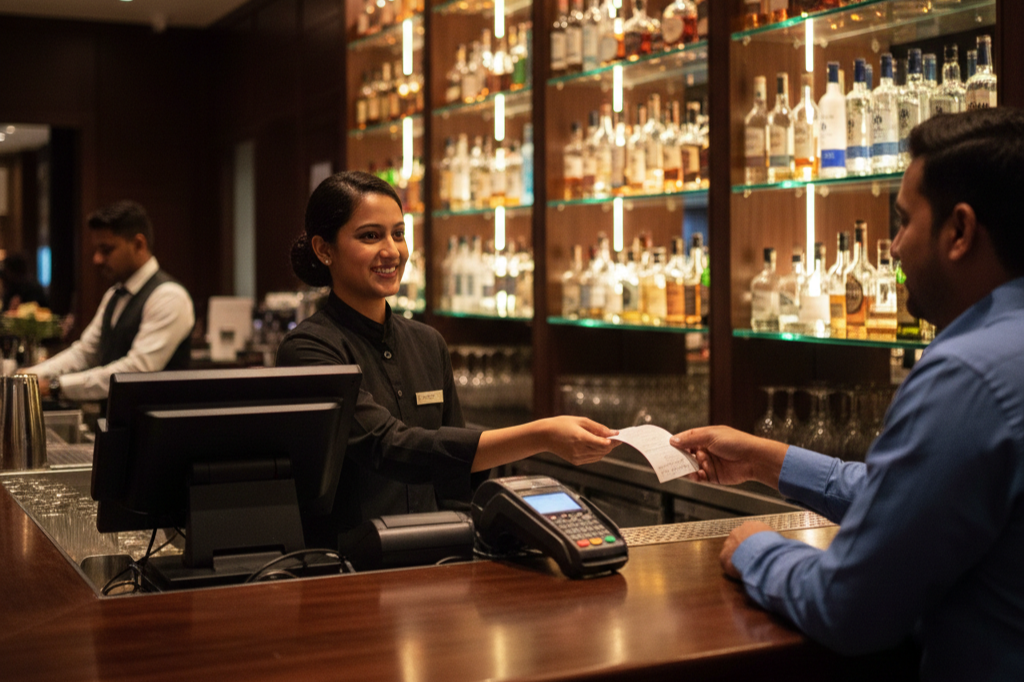
India’s alcohol retail industry is a major contributor to state revenue. The Reserve Bank of India and state budget data show that excise on alcohol accounts for 10-25% of total tax revenue in several states. With rising urban demand and premiumisation, retail operations are becoming more complex. Organised chains and premium brands are reshaping customer expectations. This is the business context for adopting liquor shop software, which is essential for compliance, operational control, and long-term profitability.
Liquor shop software in India’s regulated market
State excise boards have stringent regulations on the alcohol retail business in India. Each bottle must be tracked properly starting from manufacturing and purchase till it gets sold. All states have licensing, reporting formats, tax structures, and compliance plans. Lack of proper record-keeping may attract fines, licence suspensions, and even the closure of businesses.
Systems based on spreadsheets and manual registers cannot keep pace with the growth in regulatory pressure. A discrepancy between the physical inventory and documentation can trigger an audit. Errors in a business with high-value inventory across various tax slabs can be very costly.
Liquor shop software would solve these challenges by:
- Making invoicing automated and tax-compliant.
- State-specific tax structure.
- Barcode-based and batch-level tracking.
- Real-time reporting.
- Audit-ready documentation
As the state collects substantial revenue from alcohol, compliance inspections are becoming more common and evidence-based. Using software can help retailers stay compliant with regulatory requirements and focus on customer service and business growth. Sign up for Mocha Accounting’s liquor shop software to explore how it can add value to your business.
Liquor shop software for accurate billing
Billing is the most visible operational activity in any liquor outlet. Queues form rapidly on weekends, during peak hours, and at festivals due to higher demand. Customers expect both speed and accuracy. Even a slight delay in billing can affect customer satisfaction.
Liquor shop software simplifies billing through barcode scanning, automatic tax calculation, and real-time price updates. Since different alcohol categories are subject to different excise and VAT rates across states, an automated tax engine significantly reduces human error.
Here is how an accurate billing module in a liquor shop software adds value to the business:
- Removes undercharging caused by manual errors.
- Eliminates overcharging, which leads to customer conflicts.
- Provides accurate tax reporting to the authorities.
- Eliminates the need for employees to remember prices.
In a competitive retail market where state pricing standards tightly control margins, preventing billing leakages directly strengthens profitability.
Why liquor shop software is essential for alcohol retailers
The POS software used in liquor stores is not limited to billing. It incorporates hardware (barcode scanners, receipt printers, cash drawers) with a centralised software system.
Unlike generic retail POS systems, liquor-specific systems account for excise structures, minimum selling price norms, and state-specific reporting formats. This would ensure that the software does not require retailers to make manual adjustments to meet regulatory requirements.
The main advantages of the use of POS software in liquor store settings are:
- Pricing updates with centralised control.
- Real-time sales dashboards
- Cash reconciliation shift-wise.
- Role-based access to curb abuse.
- A combination of inventory modules.
Operational efficiency improves when sales data automatically updates inventory records. This eliminates duplicate work and helps reduce reconciliation processing time.
POS software for liquor store efficiency
Customer perception is directly affected by liquor store billing software. Consumers nowadays appreciate speed, transparency, and electronic receipts. Customers in the city, in particular, seek organised shopping experiences similar to those in supermarkets.
Billing software supplements the customer experience by:
- Quick checkout of barcode products.
- Digital invoice generation
- Proper promotional price.
- Combined discount management.
The shorter waiting time translates to increased capacity during high-volume periods, such as Diwali or New Year’s Eve. Shops with an efficient billing system can handle large volumes without disrupting operations.

Liquor store billing software for a better customer experience
Inventory is one of the largest investments in a liquor business. Premium whisky, imported wine, and aged rum involve high procurement costs. Without structured monitoring, shrinkage and internal pilferage can quietly erode margins.
Liquor stock software monitors stock on several levels:
- Brand wise
- Batch wise
- Supplier wise
- Outlet-wise, in the case of chains
Real-time updates ensure that each sale automatically reduces inventory levels. This minimises manual stock-counting errors and prevents mismatches. Automated low-stock alerts reduce missed sales opportunities.
Other benefits of liquor inventory management software are:
- Tracking of the expiry of some products.
- Dead stock identification
- Sales trend-based purchase order planning.
- Reduced physical audit time
By providing complete visibility into stock movements, retailers gain stronger control over capital tied up in inventory.
Liquor inventory management software to prevent stock losses
Alcohol retail POS software is designed with compliance in mind. Excise officers may conduct surprise inspections of stock and billing records. Instant access to organised digital data simplifies compliance verification.
Liquor shop software can generate:
- Daily sales reports
- Brand-wise excise summaries
- Tax collection statements
- Purchase and inwards registers.
- Statements of stock reconciling.
Such records are readily available to retailers within seconds, rather than having to be compiled manually. This reduces stress during inspections and demonstrates operational transparency. For multi-state operators, configurable tax modules allow adaptation to varying state norms. This flexibility is essential for expanding retail chains.
Alcohol retail POS software for compliance and reporting
India is about to shift into premiumisation in alcohol consumption, which is already happening in urban India. Industry reports indicate that premium and super-premium spirits are growing faster than mass-market categories. Single malts, craft gin, and imported wines are among the items consumers are now experimenting with.
This change is helped by wine and spirits shop software, which supports:
- Categorical sales analysis.
- Purchase history tracking of customers.
- Supplier performance management.
- Margin analysis by brand
Retailers can identify high-performing SKUs and allocate shelf space more easily. Evidence-based stocking takes over intuitive stocking. High-end customers will demand customised recommendations. The insights are software-based and help stores recommend products based on buying behaviour, making customers more loyal and more likely to buy again.
Retail POS system for liquor stores with multi-outlet control
For retailers operating multiple branches, manually consolidating sales and stock data becomes cumbersome. A retail POS system for liquor stores centralises information across outlets.
Head office can monitor:
- Outlet-wise daily sales
- Relative performance indicators.
- Price control is centralised.
- Inter outlet inventory change.
- Consolidated tax reporting
Cloud-based deployment ensures real-time access to performance dashboards from any location. This empowers business owners to make faster strategic decisions.
Scalability becomes easier when new outlets can be added without having to build separate reporting systems. Standardised processes maintain consistent compliance and operational efficiency across branches.
Mocha Accounting’s liquor shop software for operational excellence
Mocha Accounting’s liquor shop software is designed specifically to address the practical challenges faced by Indian alcohol retailers. It is not a generic retail tool but a solution tailored for excise-regulated environments.
The software provides:
- Automated excise and tax calculations aligned with state regulations
- Product-level inventory tracking to prevent discrepancies
- Barcode-enabled billing for faster checkout
- Integrated sales and real-time inventory updates
- Detailed audit-ready compliance reports
- Role-based access control to reduce internal misuse
- Purchase and supplier management modules
Retailers are enjoying a single system that has integrated billing, inventory, and compliance into a single ecosystem. This reduces manual reconciliation and minimises errors.
Enhanced reporting provisions can enable businesses to examine sales patterns and busy hours and streamline the procurement process. Increased data visibility helps protect margins and ensure regulatory compliance.
To gain a complete understanding of how Mocha Accounting’s liquor shop software can help your business, check out the pricing plans that it offers and their accompanying features before deciding which plan to go for.
Data insights from liquor shop software
The alcohol retailing business is associated with certain regulatory and financial risks. Non-compliance may lead to monetary consequences. Profits can be silently eroded through shrinkage and internal theft. Pricing errors may harm a business’s reputation. Liquor shop software can help by creating/enforcing:
- Open records of transactions.
- Computerised stock reconciliation.
- Limited access by users.
- Generalised reporting systems.
Businesses that combine their liquor store operations with POS software, inventory, and compliance modules develop a powerful internal control environment.
Consistency and accuracy of the industry would be essential to sustainability. Through technology, operational processes will remain in check despite increased sales volumes.
Conclusion
The alcohol retail business is highly regulated in India, and customer expectations are ever-increasing. Conformity is no bargain, and retailers need to offer faster, more transparent service to stay relevant in urban markets.
Liquor shop software integrates billing, inventory, and reporting into a single streamlined system. It enhances operational control through liquor store billing, liquor inventory management, and alcohol retail POS software. A retail POS solution for liquor stores facilitates effective, compliant, and scalable growth. To learn how Mocha Accounting’s liquor shop software can add value to your business.

Frequently asked questions
1. What is liquor store software, and what are its differences from the liquor store billing software?
Liquor shop software is a unified system that manages billing, inventory, and compliance within a single platform. Liquor store billing software is mainly focused on invoicing and tax calculations, while liquor shop software focuses on liquor store operations and liquor inventory management, with full control.
2. How well is liquor inventory management software compatible with the POS of the retail liquor stores?
The Aliquot-store retail POS system automatically updates stock levels after each sale, using liquor inventory management software. Such integration will ensure real-time tracking, eliminate stock mismatches, and improve the overall performance of the liquor shop software.
3. How important is alcohol retail POS software to the compliance of liquor shops?
The alcohol retail POS software is a computer program that uses digital records for all transactions and integrates data with the liquor shop software. It will help with effective tax reporting, clean sales, compliance, and audit preparedness for alcohol retailers.
4. Can wine and spirits shop software be used to assist my multi-outlet liquor business?
Yes, wine and spirits shop software linked to liquor shop software allows centralised reporting across outlets. In addition to the POS software that will handle operations and liquor inventory for the liquor stores, it will also provide continuous billing, stock tracking, and regulatory compliance across all locations.
5. Why is liquor shop software a better choice over manual accounting?
Liquor shop software will enhance billing speed, automatically calculate taxes, and integrate liquor store billing software and alcohol retail POS software. It also helps track stock, minimise errors, prevent shrinkage, and improve operational efficiency.
Leave a Reply