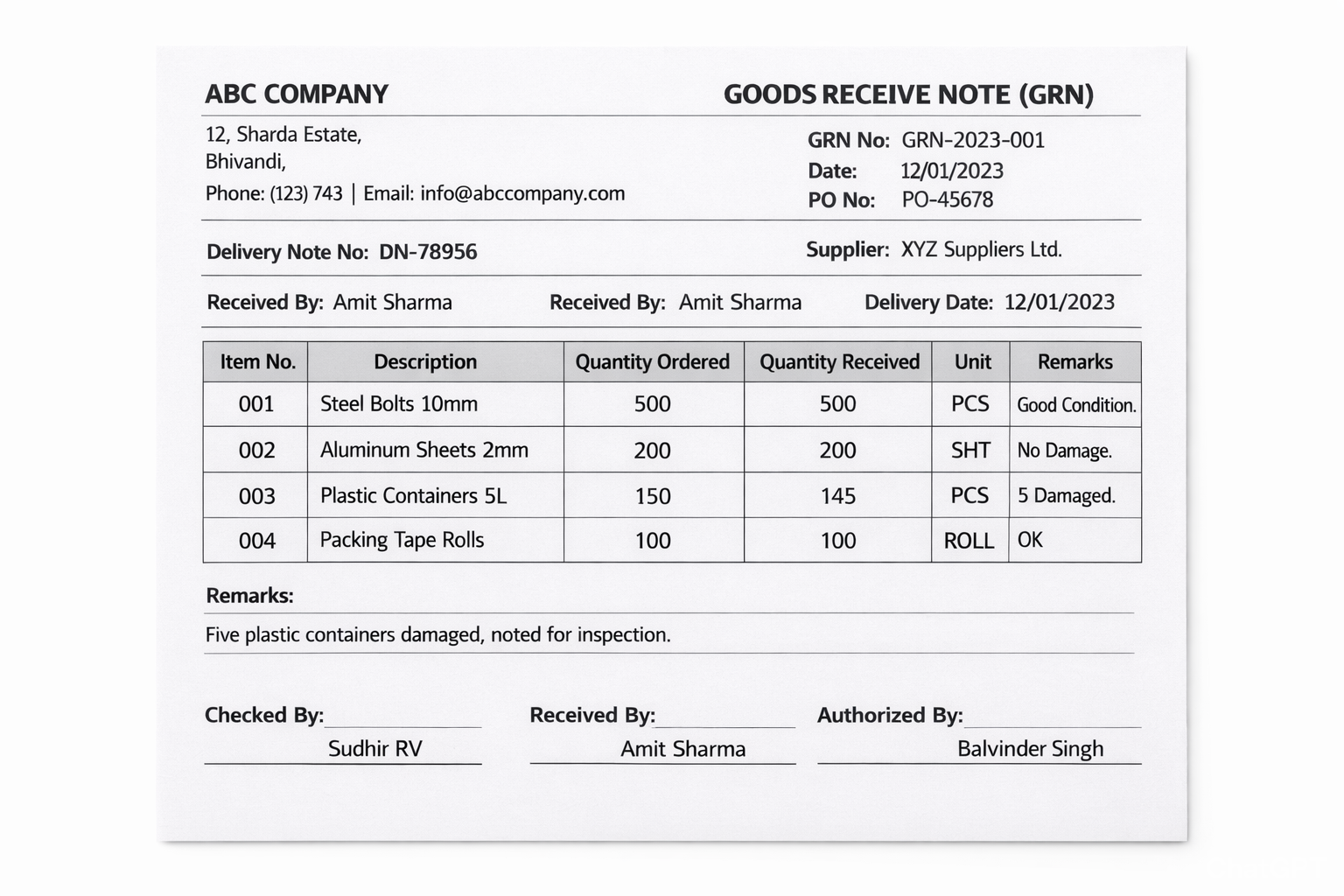
In a country where MSMEs are accustomed to operating with limited working capital, it is essential to keep accurate receiving entries, as inaccuracies may lead to incorrect inventory allocations, incorrect billing, and unapproved allocations. According to the Economic Survey 2025-26, around ₹8.1 lakh crore in MSME payments are pending, underscoring that cash flows are already constrained and further restricted by process gaps. In this scenario, whether you run a retail outlet, warehouse, manufacturing facility, or service organisation that purchases consumables, you need a system to verify what you have received upon delivery. This is where GRN plays its role.
This article will help you understand the GRN full form, what GRN is, and how to implement an efficient GRN process that can minimise disputes and enhance inventory accuracy. During this process, you will also understand how contemporary accounting and inventory management software, such as Mocha Accounting, can make GRN processes more efficient without making receiving a time-consuming, paperwork-intensive exercise.
GRN full form and meaning in simple terms
GRN stands for Goods Received Note. A GRN is the record you create when goods arrive, confirming what you received, in what quantity, and in what condition. GRN is a document that acknowledges delivery and helps the buyer compare the goods delivered with those ordered. This comparison is the heart of the GRN: it is not meant to match the supplier’s invoice; it is meant to match reality. The GRN also becomes your first reliable proof point when something goes wrong, such as shortages, breakage, incorrect items, or missing documentation.
GRN full form in the context of Indian purchasing and GST compliance
In India, discipline matters because it is closely linked to cash flow, compliance, and control. Your supplier invoice may be correct on paper, but if the delivery is short or damaged, paying the full amount creates an immediate loss. A strong GRN system protects you by requiring physical verification before bills are approved and inventory is updated. A Goods Received Note is used to validate supplier invoices and update inventory records, which is exactly what Indian businesses need when volumes rise. GRNs also support more professional record-keeping practices, that help when your accountant needs an audit or an internal check trail. On the GST side, it is worth remembering that a tax invoice is a key document for the receiver to claim input tax credits. A GRN is not a GST document in itself, but it provides the “receipt of goods” proof that finance teams rely on when reconciling purchases, stock, and invoices.
Why the GRN process prevents stock errors, disputes, and delayed payments
Most receiving issues are small, but they become expensive when they repeat. A missing carton today becomes a stockout tomorrow, which then becomes a lost sale, a rushed reorder, and a margin hit. Wrong size or specification results in slow-moving stock that blocks working capital and later requires discounting. A damaged delivery that is not recorded at receipt can turn into a dispute with the supplier weeks later, when no one remembers the goods’ condition. In short, receiving discipline is a habit for protecting profits, not a compliance chore. In the context of Indian MSMEs, where payment delays are already a major constraint, preventing avoidable disputes helps you approve bills faster and maintain better supplier relationships. When you run GRNs regularly, your purchase, stock, and payables records stay in sync, reducing end-of-month reconciliation effort.
GRN process explained step by step for Indian businesses
A good GRN process should be repeatable, fast, and hard to bypass. Begin by referring to the purchase order or purchase request so that the receiver knows what to expect before opening the package. Look for quantities and product identity, including SKU, brand, batch numbers, and any specifications that might affect acceptability. Record condition checks immediately, including damage, leakage, torn packaging, or quality issues that might affect acceptability. Record shortages and overages affect both inventory updates and subsequent invoice matching. Record the key delivery identifiers, including supplier name, challan number or delivery receipt number, tracked vehicle number, and date and time received. Then, submit the GRN for approval and link it to the supplier bill so that payment is made only after the business has accepted the goods.
Here are some checks that make the process better without slowing it down:
- Count using a standard method (piece count, weight, carton count, plus spot check) based on category.
- Separate “accepted” vs “on hold” goods physically if quality verification is pending.
- Photograph the damage at the receiving bay when a dispute is likely.
- Record who received it and who verified it to ensure accountability.
- Update inventory only after acceptance, not when the truck arrives.

GRN full form checklist for buyers, stores, and factories
Although the GRN’s full form is easy to understand, the quality of the GRN depends on the checklist it is based on. In retail, the most important things are often speed, along with accuracy in tasks such as checking quantities, making sure the barcode or label is correct, and quickly sorting items that can be sold from those that are damaged. In manufacturing, the most important things are quality control and making sure that items are sent to the correct storage location. In distribution, the key is variance control, as receiving the wrong items affects downstream customer commitments. In all of these, the most important behaviour is to document exceptions accurately at the time of receipt, rather than waiting until the office. The second behaviour is to ensure that the GRN is associated with a purchase order, thereby assisting three-way matching with the supplier’s invoice. The third behaviour is to store attachments, such as photos or high-quality notes, along with the GRN to facilitate dispute resolution.
Use this simple checklist upon receipt:
- Does the delivery match the item list and quantities from the purchase order?
- Are there any visible damages or packaging issues that require notes or photos?
- Are critical identifiers captured, such as batch, expiry, lot, or variant?
- Is the acceptance status understandable by all stakeholders: accepted, partial, on hold, or rejected?
- Is the GRN routed to accounts for bill matching and payment approval?
Common GRN mistakes Indian businesses make and how to avoid them
Most GRN problems are not technical; they are behavioural.
- The first mistake is creating GRNs after the fact, which makes them nothing more than paperwork.
- The second mistake is writing “received” before the goods have been checked, especially when quality checks are required for certain types of goods.
- The third mistake is accepting deliveries without noting shortages or damage, then raising disputes once the supplier invoice has already been processed.
- Another common issue is failing to link the GRN to a purchase order, which removes the control of three-way matching and makes approvals subjective. Differences in item naming or SKU formats are also common in businesses, making it impossible to rely on reporting.
- Teams also sometimes forget to document partial acceptances, leading to inventory inflation and overstating available stock.
To handle these problems, it is important to keep the process light yet non-negotiable. Train the receiving team to document exceptions right away and establish a standard for documenting variances. Establish a rule that an invoice cannot be approved without a corresponding GRN, except for designated categories that you set. Conduct periodic audits to sample GRNs and verify if variances have been addressed.
How to use GRNs for three-way matching and stricter bill control
Three-way matching is one of the primary reasons GRNs exist. It simply means matching three records before paying a supplier: the purchase order, the GRN, and the supplier invoice. When all three match on item, quantity, and price logic, bill approval is easy. When they do not match, you can quickly determine whether the issue is in ordering, delivery, or billing. This control matters because it prevents overpayment and reduces disputes that delay payments and strain supplier relationships. It also improves inventory accuracy because stock updates follow physical receipt rather than invoice timing. Tally’s explanation of GRN as a primary document for validating supplier invoices aligns directly with the three-way matching concept.
A practical three-way matching routine looks like this:
- Accounts match invoice quantities to GRN accepted quantities, not to ordered quantities.
- Price checks are tied to the purchase order terms or approved vendor rate cards.
- Short supplies trigger either a debit note, a credit note, or a pending adjustment based on your policy.
- Damaged supplies trigger rejection notes or partial acceptance with well-maintained documentation.
- Approval workflow is followed, so the process does not interrupt operations.
GRN full form in software workflows, including Mocha Accounting
The GRN full form is the same regardless of tools, but software makes the workflow faster and more reliable. In a good system, the GRN is not a standalone file that gets lost in email. It is connected to purchase orders, inventory updates, bills, and reporting. This is where Mocha Accounting can help: it supports purchase order workflows that you can quickly create, duplicate, and share, making it very easy to answer the question “what did we order” even before goods arrive. It also supports converting purchase orders into bills, reducing re-entry, and keeping procurement aligned with payables. Inventory tracking with real-time visibility means accepted goods can update stock consistently, while low-stock reminders support smarter reordering. On the finance side, Mocha supports bill reminders, recurring bills where relevant, and bank reconciliation workflows that reduce differences between recorded purchases and actual payments.
GRN process metrics
Once you implement a GRN routine, you should measure it, even lightly. Otherwise, the process will drift back to shortcuts, especially during busy periods. Start with GRN completion rate: how many supplier deliveries have a GRN recorded the same day? Then track the variance rate: how often quantities differ between the purchase order and actual receipt, and how often damages are noted. Measure resolution time: how long it takes to close shortages, replacements, or credit notes after a variance is recorded. Track invoice hold rate: how many invoices are paused due to missing GRNs, because that indicates where the process is breaking. Finally, track stock accuracy signals, such as the frequency of emergency purchases or frequent stockouts on items that “should be available”, because those often indicate receiving or adjustment issues. To understand how Mocha Accounting’s accounting software can add value to your business, check out the various pricing plans and their accompanying features before deciding which one works for you.
Conclusion
The full form of the GRN is Goods Received Note, and its purpose is simple: to record what you received. When you have a smooth GRN process, you avoid stock discrepancies, minimize supplier disputes, and deliver a more controlled bill-approval process. A well-defined GRN process will also help you keep precise inventory records, which is a big help in making purchasing decisions and avoiding dead stock. As you grow your business, it is best to link your GRNs to purchase orders, inventory changes, bills, and reconciliation to ensure receiving is a true control point rather than just an administrative process. To avoid surprises in your inventory or disputes in your bills, and ensure you have strong compliance and auditing records, start by making your GRNs non-negotiable and directly linked to every supplier delivery. Another good practice is to link your accounting software, such as Mocha Accounting, to your business. Click here to schedule a demo today.

Frequently asked questions
1. What is the GRN full form, and why is it used in purchasing?
The GRN full form is Goods Received Note (also called Goods Receipt Note). It is used to confirm what you physically received from a supplier, including quantities and condition, before updating stock and approving bills. This creates a well-documented record for disputes, shortages, and damaged items. It additionally bolsters control because invoices can be verified against what actually arrived rather than just what was ordered.
2. What is the correct GRN process for a small business in India?
A practical GRN process starts by checking the delivery against the purchase order or purchase request, then counting quantities and verifying item details. You should record any shortages, excesses, damage, or mismatches immediately and indicate whether the goods are accepted, partially accepted, or rejected. The GRN is then routed for approval and linked to the supplier bill for invoice matching.
3. How does the GRN process support three-way matching with purchase orders and invoices?
The GRN process makes three-way matching easier by connecting three documents: the purchase order, the GRN, and the supplier invoice. The accounts team can only authorise payment of the invoice once it is aligned with the quantities accepted through the GRN and in accordance with the PO agreement.
4. What should a GRN contain?
A GRN should include header details such as supplier name, PO No., delivery note number, location, and receiver details. It should capture the SKU or item name, the quantity ordered, the quantity received, the quantity accepted, and any variance comments, such as damage or shortages. You can include additional fields for batch number and expiry date if you are dealing with controlled or perishable goods.
5. What are common pitfalls in the GRN document, and how can I avoid them?
One pitfall is generating the GRN document retrospectively, which defeats its purpose as proof. Another is to mark items as “received” without inspecting them, which can give rise to disputes when they are later found to be missing. Another common mistake is failing to link GRNs to purchase orders, which undermines control over invoice approvals. The solution is to ensure that GRN document generation is a same-day activity and that a reference to the GRN document is required prior to approving bills.
Leave a Reply