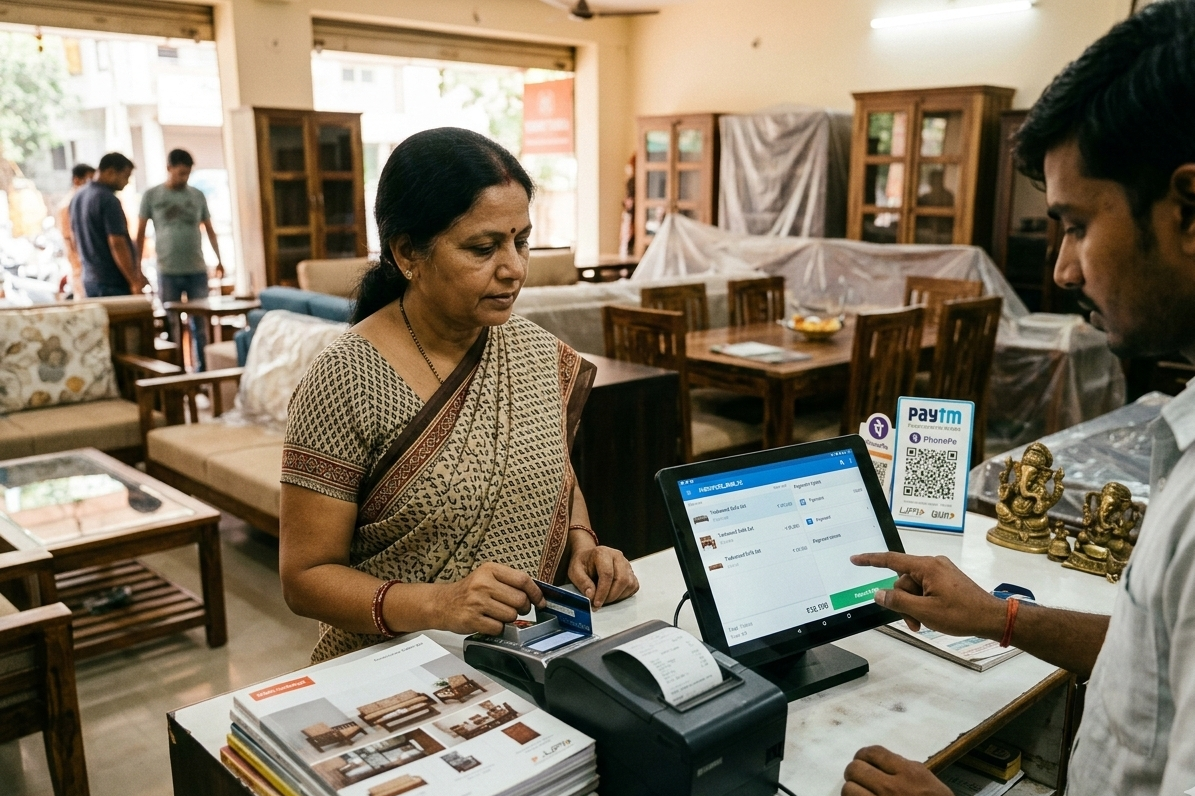
Running a furniture store looks glamorous from the outside.
But behind the scenes? It can get chaotic.
Custom orders and payments are tracked on WhatsApp. GST is calculated manually. A sofa delivery promised a week ago happens today.
Ultimately, you realize that your billing methods and inventory tracking aren’t just outdated. It’s downright risky and can quietly eat into profits. ail
That’s why furniture billing software is a must for modern furniture businesses.
Let’s check what the software is and the practical benefits for small furniture shop owners.
What is furniture billing software?
Furniture billing software is a specialized billing software for furniture shop owners that can handle unique operational transactions. Unlike generic invoicing tools or even manual systems, furniture billing software supports custom orders, made-to-order products, product variants (size, polish, material), and advanced payment tracking. Basically, it can manage the complexity of furniture sales, not just automate its invoicing.
Challenges in Furniture Shop Billing
Many businesses are transitioning from a manual furniture billing system to an automated one supported on the cloud due to the following reasons:
Managing Bulky Variants
You’re not just dealing with a single piece of furniture but with multiple bulky items, each with variants such as fabric, polish, wood type, size, and customization options. Managing these combinations manually, or without proper furniture inventory software, often leads to confusion, incorrect pricing, and the sale of items that are already booked or out of stock.
Manual Billing Errors
Errors in manual billing are more common than we realize. Handwritten invoices or basic spreadsheets increase the risk of calculation mistakes and incorrect GST applications. Delayed invoicing also affects cash flow, especially for high-value furniture orders.
Stock Tracking Gaps
Without proper billing software for furniture shops, businesses struggle to monitor real-time stock movement, reserved items, workshop production status, and raw material consumption. You’re also dealing with large, high-value inventory such as sofas, beds, and wardrobes, which increases risk in the event of mismanaged inventory and billing.
Disconnected Systems
When billing, POS, inventory, and accounting systems don’t integrate with each other, reporting becomes a hassle. You’re spending hours reconciling sales, checking stock manually, and preparing reports instead of activities that actually need your time, such as customer satisfaction and growing the business.
Inventory and billing software for furniture changes many aspects and addresses these challenges in the most efficient way. Here are some of the major differences between a general invoicing tool and a specialized pos system for a furniture store:
| Features | Regular billing software | Furniture billing software |
| Custom order management | Limited or manual | Built-in custom order tracking |
| Product variants | Basic SKU support | Advanced attribute management |
| Raw material tracking | Not supported | Links raw materials to finished goods |
| High-value invoice handling | Standard billing | Optimized for large-ticket sales |
| GST handling for furniture | Standard handling | Configured for furniture-specific GST rates |

Key Features of a Furniture Billing Software
Furniture shop billing and invoicing tools are meant to handle the end-to-end operational flow of a furniture store. Below are the core features furniture retailers should look out for:
POS Integration
A furniture store’s billing counter is capable of handling volume and large transactions quickly and accurately. A Point of Sale furniture system for retail ensures every sale is processed smoothly. Its key functions include:
- Quick product selection via SKU or barcode
- Automatic price and GST calculation
- Multiple payment modes (cash, card, UPI, credit)
- Split and partial payment handling
- Instant invoice and receipt generation
- Real-time inventory updates after billing
Inventory Tracking
This is probably the best part of automating furniture billing. Managing furniture inventory is rarely simple. Products differ by size, wood type, polish, upholstery, and customization, making structured stock management essential. An automated billing system for furniture retailers can:
- Track items by type, size, material, polish, and category
- Provide real-time stock updates after each sale
- Separate tracking for reserved and custom orders
- Monitor inward and outward stock movement
- Link raw materials to finished goods
Automated Invoicing
Furniture shop billing and retailing must comply with GST regulations while handling discounts, advance payments, and high-value invoices. With furniture store POS software, you can expect:
- Auto-calculation of CGST, SGST, and IGST
- Predefined tax settings by product category
- Configurable discounts and pricing rules
- Sequential invoice numbering
- Digital invoice storage
- Credit and debit note generation
Multi-store Support
If you’re a mid-sized furniture retailer, chances are you have multiple stores and need to consolidate billing in a single space. With multi-store support feature, you get:
- Centralized management of multiple stores
- Real-time stock visibility across locations
- Counter-wise billing management
- Role-based user access
- Unified monitoring dashboard
Sales Analytics
Understanding sales patterns is a must for managing high-ticket inventory and seasonal demand fluctuations. With this feature, you get:
- Daily, weekly, and monthly sales reports
- Product-wise and category-wise performance tracking
- Pending order summaries
- Revenue dashboards
- Exportable data reports
Accounting Integration
Your billing system must stay aligned to avoid reconciliation and manual duplication errors. With this feature, you can expect:
- Automatic syncing of invoices to ledgers
- Receivables and payables tracking
- Reduced manual data entry
- Financial summary reports
- Integration with external accounting software
Use-cases of POS system of a furniture store
Furniture billing software is built to accommodate the diverse operational structures within the industry. It supports streamlined billing while enabling accurate stock and sales tracking for furniture stores. Here are its prime use-cases:
- For retail showrooms, it manages counter sales, product variants, advance payments, and synchronised stock.
- Furniture manufacturers use the tool to connect sales orders with raw material movement, track production progress, and link completed goods directly to invoicing.
- Modular kitchen and customized furniture businesses use it to generate measurement-based quotations, record design-specific orders, and manage staged payment collections.
- Corporate and office furniture suppliers use a furniture billing system to handle high-volume transactions, varied tax structures, and contract-based billing cycles.
- Custom woodworking units use it to add project-specific requirements, monitor material usage, and maintain job-level cost records.
Benefits of Using Furniture Billing Software
Below are the key benefits retailers and manufacturers can expect:
Faster Checkout
The system frees up billing in more ways than one. You’re not just generating invoices, but also looking at automated price calculations and tax applications. Large-ticket transactions and split payments can easily be processed, thereby reducing the wait time at the counter.
Additionally, as research suggests, more customers in India are shifting toward online furniture purchases. In that case, businesses need systems that can support digital sales channels. A cloud billing solution enables seamless payment processing and instant invoice generation, ensuring smooth transactions whether the sale happens in-store or online.
Real-time Inventory Control
Every sale automatically updates stock levels and helps businesses monitor available, reserved, and in-production items. This improves stock visibility and reduces the chances of overselling.
Automated Financial Reporting
Sales data flows directly into financial records. This enables accurate revenue summaries, tax reports, and performance tracking without manual compilation.
Reduced Operational Errors
Automation minimizes calculation mistakes, duplicate entries, and data inconsistencies, leading to smoother day-to-day operations.
Scalable Growth Support
The software supports multi-store management, centralized monitoring, and system expansion as the business grows.
Choosing Mocha Accounting for your Furniture Store
Manual systems can restrict the growth of modern furniture businesses. With Mocha Accounting, you can manage invoicing, inventory, payments, and financial reporting for your furniture store in one centralized system. Our cloud accounting and billing platform simplifies operations while supporting long-term growth.

Frequently Asked Questions
1.What is furniture billing software, and how does it work?
Furniture billing software is a specialized system designed to manage invoicing, inventory, payments, and reporting for furniture businesses. It records sales, automatically updates stock, calculates taxes, and stores transaction data digitally on one platform.
2.Can furniture POS systems track inventory by item type and size?
Yes. Advanced systems track products by category, dimensions, material, polish, and other variants, ensuring accurate stock visibility.
3.How does billing software integrate with accounting systems?
Furniture billing software integrates with accounting systems via built-in connectors or APIs, securely transferring sales, tax, payment, and invoice data in real time or at scheduled intervals.
4.Is furniture billing software GST-compliant?
Yes, most systems generate GST-ready invoices with automated tax calculations.
5.How does software help improve sales tracking and reporting?
Furniture billing systems provide structured reports, dashboards, and performance summaries for better decision-making.
Leave a Reply