If you’ve tried cobbling together spreadsheets, QuickBooks, and a prayer, you know that property management accounting has unique challenges that generic tools can’t solve.
Property-specific accounting software handles all kinds of things that are unique to property management, including:
- Trust accounting
- Owner distributions
- 1099 filings
- and the dozens of other financial tasks that come with managing rental properties and HOAs
The right platform saves you hours every month, reduces errors, and gives property owners the transparency they expect.
This guide compares the 10 best property management accounting software platforms in 2025, including our own all-in-one tool, Mocha Manage, designed to be both simple and easy to use yet surprisingly resourceful.
We’ll pit it against the best tools in the space and break down what each tool does well, where it falls short, and which one makes the most sense for your portfolio size and management style.
How We Evaluated Property Management Accounting Software
We’ve reviewed each platform on the following criteria:
- Accounting accuracy and compliance: Does it handle trust accounting correctly? Can it generate audit-ready financial statements?
- Property-level reporting: Can you track finances by property, unit, owner, and portfolio?
- Integration capabilities: Does it connect to rent collection, maintenance management, and banking?
- Ease of use: Can someone without an accounting background navigate it?
- Owner reporting: Can you generate clear, professional owner statements?
- Scalability: Will it work for 5 units? 500 units?
- Support quality: When you have a question, can you get help?
Below, we’ll touch briefly on property management-related features. However, as the name suggests, this guide focuses primarily on property management accounting.
For that reason, our comparison and breakdown will focus on accounting-related features.
Disclosure: The guide below includes our own property accounting tool, Mocha Manage.
Mocha Manage was designed by seasoned CPAs and property managers, with the mission to deliver an experience that actually fulfills the accounting needs of landlords and property managers.

Instead of a bloated collection of tools that are hard to navigate or are missing core features, we wanted to deliver something streamlined, easy to use, yet all-encompassing.
With that said, the guide below is meant to be as unbiased as possible and provide the software listed in a fair light so that you have several options to choose from.
10 Best Property Management Accounting Software [Updated for 2026]
Here are the 10 best property management accounting software platforms, compared head-to-head.
1. Buildium – Best for Mid to Larger Portfolios

Buildium is the industry standard for professional property management.
It’s what you use when you’re managing 50+ units and need a platform that can handle trust accounting, owner distributions, and everything else without breaking.
Best For: Professional property managers with 20-200+ units
Key Features
- Complete property management and accounting platform with trust accounting for property managers and owner portal with automated financial statements
- Rent collection with payment processing, tenant and lease management, and maintenance work order system
- Financial reporting with customizable reports, budget tracking, and owner accounting
Pros
- Industry-standard platform used by thousands of professional property managers
- Comprehensive feature set covers every aspect of property management
- Excellent reporting and owner accounting capabilities
- Strong customer support with phone and chat options
Cons
- Can be complex for smaller landlords or self-managed properties
- Setup fees charged for each bank account used for online payments
- Phone support only included in higher-tier plans
Pricing

Starts at $58/month for up to 20 units; scales with portfolio size
2. AppFolio – Best for Large Portfolios with Complex Needs

AppFolio is built for property management companies managing hundreds of units across multiple properties.
It’s powerful, comprehensive, and designed for teams, not solo landlords.
Best For: Large property management companies with 100+ units
Key Features
- Comprehensive property management platform with advanced accounting tools and automated workflows
- Owner and investor portals with real-time financial access, plus smart bill entry that learns from approval patterns
- Utility management and billing integration with robust financial reporting and customizable dashboards
Pros
- Excellent for managing large portfolios with complex accounting needs
- Strong automation features reduce manual work
- Intuitive modern interface with mobile app
- Great reporting capabilities with real-time data
Cons
- Expensive, especially with add-ons
- May be overkill for smaller portfolios
- Less customizable than some competitors for unique accounting workflows
Pricing

Custom pricing (typically starts around $1.40 per unit/month)
3. DoorLoop – Best for Small Landlords

DoorLoop positions itself as the easy-to-use alternative to Buildium and AppFolio.
It delivers professional-grade features without the complexity or steep learning curve.
Best For: Property managers with 10-100 units who want professional features without complexity
Key Features
- Full accounting suite with automated rent collection, payment processing, and bank reconciliation
- Owner and tenant portals for self-service access, plus maintenance management with work orders and vendor tracking
- Lease management with e-signatures and financial reporting with customizable reports
Pros
- User-friendly interface that’s easier to learn than Buildium or AppFolio
- Comprehensive features at a competitive price point
- Good customer support and onboarding process
- Regular feature updates and improvements
Cons
- Newer platform with smaller user base than established competitors
- Some advanced features may require higher-tier plans
- Integration ecosystem not as robust as Buildium or AppFolio
Pricing

Starts at $69/month for up to 20 units
4. TenantCloud – Best Budget-Friendly Option

TenantCloud offers a surprisingly robust free plan for landlords just getting started.
The paid plans add accounting features that compete with platforms costing 2-3x more.
Best For: Landlords with 1-20 units looking for affordable property management accounting
Key Features
- Free plan with basic property management and accounting tools
- Paid plans add automated rent collection, financial reporting, and tenant screening
- Online rent collection with accounting tools for tracking income and expenses
Pros
- Free plan is genuinely useful for small landlords
- Affordable paid plans with good feature sets
- Easy to use with minimal learning curve
- Good mobile app for managing on the go
Cons
- Limited advanced accounting features compared to premium platforms
- Financial reporting not as comprehensive as Buildium or Mocha
- Customer support limited on free plan
Pricing

Free plan available; paid plans start at $18/month per property
5. Landlord Studio – Best for Real Estate Investors

Landlord Studio is built for real estate investors who need accurate accounting for tax purposes.
It focuses on income and expense tracking, Schedule E preparation, and financial analytics.
Best For: Real estate investors with 1-30 properties focused on tax compliance
Key Features
- Real estate-specific accounting with automated expense categorization and receipt scanning
- Bank account integration with automatic transaction import and Schedule E report generation
- Property-level financial tracking with rent collection and automated reminders
Pros
- Excellent for real estate investors focused on tax compliance
- Receipt scanning and mileage tracking for complete expense documentation
- Clean interface with strong financial analytics
- More affordable than full-service property management platforms
Cons
- Limited tenant management and lease tracking compared to comprehensive platforms
- Not designed for property managers serving third-party owners
- Maintenance management features are basic
Pricing

Starts at $15/month for up to 5 units; scales with portfolio size
6. Yardi Breeze – Best for Commercial Properties

Yardi Breeze is the simplified version of Yardi Voyager, the enterprise platform used by major commercial property management companies.
It brings commercial-grade accounting to smaller portfolios.
Best For: Commercial property managers with 5-100 units
Key Features
- Commercial property management with lease tracking, CAM reconciliation, and tenant billing
- Accounting suite with GL accounting, accounts payable/receivable, and financial reporting
- Property and lease management with tenant and owner portals for self-service access
Pros
- Built for commercial properties with complex lease structures
- Strong accounting capabilities with full GL functionality
- Backed by Yardi’s reputation in commercial property management
- Scalable from small portfolios to larger operations
Cons
- More expensive than residential-focused platforms
- Can be overkill for residential properties
- Steeper learning curve than user-friendly alternatives
Pricing

Starts at $100/month for basic features minimum, while their premier plan is a whopping $400/month.
7. QuickBooks Online – Best Generic Accounting Platform

QuickBooks Online isn’t built for property management, but it’s what many landlords use because they’re already familiar with it.
With the right setup and add-ons, it can work for property accounting.
Best For: Landlords with 1-10 properties who want to use familiar accounting software
Key Features
- General business accounting with income and expense tracking, invoicing, and bill payment
- Bank integration with automatic transaction download and class tracking to separate different properties
- Financial reporting with customizable P&L, balance sheet, and cash flow statements
Pros
- Widely used platform with extensive resources and support
- Integrates with many property management apps
- Powerful reporting and customization capabilities
- Can handle both property accounting and personal/business finances
Cons
- Not designed for property management—requires workarounds for trust accounting, owner distributions, and property-specific needs
- No native property or unit tracking
- Requires additional apps for rent collection, maintenance, and tenant management
Pricing

Starts at $35/month for Simple Start; Advanced plan at $235/month
8. Rentec Direct – Best for Self-Managing Landlords

Rentec Direct focuses on landlords who self-manage their properties and need straightforward accounting without enterprise complexity.
Best For: Self-managing landlords with 5-50 units
Key Features
- Property accounting with income and expense tracking by property and unit
- Rent collection with online payments, tenant and lease management, and maintenance work orders
- Financial reporting including tax-ready reports and owner statements
Pros
- Designed specifically for landlords, not property management companies
- Good balance of features without overwhelming complexity
- Affordable pricing for small to medium portfolios
- Solid customer support and training resources
Cons
- Less robust than Buildium or AppFolio for professional property managers
- Limited advanced accounting features
- Interface feels dated compared to newer platforms
Pricing

Starts at $45/month for up to 10 units; Pro plan at $90/month for 50 units
9. Hemlane – Best Free Plan for Small Landlords

Hemlane offers a genuinely useful free plan with unlimited properties.
The paid plans add features like rent collection and full accounting, but the free tier is perfect for DIY landlords just starting out.
Best For: Small landlords with 1-5 properties looking for free accounting
Key Features
- Free plan with unlimited properties and basic accounting
- Paid plans add rent collection, tenant screening, and advanced reporting
- Property accounting with income and expense tracking, plus maintenance and tenant management
Pros
- Free plan includes unlimited properties, which is rare
- Easy to use for landlords new to property management software
- Good upgrade path as your portfolio grows
- Solid feature set even on free plan
Cons
- Free plan requires connecting a financial institution to each property
- Advanced features like rent collection require paid plans
- Not designed for professional property managers
Pricing

Free plan available; paid plans start at $30/month.
10. Mocha Manage – Best All-in-One for Property Managers and HOAs
Mocha Manage is purpose-built for property managers and HOA boards who need accounting that actually works for their business.
Not QuickBooks with workarounds. Not a maintenance app with basic bookkeeping tacked on.
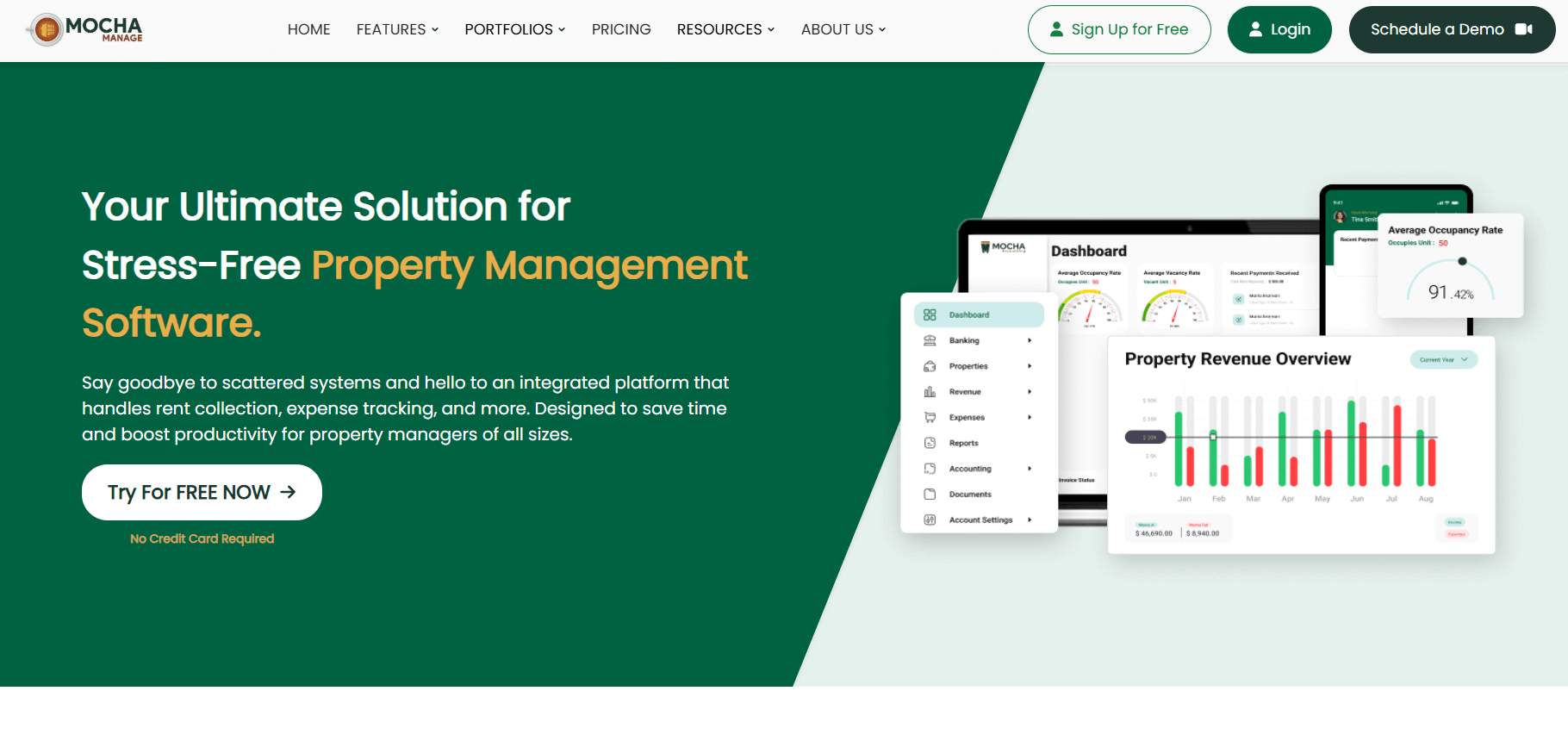
Real property management accounting is integrated with the tools you use every day, from real-time accounting insights that deliver a 360-degree view of your portfolio to automation that makes your job easier from start to finish.
Best For: Property managers with 5-50+ units, HOA boards, community associations
Key Features
- Complete property accounting with real-time dashboards showing cash flow, income, and expenses broken down by property, unit, and owner. Native fields for property-specific transactions—no forcing real estate data into generic business accounting categories.
- Trust accounting compliance with separate tracking for security deposits, owner funds, and operating accounts. Built-in safeguards ensure you’re always compliant with state regulations.
- Owner statements and distributions generated automatically with transparent calculations showing management fees, expenses, and net owner earnings. Schedule automatic distributions or approve manually.
- Automated rent collection with recurring billing, late fee automation, and bank integration. Payments automatically post to the right units and sync with your accounting records.
- Maintenance tracking integrated with accounting so work orders, vendor invoices, and expenses are connected to the properties they belong to. No more reconciling three different systems.
- Financial reporting designed for property owners and HOA boards—balance sheets, P&L statements, cash flow reports, budget variance analysis, all customizable by property or portfolio.
- 1099 filing automation for contractors and vendors with year-round payment tracking.
Pros
- Purpose-built for property management and HOA accounting with features that match how you actually work.
- All-in-one platform eliminates the need for QuickBooks plus separate apps for rent collection, maintenance, and owner communication.
- Clean, intuitive interface that doesn’t require accounting training to use.
- Excellent customer support with property management expertise.
- Strong focus on compliance and audit-ready records.
Cons
- Not as robust a feature set as some more comprehensive tools
Pricing

Mocha offers one of the most affordable plans on our list, coming in at just $1 per property with no minimums.
And unlike other property accounting tools, you get the lion’s share of features just from the basic plan.
How to Choose the Right Property Management Accounting Software
Here’s how to evaluate what your situation actually needs.
If you manage 1-5 properties and want to minimize costs
Consider starting with platforms that offer free plans or low monthly fees. At this scale, you need basic income and expense tracking, but probably don’t need advanced features like trust accounting or owner distributions. Look for software that’s simple to set up and doesn’t require extensive training.
Key features to prioritize:
- Basic income and expense tracking by property
- Bank account integration
- Simple financial reporting
- Online rent collection (or integration with payment processors)
- Reasonable pricing for small portfolios
If you’re a real estate investor focused on tax preparation
Your priority is accurate record-keeping that makes tax season easier. Look for platforms built specifically for real estate investors rather than property managers.
Key features to prioritize:
- Automated expense categorization
- Receipt scanning and documentation
- Schedule E report generation
- Property-level P&L statements
- Mileage tracking for property visits
- Clear audit trail for tax compliance
If you manage 5-50 units and need comprehensive accounting
This is where purpose-built property management accounting becomes critical. You’re dealing with enough complexity that generic tools create more work than they save. Mocha Manage is designed specifically for this range—comprehensive enough to handle trust accounting and owner distributions, but not so enterprise-focused that it’s overwhelming.
Key features to prioritize:
- Property-level and unit-level tracking
- Trust accounting compliance
- Owner statement generation
- Integrated rent collection and maintenance management
- Automated 1099 preparation
- Real-time financial dashboards
- Bank reconciliation tools
If you’re a professional property manager with 20-200 units
You need industrial-strength accounting that can handle multiple owners, complex distributions, and detailed reporting. Look for platforms used by professional management companies with robust support and comprehensive feature sets.
Key features to prioritize:
- Multi-entity accounting and reporting
- Advanced trust accounting with audit trails
- Owner portal with self-service financial access
- Vendor management and AP automation
- Budget vs. actual tracking
- Custom financial reporting
- Integration with other business systems
If you manage 100+ units or commercial properties
At enterprise scale, you need platforms designed for teams and complex workflows. For commercial properties, look specifically for software that handles CAM reconciliation, percentage rent, and complex lease structures.
Key features to prioritize:
- Scalable architecture that won’t slow down with volume
- Advanced automation to reduce manual work
- Comprehensive user permissions and controls
- GL accounting capabilities
- API access for custom integrations
- Dedicated account management and support
If you already use QuickBooks for other business accounting
QuickBooks can work for property accounting if you’re comfortable with workarounds and adding third-party integrations. However, be realistic about whether retrofitting a general business tool is actually easier than adopting purpose-built software.
Consider this option if:
- You have only a few properties
- You’re already proficient in QuickBooks
- You’re willing to use class tracking and manual processes for property-specific needs
- You don’t need trust accounting compliance
Skip this option if:
- You manage properties for third-party owners
- You need trust accounting
- You want integrated rent collection and maintenance management
- You’re tired of juggling multiple systems
The right choice depends on your portfolio size, whether you manage for others or yourself, and how much accounting complexity you’re willing to handle.
What Property Management Accounting Software Should Include
Before you commit to a platform, make sure it has these essential features:
1. Property-level accounting
You need to track income and expenses by property, not just in one consolidated account. Look for software that lets you generate property-specific P&L statements, balance sheets, and cash flow reports.
2. Trust accounting
If you manage properties for others, you’re legally required to keep tenant deposits and owner funds separate from your operating accounts. Your software should have built-in trust accounting with clear audit trails.
3. Owner reporting
Owners want to see detailed financial statements showing exactly how their property performed. Your software should generate professional owner statements that break down income, expenses, management fees, and distributions.
4. Rent collection integration
Manual rent collection creates errors and delays. Your accounting software should connect to automated rent collection tools so payments are recorded instantly and applied to the correct units.
5. 1099 preparation
At tax time, you need to send 1099 forms to contractors and vendors. The right software tracks these payments all year and automates 1099 filing.
6. Bank reconciliation
Your software should connect to your bank accounts and automatically import transactions for easy reconciliation. This saves hours every month and reduces errors.
7. Customizable chart of accounts
Property accounting uses different categories than other businesses. Your software should come with a pre-configured chart of accounts designed for rental properties and HOAs.
8. Multi-property reporting
If you manage multiple properties, you need the ability to run reports across your entire portfolio or drill down into individual properties.
Take Control of Your Property Management Accounting
The right accounting software transforms how you manage properties.
You save hundreds of hours every year. You generate owner statements in minutes instead of hours. You catch errors before they become compliance issues.
But many property management platforms have become bloated with features you’ll never use, confusing interfaces that require extensive training, and rigid systems that don’t adapt to how you actually work.
Mocha Manage offers a comprehensive solution that eliminates the complexity.
Property accounting and management in one integrated platform. Built specifically for property managers and HOAs. Clean interface. Powerful features. No QuickBooks workarounds needed.
- Say goodbye to scattered systems. No more juggling QuickBooks for accounting, one app for rent collection, another for maintenance tracking, and spreadsheets to tie it all together. Mocha Manage is your all-in-one integrated platform designed specifically for property managers and landlords.
- Get a 360° view of your property portfolio. Real-time dashboards show exactly where your finances stand—property by property, unit by unit. Make informed, data-backed decisions with intuitive reporting tools that actually make sense for property management.
- Built for property managers, not adapted from business tools. Native property and tenant fields. Trust accounting compliance built in. Automated owner distributions. Maintenance tracking from request to resolution. 1099 filing automation. Everything property managers actually need, without the workarounds.
- Designed to save time and boost productivity for property managers of all sizes—whether you’re managing 5 units or 500+, residential or HOA, single properties or entire portfolios.
Try Mocha Manage for free to see how it can simplify your property management accounting.
Leave a Reply