Key Takeaways
- The best condo accounting software handles fund-based financials (operating, reserve, and special assessment funds) natively, not as a workaround
- Platforms built specifically for community associations outperform general property management tools when it comes to condo-specific accounting like assessment tracking, reserve fund management, and compliance reporting
- Pricing ranges from free (PayHOA) to enterprise custom quotes (CINC Systems, Vantaca). What you pay depends on your portfolio size and how much accounting depth you need
- Look for native accounting, owner portals, fund-based reporting, violation tracking, and transparent pricing as must-have features
- All-in-one platforms like Mocha Manage eliminate the need to pair a separate accounting tool with your management software
Condo accounting isn’t like regular bookkeeping.
You’re tracking assessments from hundreds of unit owners. Managing an operating fund and a reserve fund that can never touch each other. Collecting special assessments for a roof replacement that’s three years out. Running financial statements that satisfy both the board and the auditor.
Keep in mind, most general accounting software wasn’t built for this. And a lot of property management software treats condo financials as an afterthought, bolting on basic accounting features designed for rental portfolios and hoping nobody notices the gaps.
The platforms on this list were evaluated specifically for how well they handle condo and community association accounting. Not general property management. Not rental-first tools with HOA features added later. Condo accounting.
Here’s what we found.
How We Evaluated
We looked at each platform through the lens of what condo associations and their management companies actually need from accounting software.
That means fund-based accounting (operating, reserve, and special assessment funds tracked separately), assessment billing and collection, AP/AR management, financial reporting that meets board and audit requirements, and owner portals where homeowners can view their accounts and make payments.
We also weighed pricing transparency, ease of use, implementation timeline, and how well each platform serves both self-managed condo boards and professional management companies.
Disclosure: Mocha Manage publishes this blog. We included ourselves on this list because we genuinely believe we belong here, but we also included platforms that compete directly with us. Our goal is to help you find the right fit, even if that’s not us.
8 Best Condo Accounting Software for HOAs and Management Companies (2026 Edition)
Below are our picks for the top condo accounting software of 2026.
Each pick is evaluated based on the above criteria, with some being more comprehensive options and others being dedicated more uniquely to one or more key features.
Here are our top picks for the best condo accounting software:
1. CINC Systems

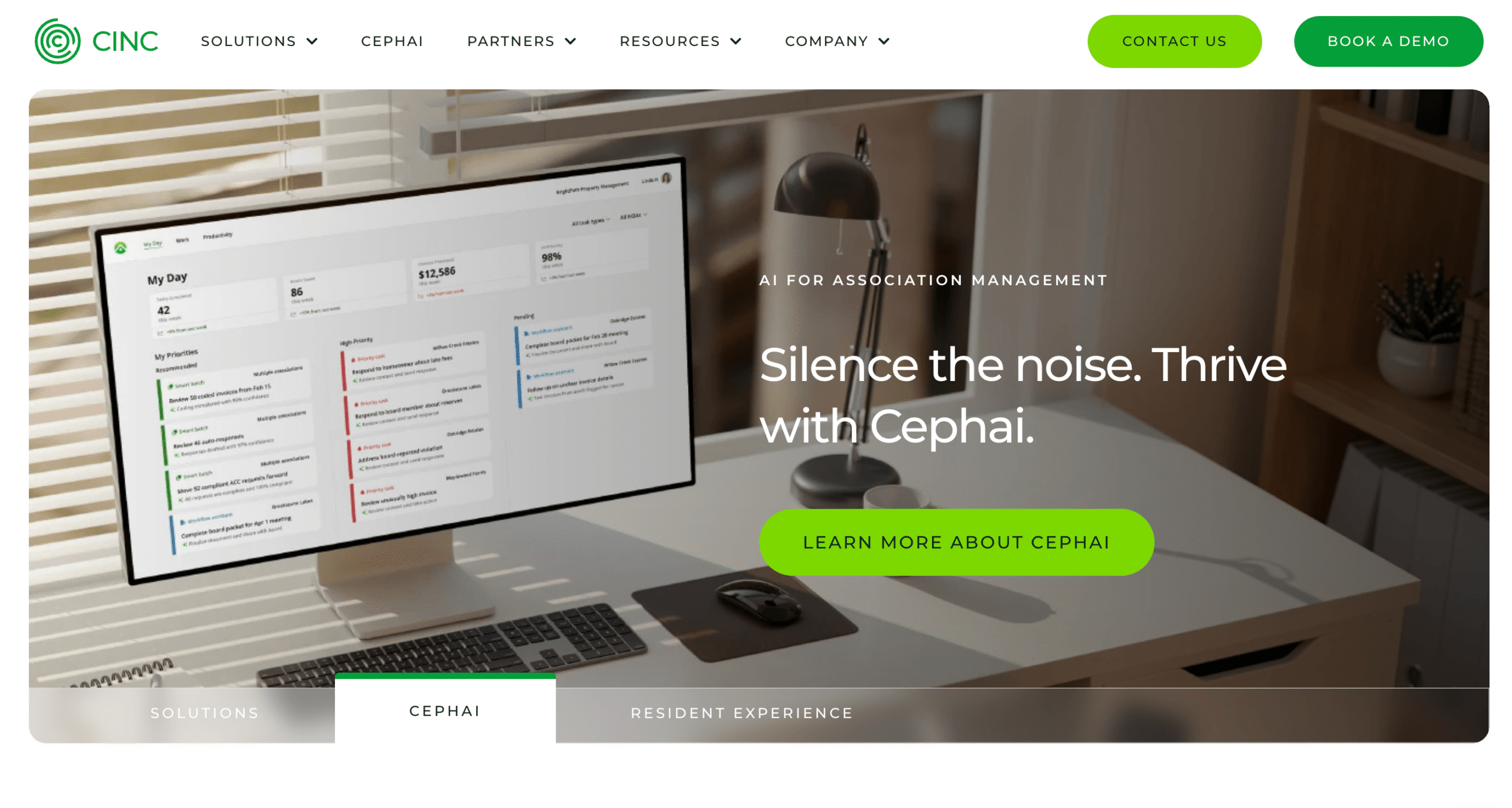
CINC Systems is an enterprise-grade platform built exclusively for community association management companies.
The accounting is strong, including general ledger, AP/AR, bank reconciliation, assessment billing, delinquency management, budget creation, and financial reporting are all native to the platform. CINC handles fund-based accounting natively, which matters for condos tracking operating and reserve funds separately.
The platform also includes violation management, architectural review workflows, a homeowner portal, and vendor management. It integrates with lockbox services for payment processing and supports ACH, credit card, and check payments.
Best For
Large management companies running 50+ condo associations. CINC is built for scale, not for a single self-managed board.
Key Features
- Native fund-based accounting with general ledger and bank reconciliation
- Automated assessment billing and delinquency management
- Budget creation and variance reporting
- Homeowner portal for payments and account access
- Violation tracking and architectural review workflows
- Lockbox integration and multiple payment methods
- Reporting suite designed for board packages and audits
Pricing
Custom quotes only. CINC doesn’t publish pricing. Expect enterprise-level costs, typically $1.50-$2.50 per unit/month with minimums in the $150-$300/month range.
Pros
- Purpose-built for community association management
- Deep, native accounting designed for fund-based financials
- Strong delinquency and collections tools
- Scales well for large management company portfolios
- Integrates with lockbox and banking services
Cons
- No transparent pricing
- Overkill for self-managed condos or small boards
- Steep learning curve for new users
- Enterprise pricing puts it out of reach for smaller operations
2. Condo Control

Condo Control is a communication and operations platform for condos and HOAs, founded in 2008 in Toronto. It handles amenity booking, service requests, package tracking, announcements, and security tools well.
The catch: Condo Control does not include native accounting. For financials, you need to connect it with QuickBooks, Yardi, or another external accounting tool through an integration. That means you’re running two systems and paying two subscriptions to cover what some platforms handle in one.
Having said that, for condos where accounting is managed separately by a bookkeeper or management company, this split might not matter. For boards where the treasurer handles both operations and finances, it’s a real gap.
Best For
Mid-to-large condos and high-rises that need strong communication and amenity management tools. Best when paired with a separate accounting solution.
Key Features
- Announcements via email, text, and voice
- Amenity booking and event management
- Service request tracking
- Package tracking and front desk tools
- Security console with incident reporting and visitor management
- Resident portal and mobile app
- AI assistant for announcements and resident Q&A
- QuickBooks and Yardi integrations for accounting
Pricing
Custom quotes across three tiers (Standard, Modern, and Premium Living). Third-party sources suggest plans start around $49/month plus setup fees.
Pros
- Excellent communication and amenity booking tools
- Strong customer support with fast response times
- Purpose-built for condos (not adapted from rental software)
- Regular product updates based on user feedback
- Security and concierge tools are a real differentiator for high-rises
Cons
- No native accounting (requires QuickBooks or another external tool)
- Custom pricing with setup fees
- Learning curve steeper than expected for new users
- Search and navigation can feel clunky in certain modules
3. Buildium

Buildium is a cloud-based property management platform owned by RealPage. It serves a mixed audience of rental property managers and community associations, with accounting tools that include a general ledger, AP/AR, bank reconciliation, and financial reporting.
For condos, Buildium offers assessment tracking, violation management, resident portals, and board member tools. The accounting is capable, though the platform’s roots are in rental property management, and some condo-specific workflows (like fund-based reserve tracking) require manual configuration.
Best For
Management companies that handle both rental properties and condo associations in one portfolio.
Key Features
- General ledger accounting with bank reconciliation
- Assessment billing and online payment collection
- Resident and owner portals
- Violation tracking and architectural review requests
- Maintenance management and work orders
- Financial reporting and budget tools
- Integration with RealPage ecosystem
Pricing
Starts at approximately $62/month (Essential plan). Growth and Premium tiers add features like advanced reporting and custom branding. Per-unit pricing applies for larger portfolios.
Pros
- Strong accounting with built-in general ledger
- Handles mixed portfolios (rentals + condos) in one platform
- Good financial reporting and budget vs. actual tools
- Resident portals for payments and document access
- Responsive customer support
Cons
- Rental-first DNA means some condo workflows feel adapted, not native
- Fund-based reserve tracking requires manual setup
- Premium features locked behind higher-priced tiers
- Interface can feel dated compared to newer platforms
- Learning curve for full feature adoption
4. Vantaca

Vantaca is a VC-backed enterprise platform built exclusively for community association management. It raised $300 million in 2025 and is valued at $1.25 billion. The platform includes native accounting, workflow automation, AI tools (HOAi), analytics (Vantaca IQ), and homeowner portals.
The accounting is strong: AP/AR, bank reconciliation, assessment billing, budgeting, and real-time financial reporting. Vantaca’s “Action Items” feature automates repetitive tasks across billing, violations, and approvals, which management companies running large portfolios value highly.
Best For
Mid-to-large management companies managing 500+ doors that need enterprise automation and deep accounting.
Key Features
- Native fund-based accounting with bank reconciliation
- Automated workflow engine (“Action Items”) for billing, violations, and approvals
- HOAi (AI-powered assistant for communications, invoices, and homeowner Q&A)
- Vantaca IQ analytics dashboard
- Homeowner and board portals
- Vendor management and insurance tracking
- Managed accounting services available as an add-on
Pricing
Custom quotes only. Reviewers describe it as expensive. Third-party sources estimate pricing in the $10-$100/month range depending on portfolio size and modules.
Pros
- Purpose-built for community association management
- Strong native accounting with real-time reporting
- Powerful workflow automation that saves real time
- AI tools ahead of most competitors
- Highly customizable to match your specific processes
Cons
- Steep learning curve (reviewers report still learning after two years)
- Expensive with no public pricing
- Bugs that persist while new features ship
- 8-12 week implementation timeline
- Interface can feel click-heavy for basic tasks
5. AppFolio

AppFolio is a publicly traded property management platform that serves residential, commercial, and community association managers. The platform is mobile-first with a clean, modern interface and strong automation features.
For condos, AppFolio handles assessment billing, violation tracking, architectural reviews, and financial reporting. The accounting includes AP/AR, bank reconciliation, and general ledger tools. The mobile experience is consistently rated as one of the best in the industry.
Best For
Growing management companies (50+ units minimum) that prioritize a modern, mobile-first experience.
Key Features
- General ledger accounting with AP/AR and bank reconciliation
- Assessment billing and online payment processing
- Violation tracking and architectural review workflows
- Mobile app for managers and homeowners
- Maintenance management and vendor coordination
- AI-powered communication tools
- Financial reporting and budget tracking
Pricing
Starts at $0.80/unit/month for community associations under the Core plan. 50-unit minimum required. Additional fees for premium features and integrations.
Pros
- Industry-leading mobile experience
- Clean, modern interface that’s intuitive to learn
- Strong automation and AI-powered tools
- Good financial reporting
- Handles mixed portfolios (rentals + associations)
Cons
- 50-unit minimum excludes smaller condos
- Aggressive annual price increases (30-40% reported by long-term users)
- Rental-first design with HOA features added later
- Support quality has declined, according to recent reviews
- Annual contracts with limited month-to-month flexibility
6. Condo Manager (MRI Software)
 Condo Manager is one of the few platforms built specifically for condo and HOA management from the ground up. Now part of MRI Software’s ecosystem, it’s been serving community associations for over two decades.
The platform stores detailed profiles for owners, tenants, vendors, units, and associations. Accounting tools include check scanning, lockbox processing, and support for unlimited bank accounts. Financial statements can be customized with visual development tools.
Best For
Established management companies that want a condo-specific platform with deep accounting and compliance tools.
Key Features
- Full accounting suite with general ledger and fund tracking
- Check scanner and lockbox processing support
- Unlimited bank account management
- Owner and tenant profile management
- Violation tracking and CC&R enforcement
- Custom letter templates for violations, ACC requests, and late notices
- Online owner portal for account access
Pricing
Contact for pricing. Available in PRO, PRO+, and Condo Manager Live versions with different feature tiers.
Pros
- Built specifically for condo and HOA management (not adapted from rental software)
- Deep accounting with lockbox and check scanning
- Strong violation and compliance tracking
- Customizable financial statements and reporting
- Long track record in the condo space
Cons
- Interface feels dated compared to modern platforms
- Part of MRI’s larger ecosystem, which adds complexity
- No transparent pricing
- Data conversion from other platforms can have rough spots
- Lacks the mobile-first design of newer competitors
7. PayHOA

PayHOA is the budget-friendly option for self-managed condos and small associations. The platform covers the basics: dues collection, accounting, violation tracking, maintenance requests, and a homeowner portal.
Where PayHOA stands out is accessibility. The free tier supports up to 100 units with core features, and the paid plans start at $49/month. For a small condo board that just needs to collect assessments, send announcements, and track expenses, it’s a good value.
Best For
Self-managed condos with fewer than 100 units and limited budgets.
Key Features
- Dues collection and online payment processing
- Basic accounting and financial reporting
- Violation tracking and management
- Homeowner portal for payments and document access
- Maintenance request tracking
- Email and text communication tools
- Board meeting management
Pricing
Free plan for up to 100 units with core features. Paid plans start at $49/month with additional functionality. Transparent, publicly listed pricing.
Pros
- Free tier is genuinely usable for small condos
- Transparent, affordable pricing
- Easy to set up and learn
- Covers the basics well for self-managed boards
- Good customer support for the price point
Cons
- Accounting tools are basic compared to full-featured platforms
- Limited reporting depth for larger or more complex associations
- Not built for professional management companies
- Fewer integrations than enterprise alternatives
- Feature depth drops off quickly beyond core functions
8. Mocha Manage

Mocha Manage was built by CPAs who are also property managers. That origin story shows up most clearly in the accounting.
Fund-based financials are native. Operating funds, reserve funds, and special assessment funds are tracked separately from day one. No manual configuration. No workarounds. The people who designed the financial engine understand condo accounting at the level your auditor expects.
Assessment tracking, AP/AR, budgeting, trust accounting, and financial reporting are all built in. You don’t need QuickBooks on the side. You don’t need a separate tool for your books. The accounting is the foundation, and everything else (violations, architectural requests, homeowner portals, board communication) is built around it.
Pricing is transparent and per-unit. You know what you’re paying before you talk to anyone. No demos required to find out costs. No setup fees. No enterprise custom quotes.
For condos that need their accounting to be right (which is every condo managing other people’s money), Mocha delivers the financial depth of enterprise platforms without the complexity, pricing opacity, or years-long learning curve.
Best For
Condo associations and management companies that prioritize accounting accuracy, transparent pricing, and a platform they can actually learn and use without a 12-week onboarding.
Key Features
- Native fund-based accounting (operating, reserve, and special assessment funds)
- Assessment tracking and automated billing
- AP/AR with trust accounting
- Reserve fund tracking and budget management
- Violation enforcement and architectural request management
- Homeowner portal for payments, documents, and requests
- Board communication tools
- Financial reporting designed for board packages and audits
- No QuickBooks integration needed (accounting is built in)
Pricing
Transparent, per-unit pricing published on the website. Free trial available. No setup fees, no custom quotes.
Pros
- CPA-built accounting designed specifically for fund-based condo financials
- Transparent pricing with no hidden fees
- Quick setup (days, not months)
- Intuitive interface without enterprise complexity
- Trust accounting and reserve tracking built in natively
- Works for both self-managed boards and professional management companies
Cons
- Newer platform with a smaller user base than Buildium or AppFolio
- Fewer third-party integrations than enterprise competitors
- Less suited for very large enterprise portfolios (500+ associations)
How to Choose the Right Condo Accounting Software
The truth is, the right platform depends on how your condo operates and who’s managing the books.
Self-Managed Condos (Volunteer Board)
You need something simple, affordable, and easy to learn. Nobody on your board is a full-time property manager, and your treasurer shouldn’t need accounting certification to run the software.
Look at PayHOA if budget is the primary concern. Look at Mocha Manage if you want real fund-based accounting without the complexity of an enterprise tool.
Small-to-Mid-Size Management Companies
You’re managing a handful of condo associations alongside other properties. You need native accounting that handles fund-based financials, a homeowner portal, and enough reporting depth to satisfy your boards.
Mocha Manage and Buildium are strong options here. Mocha if you want CPA-built accounting as the foundation. Buildium if you also manage rental properties and want both in one platform.
Large Management Companies (100+ Associations)
You need enterprise-grade automation, deep customization, and accounting that scales across hundreds of associations with different governance structures.
Vantaca and CINC Systems are the market leaders at this scale. Both offer the depth and automation large firms need, but both come with enterprise pricing and implementation timelines to match.
Condos That Primarily Need Communication and Operations
If your accounting is already handled by a management company or external bookkeeper and you just need tools for amenity booking, communication, and resident engagement, Condo Control is purpose-built for that use case.
What Condo Accounting Software Should Include
Before you commit to a platform, make sure it checks these boxes.
- Fund-based accounting. Operating and reserve funds need to be tracked separately with distinct bank accounts and financial statements. This isn’t optional for condos. Any platform that lumps all your money into one bucket will create audit problems.
- Assessment billing and collection. Automating monthly or quarterly assessment invoices and accepting online payments reduces delinquencies and saves your treasurer hours every month.
- AP/AR management. You need to track what the association owes vendors and what homeowners owe the association. Both sides of the ledger matter.
- Financial reporting. Balance sheets, income statements, budget vs. actual reports, and aging reports. Your board needs these at every meeting. Your auditor needs them at year-end.
- Owner/homeowner portal. Residents should be able to view their account balance, pay assessments, and access association documents without calling the management office.
- Violation and compliance tracking. CC&R enforcement is part of condo management. Your software should handle it alongside your accounting, not in a separate system.
- Transparent pricing. If you can’t find out what a platform costs without scheduling a demo, that’s a signal. The best tools for small-to-mid-size condos are upfront about what you’ll pay.
Try Mocha Manage Free
Condo accounting has specific requirements that general property management and basic bookkeeping tools don’t always meet. Fund-based financials, assessment tracking, reserve management, and compliance reporting all demand purpose-built software.
The platforms on this list range from budget-friendly options for small self-managed boards to enterprise systems for national management companies. The right choice depends on your condo’s size, your management structure, and how much accounting depth you actually need.
If your current setup involves spreadsheets, QuickBooks workarounds, or a property management tool that treats condo accounting as an afterthought, it might be time to switch to something built for the job.
Try Mocha Manage free to see what condo accounting looks like when it’s designed by CPAs from the ground up.
Leave a Reply