Tally vs Cloud Accounting Software for Modern Payments

Tally vs Cloud Accounting Software for Modern Payments

Your CA Is on Tally. Your Customers Pay Online. Nothing Connects the Two.

India’s medium and enterprise businesses are sitting on a hidden productivity problem: their accounting lives in an older version of Tally that doesn’t speak to their sales, invoicing, or online payment channels. This report presents the data — and the fix.

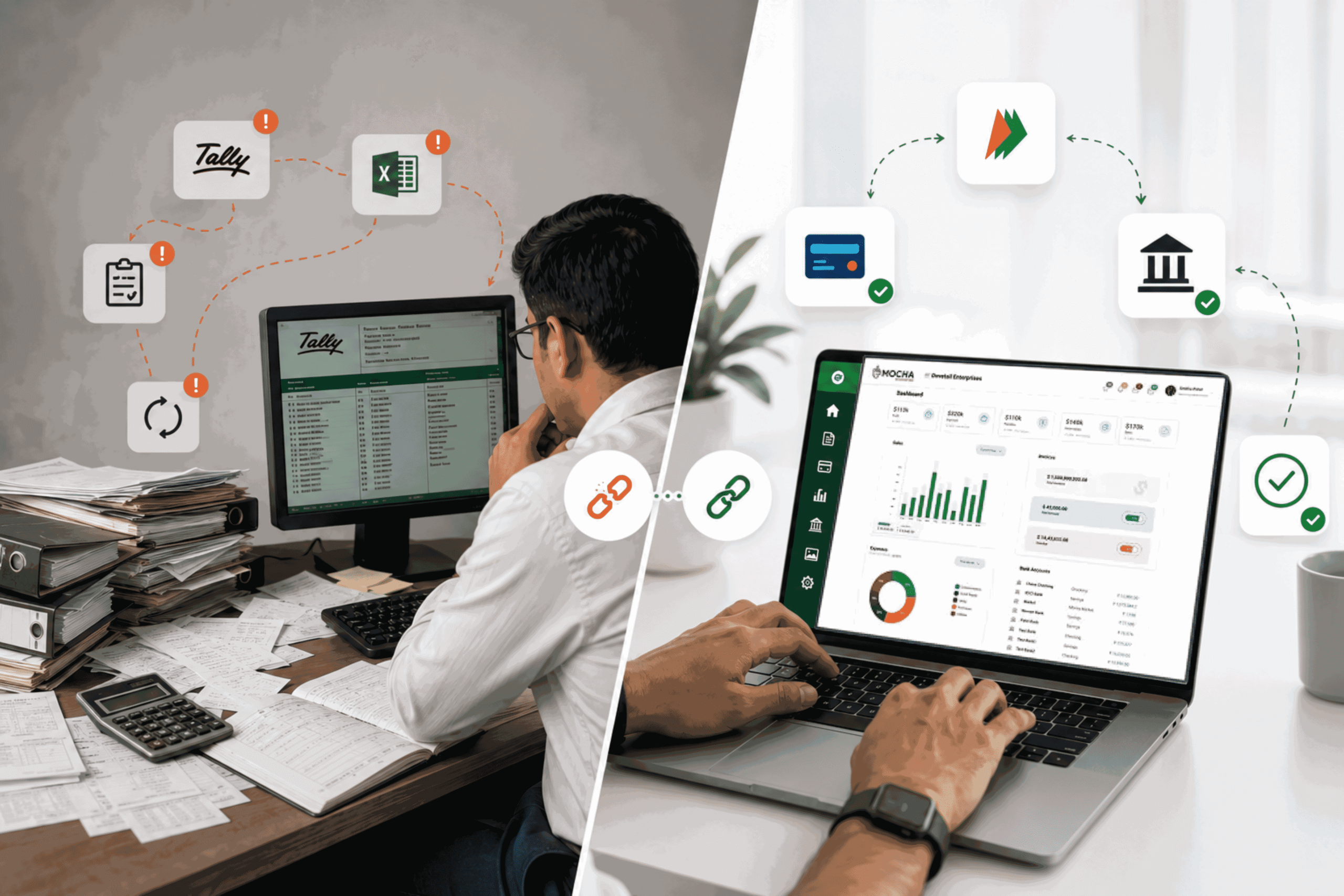
For millions of Indian businesses, accounting and payments exist in parallel universes. A customer pays via UPI, credit card, or bank transfer — and someone, somewhere, manually copies that into Tally. That someone is your CA, your accounts executive, or you. It takes time, creates errors, and delays every financial decision that depends on accurate data. There is a better way — and the fastest-growing enterprises in India are already using it.

The Tally Problem No One Talks About

Tally has been India’s accounting standard for over three decades. Your CA learned on it. Your finance team was trained on it. For basic ledger management and statutory compliance, it still functions. But the India your business operates in today — where 83% of all retail payments move through UPI, where clients pay via credit card EMI, where SaaS subscriptions auto-debit via NACH — is a fundamentally different environment than Tally was built for.

The core limitation of older Tally versions (including Tally ERP 9, which many CA firms still run) is not the ledger — it is the disconnection between sales, invoicing, and payment collection. There is no native mechanism for a customer to click “Pay Now” on your invoice and have that payment land in your Tally books automatically. Every rupee must be entered by hand.

✗ Tally ERP 9 / Older Setup ✓ Mocha Accounting — Integrated
No native UPI or credit card payment acceptance Accept UPI, credit card & ACH directly from invoices
Payments entered manually into ledger by CA or accounts staff Payments auto-post to the correct ledger entry instantly
Sales invoices disconnected from payment status Every invoice shows live payment status
Reconciliation is a month-end or deal — not real-time Reconciliation happens automatically as payments arrive
No “Pay Now” link on invoices sent to customers “Pay Now” button embedded in every invoice you send
GST data must be extracted and reformatted for filing GST-compliant records created at point of transaction
Cash flow visibility only after books are manually updated Real-time cash position — always current
Cloud access requires expensive third-party add-ons 100% cloud-based — access anywhere, any device


India’s Payment Revolution Has Outpaced Its Accounting Software

The pace of digital payment adoption in India has been extraordinary. India now accounts for 49% of all real-time payment transaction volume globally, recognised by the IMF as the world’s largest retail fast-payment system. UPI alone processed 228.3 billion transactions in 2025, up from 172.2 billion in 2024 — a 32.5% year-over-year increase.

Metric Details
228.3B UPI Transactions in 2025 — NPCI, 2025
83% India retail payment volume via UPI, 2024 — RBI Payments System Report
37% YoY growth in merchant UPI payments, H1 2025 — NPCI / Meetanshi
₹299.7L Cr Total UPI value transacted in 2025 — NPCI

For medium and enterprise businesses, this is not abstract. Your clients are increasingly paying via UPI and credit card rather than issuing cheques. Yet for businesses still on legacy Tally ERP 9 or older TallyPrime setups, every one of these payments is being manually recorded — an enormous, compounding cost.

The Core Mismatch

Your customers are paying faster than ever. Your books are updating slower than ever — because every digital payment still requires a human to enter it into Tally. Integrated cloud accounting software eliminates that step entirely.

India’s Accounting Software Market: At an Inflection Point

India’s accounting software market was valued at USD 877 million in 2025, projected to reach USD 2.1 billion by 2035 at a 9% CAGR. Growth is accelerating fastest in cloud-based, GST-compliant platforms with integrated payment capabilities.

Metric Details
$877M India accounting software market, 2025 — Market Research Future
14.5% India CAGR for AP automation — highest globally — Future Market Insights, 2025–35
63M+ MSMEs in India; ~30M now using digital accounting — Jadhavar Business Intelligence
70% Of SMEs actively seeking compliance-ready software — Market Research Future, 2025

Over 14 million newly registered GST taxpayer entities require access to compliant accounting systems. Over 60% of all new accounting software adoptions in India are now via cloud deployment. The businesses pulling ahead are those connecting GST compliance with payment automation — so that every UPI, credit card, or ACH receipt automatically creates a GST-correct transaction record with no manual input.

The Real Cost of Keeping Payments Separate from Accounting

The true cost hides in plain sight — absorbed into salary hours, month-end sessions, and the occasional misfiled return. Here is what the data reveals:

Cost Metric Manual / Tally Setup Mocha Accounting (Integrated)
Cost per invoice processed ~₹1,100–₹1,400 (global avg. $13.54) ~₹245 (global avg. $2.98)
Payment-to-ledger lag 1–4 days (manual entry queue) Instant (auto-post on receipt)
Monthly reconciliation time 40–80 hours for medium enterprise 2–6 hours (exception review only)
GST filing preparation time 30–50 hours per quarter 3–8 hours (data pre-structured)
Touchless processing rate <10% in legacy desktop setups 52.8% in best-in-class orgs (2025)
Fraud detection Manual review — error-prone AI-powered — 37% lower fraud losses

Automated AP processes drive cost reductions of up to 78%, with top-performing departments processing invoices at just ₹245 each compared to ₹1,100–₹1,400 in manual setups. — PLANERGY Software, 2025


What Integrated Payment-Accounting Looks Like in Practice

Here is the exact workflow when accounting and payments are connected — a 4-step cycle that runs without human intervention.

01. You Raise an Invoice in Mocha Accounting

Your sales team creates an invoice. It pulls the customer’s GST details, applies the correct tax slab, and generates a professional invoice with a “Pay Now” button embedded automatically.

02. Your Customer Pays — Their Way

The customer pays via UPI (instant), credit card (including EMI options), or ACH/NACH bank transfer. One tap, payment done. No account numbers to copy, no IFSC codes, no WhatsApp confirmations.

03. The Entry Writes Itself

The moment payment clears, Mocha Accounting creates the journal entry: invoice marked paid, receivable cleared, payment categorised by method. MDR expense calculated. GST record updated. Books reflect the new position instantly.

04. Reconciliation Is Already Done

Because the payment and the accounting entry are generated from the same event, there is nothing to reconcile manually. The bank feed confirms the deposit; the system matches it. The month-end reconciliation exercise — the one that used to take days — is already complete.

CASE STUDY • IT SERVICES COMPANY, BENGALURU

230 Enterprise Invoices/Month. Zero Manual Entry.

A Bengaluru-based SaaS company billing 230 enterprise clients monthly ran a 5-person accounts team to manage payment tracking, Tally entry, and GST preparation. After moving to integrated cloud accounting software, the same billing volume is handled by 2 people. The other 3 were redeployed to FP&A and business intelligence. Annual savings: approximately ₹28 lakh in compensation and ₹6 lakh in audit preparation fees. GSTR-1 filed within 3 days of month-end, not 3 weeks.

Accepting UPI, Credit Cards, and ACH — Without Adding Complexity

Each payment rail settles at a different time with different fee structures. An integrated platform accounts for all of it automatically.

Payment Method Business Use Case Accounting Treatment (Automatic)
UPI B2B invoices under ₹5L, retail, field sales Instant receipt; UTR matched to invoice; ledger updated in real time
Credit Card Corporate procurement, enterprise clients, export billing Settlement (net of MDR) posted on settlement date; MDR split as expense
ACH / NACH SaaS subscriptions, retainers, recurring EMI collections Mandate-linked; auto-posts on each debit cycle; no manual trigger
NEFT / RTGS High-value B2B, project milestone billing UTR-based auto-match from bank feed; ledger entry generated on confirmation

The GST Compliance Multiplier

India’s GST regime — with its multi-slab structure, mandatory GSTR filings, and input tax credit reconciliation against GSTR-2A and 2B — made the case for integrated accounting software inescapable. For a business issuing 200+ invoices per month, maintaining GST accuracy manually is a significant operational burden. With integrated payment accounting software, every completed sale creates a complete, GST-structured record automatically.

GST Activity With Tally (Manual Entry) With Mocha Accounting
GSTR-1 preparation 30–50 hrs of manual data assembly Auto-populated; review in 2–4 hours
2A/2B ITC reconciliation Manual export → Excel → match System-matched; exceptions flagged automatically
e-Invoicing compliance Requires separate e-invoice plugin Built-in; IRN generated on save
Late filing risk Higher — data gaps cause delays Lower — complete data always available

Making the Switch: What to Expect When Moving from Tally

Data Migration from Tally

Modern cloud accounting platforms include data migration tools that import Tally data — chart of accounts, opening balances, customer and vendor masters, GST ledger history — into the new system cleanly. Migration for a medium business typically takes 2–5 working days, including validation. Historical data is preserved, and the CA can review it in the new platform from day one.

Your CA’s Learning Curve

CAs trained on Tally adapt to modern cloud accounting software faster than most finance teams expect — because the underlying accounting logic (double-entry, ledger structure, GST treatment) is identical. The difference is the interface: cloud platforms are browser-based, multi-user, and don’t require license key management. Most CAs report that routine tasks — bank reconciliation, voucher entry review, GST report generation — are faster in the new system within two weeks.

What the CA Relationship Looks Like After Integration

Integrated accounting software does not replace your CA. It changes what your CA spends time on. Instead of manually entering payment receipts and assembling GST data, your CA shifts to review and advisory: checking exception reports, analysing trends, advising on working capital, and preparing for audits from pre-structured data. Most CAs who work with integrated platforms describe it as a significant improvement in their own productivity — and in the quality of advice they can offer clients.

CASE STUDY • RETAIL GROUP, DELHI NCR

₹40-Crore Retail Chain: Tally ERP 9 to Cloud in 6 Weeks

A multi-category retailer with 8 outlets across Delhi NCR ran Tally ERP 9 on a shared server. Each store manager submitted daily collection reports via email; the accounts team in head office spent 3 days per week compiling and entering data. After migration to cloud accounting software with UPI and card integration, daily consolidated revenue by outlet and payment method was available by 9am without manual reports. Monthly close moved from Day 12 to Day 4. Audit preparation time for FY26 dropped by 60%.

MOCHA ACCOUNTING — INTEGRATED CAPABILITIES

Built for India’s Enterprise Payment Reality

Mocha Accounting connects UPI, credit card, and ACH payment collection directly to your accounting ledger — so every rupee your business earns is recorded the moment it arrives.

• Accept UPI, credit card (including EMI), and ACH payments from a single platform

• Invoices go out with embedded “Pay Now” links — no separate payment page setup required

• Sales transactions post to the correct ledger automatically — zero manual entry

• GST-compliant records created at the point of each transaction

• Real-time accounts receivable aging — always current, not end-of-month

• GSTR-1 and GSTR-3B preparation from pre-structured, complete data

• Multi-user cloud access — your CA, your CFO, your sales team, on one platform

• Full audit trail for every payment, entry, and reconciliation action

The Automation Flywheel: Value That Compounds Over Time

The integration advantage is not a one-time event — it compounds. Here is what the first two years look like for a medium enterprise:

Month 1: Payments auto-post. Reconciliation time drops 70%+. Finance team reclaims 40+ hours per month.

Month 3: Receivables aging is always current. Collections follow-up becomes targeted — you know exactly who owes what, in real time.

Month 6: Cash flow forecasting becomes reliable because actuals feed projections automatically from live transaction data.

Year 1: GST filings are data-ready before the deadline. Audit preparation is a review exercise, not a reconstruction of scattered records.

Year 2+: The business holds a complete, structured, searchable financial record — the kind that supports bank credit, investor due diligence, and board reporting without custom preparation work.


Conclusion: The Finance Stack India’s Enterprises Need in 2026

India’s payment infrastructure is world-class. UPI captured 83% of retail payment volume in 2024 and accounts for 49% of all real-time transactions globally. Your customers are ready to pay you digitally, instantly, and effortlessly.

The bottleneck is not in the payment. It is in what happens after. When payments land in a bank account and wait 2–4 days to be manually entered into an older version of Tally, the business loses visibility, accuracy, and time it cannot get back. For medium and enterprise businesses operating at scale, this gap is not a minor inefficiency — it is a structural cost that compounds every month.

Cloud-based accounting software with integrated UPI, credit card, and ACH payment collection is the clearest answer to this problem available in India today. It does not replace your CA — it frees your CA to do the work that actually matters. It does not disrupt your accounting process — it completes a workflow that currently stops halfway.


Your Books Should Reflect Today’s Business, Not Last Week’s.

See Mocha Accounting in 20 minutes. A live, personalised walkthrough built around your business type, your payment channels, and your current accounting setup.

Book Your Free Demo: mochaaccounting.com/schedule

Start Your Free Trial: mochaaccounting.com/register

Comments

Leave a Reply

Your email address will not be published. Required fields are marked *