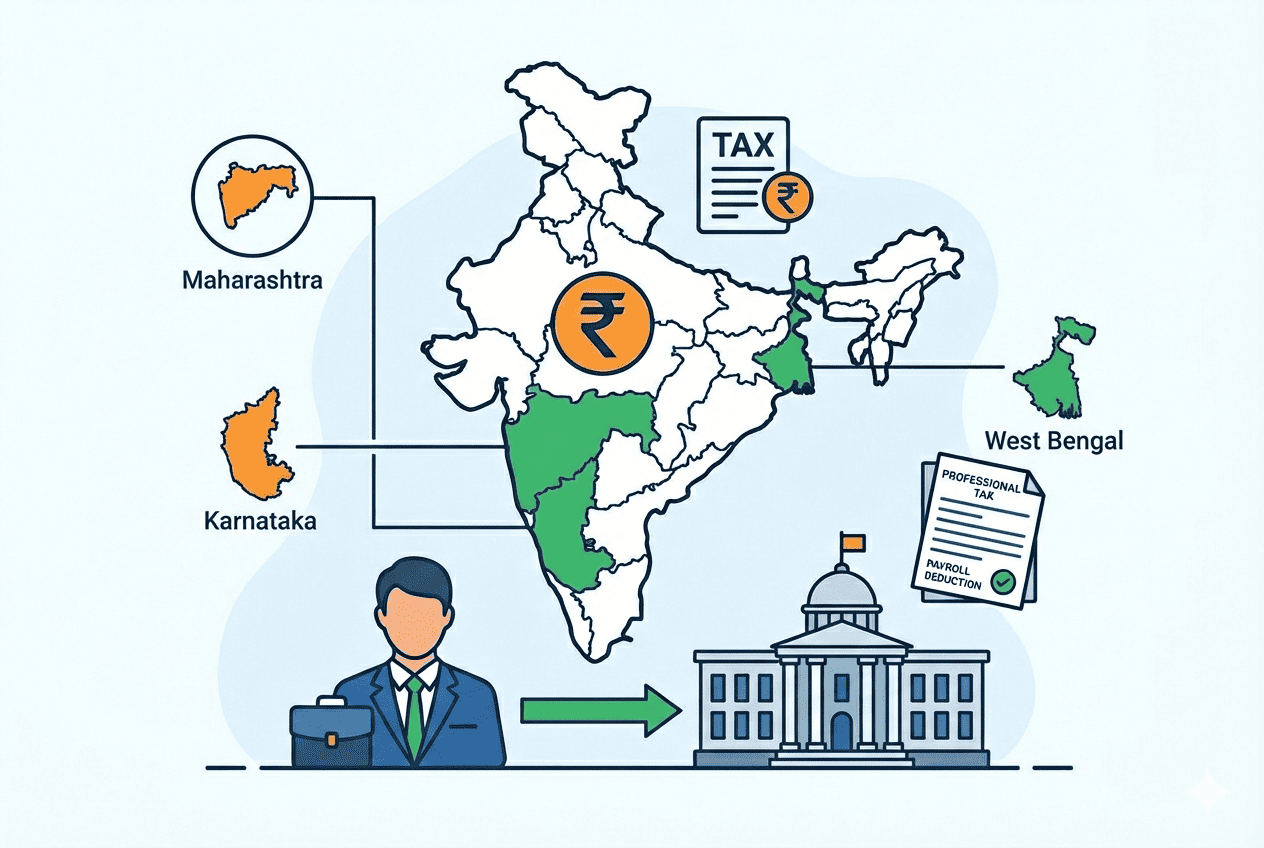
Professional tax is a state levied tax on people who earn income either by way of employment, trade, or profession. Although the required sum is quite small, it must be complied with in the relevant states. Article 276 of the Constitution of India permits state governments to impose professional tax, but limits it to a maximum of Rs. 2500 per annum per person.
Although the financial burden is not high, professional tax calculation errors may result in fines, interest, and compliance penalties. The professional tax slab and frequency of deduction vary by state because the tax is regulated by state laws. Salaried employees have their tax deducted and deposited by their employers, and the self-employed persons are required to enrol and pay directly.
This blog describes the calculation of professional tax in detail, the applicable slab structures, the state-wise comparison of professional tax rules, and provides practical examples to clarify them.
What is professional tax, and who is subject to pay it?
Some state governments impose a professional tax on income derived from employment, business, or a profession. It applies to:
- Salaried employees
- Consultants, lawyers, chartered accountants, and doctors.
- Traders and business owners
- Partnerships, companies, and LLPs.
When applicable, employers deduct the tax from employees’ salaries each month. Self-employed professionals are required to get enrolment and pay as per the professional tax slab of their state.
Even though the constitutional limit is 2,500 per year, the actual framework for state-wise professional tax varies across states. It is charged monthly in some states, half-yearly or annually in others. Calculation of professional tax should therefore be in line with state legislation to be compliant.
How professional tax calculation works in India
The calculation of professional tax is mainly based on three factors:
- Status of business or employment.
- Monthly or annual income
- Professional tax slab that applies.
In the case of salaried persons, employers deduct tax from the salary at the applicable professional tax slab and remit it to the state government. In most states, deductions are made monthly, but February usually has a larger deduction to reach the annual limit.
For example, in Maharashtra, workers with a monthly income of more than 10,000 pay 200/month and 300 in February to complete 2500/year.
The computation of professional tax should take into account:
- Exemptions on salary thresholds
- Certain states have gender based exemptions
- Extra exceptions for elderly citizens or disabled people
- Adjustment in February, where necessary
The inability to use the appropriate professional tax slab will result in under- or over-deduction, leading to compliance issues. Automating accounting processes with software such as Mocha Accounting is a step towards ensuring tax compliance. Sign up for Mocha Accounting to learn how it can add value to your business.

Understanding the professional tax slab system
The professional tax slab structure varies across states. It is generally based on monthly income brackets.
Below is an illustrative table of sample professional tax slab structures in selected states.
Example table: Professional tax slab comparison
| State | Monthly Income Range | Monthly Tax (Rs. ) | Special Note |
| Maharashtra | Up to 7,500 (women exempt up to 10,000) | Nil | Slab-based |
| Maharashtra | Above 10,000 | 200 (300 in Feb) | Annual Rs. 2,500 |
| Karnataka | Up to 15,000 | Nil | Threshold-based |
| Karnataka | Above 15,000 | 200 | Fixed rate |
| West Bengal | Varies from 10,001 to above 40,000 | 110 to 200 | Slab-based |
| Tamil Nadu | Half-yearly slabs based on salary | 0 to 1,250 | Paid twice yearly |
The professional tax slab determines the deduction amount. Employers must verify current state notifications before performing professional tax calculations.
Key observations:
- Some states offer income-based exemption thresholds.
- Certain states revise professional tax slab limits periodically.
- The February adjustment is common in Maharashtra.
Understanding the professional tax slab correctly ensures accurate payroll processing.
Professional tax regulations in various states
Professional tax is not charged in every state. It is not enforced in states like Delhi and Uttar Pradesh. Nevertheless, several key states do, and the regulations vary greatly.
The state-wise patterns of professional tax are outlined below.
Maharashtra
One of the most organised models of state-wise professional tax. Deductions are monthly. February already has 300 deductions, leaving only 300 to complete the annual limit.
Karnataka
Flat deduction of 200 per month to employees with income more than the threshold.
West Bengal
Several professional tax slabs based on salary. The deduction ranges between 110 and 200 per month.
Tamil Nadu
Half-yearly payment system. The professional tax slab is not charged monthly but rather biannually.
Gujarat
Both salaried and self-employed professionals are subject to it with organised slab-based deductions.
Registration and filing of professional tax returns in each state differ. Professionals need enrolment, and the employers need a Professional Tax Registration Certificate.
When calculating professional tax, one should ensure it is calculated in accordance with the state-wise professional tax regulations in the place of employment, rather than the company headquarters.
Calculation of professional tax using real-life examples
Practical examples can help clarify how to calculate professional tax more effectively.
Example 1: Maharashtra salaried employee
Monthly salary: Rs. 35,000
Professional tax slab applicable: 200/month.
February deduction: Rs. 300
Calculation:
Rs. 200 × 11 months = Rs. 2,200
February deduction = Rs. 300
Calculation of total annual professional tax = 2500.
Example 2: Karnataka employee
Monthly salary: Rs. 25,000
Professional tax slab: 200 a month.
Calculation:
Rs. 200 × 12 months = Rs. 2,400 annually
Example 3: Below threshold employee
Monthly salary in Karnataka: Rs. 14,000
Threshold: Rs. 15,000
Professional tax computation = Nil.
Example 4: Self-employed professional in West Bengal.
Annual income: Rs. 6,00,000
Professional tax slab that is applicable: 200 per month.
Professional tax, calculated annually, is 2400 INR.
These illustrations illustrate the differences in the calculation of professional tax under the state-wise framework.
Registration of professional taxes, payment, and filing of returns.
Professional tax calculation is just one aspect of compliance. On-time registration and payment are also significant.
Registration types are:
- PTRC for employers
- PTEC among self-employed professionals.
The employers pay the professional tax at the applicable slab and remit it within the stipulated timeframes. The frequency of return filing varies by state under the professional tax laws.
The penalties that can be imposed on late payments include:
- Interest per month of delay
- Fixed penalty amounts
- Further prosecution in severe cases
Keeping good records will guarantee easy auditing and proper calculation of professional tax.
Mistakes in professional tax calculation
Many companies make unnecessary mistakes in professional tax calculations due to a lack of understanding of state regulations.
Use of the wrong professional tax slab
Miscalculation may result from using outdated professional tax slab notifications.
Missing a higher deduction in February
In Maharashtra, a higher amount gets deducted every February, and if that gets missed, it results in a mismatch.
Mistaken state of employment
Professional tax is levied at the state level, not based on the state of incorporation of a company.
Failure to upgrade payroll software
The automated payroll systems should be updated to reflect the current professional tax slab changes.
Such errors can be avoided to ensure efficient calculation of professional taxes and avoid penalties.
The importance of proper professional tax calculation to businesses
Professional tax is calculated accurately, which is a sign of good payroll governance. Although the tax is relatively small, failure to comply may result in legal issues.
The advantages of appropriate compliance are:
- Smooth statutory audits
- Improved employee trust
- Eschewing of interest and penalties
- Increased payroll transparency
For multi-state organisations, knowledge of state-specific professional tax differences will ensure proper deduction at branches.
Calculation of professional tax might seem easy, but the wrong choice of slab or late filing can pose compliance risks. Companies must regularly check the professional tax slab that applies in each state of operation. A step towards improving tax compliance in businesses is to incorporate accounting software such as Mocha Accounting. Have a look at the pricing plans offered by Mocha Accounting to choose the one with the features best suited to your growing business.
Quick reference comparison of state-wise professional tax
|
Factor |
Maharashtra | Karnataka | West Bengal | Tamil Nadu |
| Frequency | Monthly | Monthly | Monthly | Half yearly |
| Max Annual | Rs. 2,500 | Rs. 2,400 | Rs. 2,400 | Rs. 2,500 |
| Slab based | Yes | Threshold based | Yes | Yes |
| February adjustment | Yes | No | No | No |
This comparison highlights how state-wise professional tax differs in structure and payment method.
Conclusion
Professional tax might seem insignificant relative to income tax, but its compliance impact is enormous. Professional taxes need to be calculated in line with the existing structures for professional tax slabs and state-wise professional tax regulations. Employers and self-employed professionals alike must keep abreast of state-level notifications to ensure they are accurate.
Compliance is an area that must be closely followed to stay abreast of the professional tax slab and state tax evasion. The practical examples show how the total amount changes with a few changes in salary or state location.
Professional tax is calculated correctly, which helps avoid penalties, enhances payroll, and ensures compliance. Managing professional tax can be easy and risk-averse with the right knowledge and with well-laid-out procedures. Businesses can also benefit tremendously from using accounting software such as Mocha Accounting to streamline their tax compliance. Schedule a demo today to learn more about how Mocha Accounting can add value to your business.

Frequently asked questions
- How is professional tax calculated in India?
Professional tax is calculated based on the professional tax slab applicable in a specific state and is payable within that state. The employers subtract it from the employees’ salaries and remit it to the state government. Self-employed professionals must register and calculate their own taxes, paying in accordance with the professional tax regulations applicable in the state.
- Is there a relative difference in the professional tax slab amongst states?
Yes, the professional tax slab varies from state to state. The income thresholds, frequency and limit per year vary among states. Professional tax laws in the states allow deductions either monthly or half-yearly, or in other forms.
- Does it mean that there is no professional tax in all the Indian states?
No, professional tax is not imposed in all the states. It is regulated by Article 276 of the Constitution. States imposing it have their own professional tax slab structure and state-wide professional tax compliance provisions.
- What if the wrong professional tax slab is charged?
When an incorrect professional tax slab is utilised, the deductions are either under- or over-deducted. It may lead to fines, interest, or notices under state professional tax laws. Employers are expected to stay up to date on slabs regularly.
- What is the practice by companies with respect to professional tax in several states?
The various companies in various states will have to comply with the professional tax regulations applicable in each state at each branch. The calculation of professional tax should also align with the local professional tax slab to ensure correct deductions and compliance.
Leave a Reply