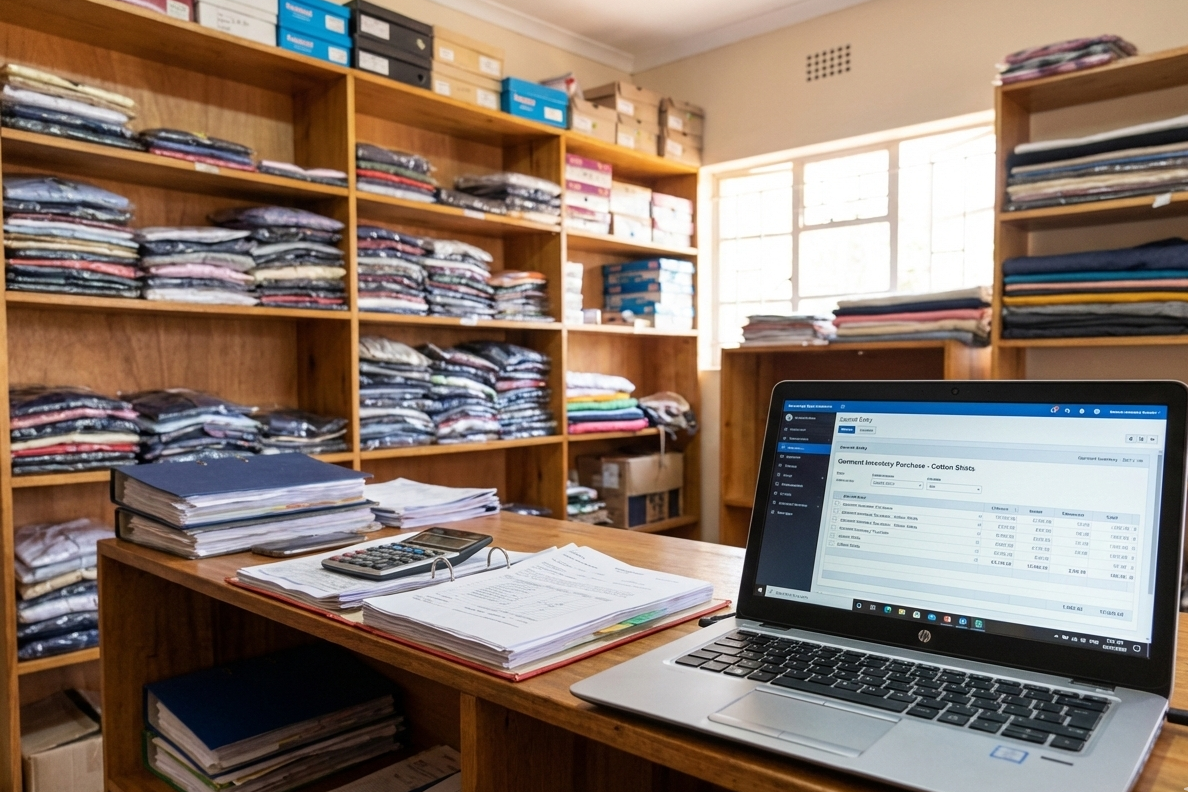
India’s garment and textile industry is fast-paced and large, but despite the rapid growth, garment businesses often experience constrained cash flow. This sector is vital to the country: according to the Government of India, textiles and apparel (including handicrafts) made up 8.63% of total merchandise exports in 2024-25, worth $37.7 billion. India is also among the world’s top textile and apparel exporters. The market is valued at about $225 billion and could reach $350 billion by 2030, propelled by rising incomes and changing shopping habits. The industry also employs over 45 million people across the textile value chain.
This size causes challenges for garment businesses of all sizes. Styles evolve, SKUs are endless, returns are frequent, and seasonal trends can cause inventory to fluctuate widely. Cash flow is also a rising concern for Indian MSMEs, with the Economic Survey 2025-26 reporting delayed payments of about ₹8.1 lakh crore, which puts pressure on working capital and makes inventory planning more difficult. GST compliance is also changing, with changing rules for textiles and readymade garments, so accurate tax handling and precise records are essential.
In this environment, accounting software for garment industry connects sales, inventory, purchasing, production costs, and taxes into a single, reliable system. This guide explains why the garment industry needs accounting software and shows how Mocha Accounting can help as your business grows.
Why accounting software for garment industry matters most in India
Garment businesses in India rarely have a simple sales and purchase process. Producing and selling a single item of clothing requires purchasing fabric, dyeing, sewing, finishing, and shipping, with losses, rework, and waste along the way. Doing all this on a spreadsheet means that mistakes are hidden until you miss a delivery, can’t locate your inventory, or run out of money. As India’s textile and apparel market grows, the cost of these mistakes rises with volume, making accounting software for garment industry as essential.
There is also pressure on working capital. If payments are delayed, you can’t reorder popular items or pay vendors on time, disrupting production and eroding customer confidence. Compliance is another challenge. GST rules for textiles and garments have changed, with new thresholds and rates for readymade garments, making correct classification and careful invoicing as essential.
Why accounting software for garment industry differs from generic bookkeeping
Generic accounting tools just don’t cut it for garment businesses. Such businesses have variants, job work, multiple warehouses, high return rates, frequent price reductions, and a constant inflow of new products. Your accounting system needs to track stock at the SKU level, record purchases and bills accurately, and still give you financial reports that you can rely on.
A garment business also needs well-defined workflows across teams. The store team focuses on sales, returns, and discounts. The warehouse team handles receipts, transfers, and adjustments. The accounts team manages bills, payments, GST, and reconciliation. The owner needs a single source of truth that connects everyone. That’s why accounting software for the garment industry should include features such as inventory controls, purchasing workflows, and tax-ready invoicing in addition to journal entries. It also needs precise, easy-to-read reports so you can make data-driven business decisions.
Accounting software for garment industry that keeps inventory accurate
If you stock 100 T-shirts in your garment retail business, it’s not as simple as storing 100 units of one SKU. Those 100 units are split across sizes, colours, and fits. This is where stock confusion often starts, because the business remembers the total but loses track of the details. A good system tracks stock by SKU, supports inventory across multiple locations, such as a store and a warehouse, and records transfers so you don’t double-count.
Mocha Accounting tracks inventory at the SKU level with live updates, so your stock levels reflect transactions as they occur. Low-stock reminders help you reorder essentials and fast-selling items before they run out. Multi-warehouse tracking and transfers are useful if you keep bulk stock in one place and sell from another, or if you have several outlets.
To keep inventory under control, good systems also help you spot problems early. Product insights that show fast and slow movers let you act before dead stock builds up. Seeing return patterns helps you determine whether a style has quality issues, sizing problems, or simply doesn’t match the requirement.
Garment accounting software for sales, returns, discounts, and customer credits
Garment sales are rarely as simple as a single invoice. Customers often exchange sizes. Retail discounts change every week. Online orders can lead to a high return rate. Wholesale clients may ask for credit notes, partial returns, or changes after delivery. If you handle these without a garment accounting software, your revenue may look too high, your inventory may be wrong, and your accounts team could spend weeks fixing mistakes.
Mocha Accounting provides organised billing with professional invoices, customisation, and recurring billing for regular B2B clients. Automatic payment reminders help reduce follow-up work and optimise payments, which is important when working capital is constrained. Credit memo tracking simplifies the management of client returns and credits, ensuring all changes are tracked and traceable, and the inventory is current.
If you are looking for a simple operational checklist for sales discipline, look for software that supports:
- Easy and templatised invoice creation with consistent line-item structure
- Customer-level reporting so you can track receivables and buying patterns.
- Structured credits for returns, rather than ad hoc adjustments
- A repeatable workflow for recurring customers
The Customer Management Dashboard of Mocha Accounting’s accounting software for garment industry provides detailed information by customer, making this tool a great addition for any garment business.

Textile accounting software for purchasing, vendor bills, and cash control
Garment and textile businesses protect their margins by sourcing carefully. Fabric prices change, vendor lead times vary, and quality can vary from batch to batch. If your purchasing process is unstructured, you might end up with duplicate orders, mismatched bills, or stock arriving without a linked order. This makes it hard to control costs and even harder to audit later. A strong purchasing process starts with purchase orders, which give you visibility into spending before you spend.
Mocha Accounting’s textile accounting software makes it easy to quickly create, duplicate, and share purchase orders, which is helpful because many businesses reorder common items with minor changes. PO-to-bill conversion reduces re-entry and keeps procurement aligned with payable records. Vendor tracking and visibility into purchase history make supplier conversations easier because you can reference facts rather than rely on memory. Bill reminders help you manage payables and avoid late fees, while partial payments support real-world payment patterns. Mocha Accounting offers a fully interactive Vendor Management Dashboard that allows businesses to track vendor payments and outstanding bills and control expenses.
Cash control becomes far more manageable when purchasing and banking are connected. Mocha supports bank reconciliation workflows with secure bank connections, statement uploads, categorisation rules, and split transactions. That helps you match what happened in the bank to what is recorded in your books, which is how you catch mistakes early. In industries with constrained working capital, this discipline matters as much as sales growth.
Clothing business accounting software for GST, invoicing, and compliance readiness
Tax compliance is far from a back-office job in the garment industry. It affects your pricing, margins, and audit risk. India’s GST reforms for textiles and readymade garments bring new thresholds and rates that must be applied correctly on each invoice. If you get classifications or rates wrong, fixing them can be hard and may involve credit notes, revised invoices, reconciliations, or even customer disputes. For businesses selling via multiple channels, things get more complex because each customer type has different record-keeping needs.
Mocha Accounting provides GST-ready billing with proper tax classification, GST reporting, and processes to keep you organised for tax submissions. E-invoicing functionality for applicable B2B scenarios minimises compliance risks and accelerates subsequent reconciliation. Audit trails enhance accountability by recording actions to create, update, or delete, which is helpful when multiple employees are working on invoices and adjustments. Secure sharing of reports enables you to work with accountants and financial advisors without distributing different versions of spreadsheets.
If you want a checklist to evaluate compliance-readiness of your clothing business accounting software, ensure your software can:
- Apply taxes consistently at the line item level
- Generate GST reports that support reconciliation and filing
- Maintain traceable records for returns, credits, and adjustments
- Provide an audit trail for key actions and edits
Garment factory accounting system for production costing and GST software needs
Manufacturing adds another layer of complexity: production costs. Even small operations face cutting, stitching, finishing, rework, and waste costs. If you can’t measure production cost per style, you can’t price confidently. You might underprice and lose margin, or overprice and lose sales. Knowing your production costs also helps you decide whether to make items in-house, outsource, or switch suppliers for certain tasks.
Many businesses start by tracking costs employing spreadsheets, but this approach breaks down when you have multiple styles and overlapping batches. You need a system that organises purchase costs, bills, and inventory movements, so you can make costing decisions with accurate data. Mocha Accounting helps by keeping purchasing, billing, and inventory in sync, which improves cost accuracy. Its reports let you see profitability by product or customer segment, instead of relying on broad averages.
For GST-linked costing decisions, accuracy also matters. Tax treatment affects landed cost, pricing, and margins, especially when you sell across channels and states. A production costing and GST software that keeps invoices and tax reporting consistent reduces the need for later corrections.
Inventory and accounting integration for garment businesses
In the garment business, if inventory is managed in one tool and accounting in another, you end up with daily reconciliation work: stock mismatches, missing bills, untracked returns, and an uncertain understanding of cash flow. Integration means your main actions update everything important, without extra steps.
An integrated workflow looks like this:
- A purchase order is created and shared with the supplier
- The purchase order is converted into a bill when confirmed
- Stock is received, and inventory updates are immediately updated by SKU
- Sales invoice is created, and the inventory is reduced automatically
- Returns generate credit memos and adjust inventory correctly
- Banking reconciliation confirms cash movements match recorded transactions
- Reporting dashboards show sales, stock, and cash in one view
Mocha Accounting supports this end-to-end flow across invoicing, sales, purchase orders, bills, inventory tracking, banking reconciliation, and reporting. Multi-warehouse tracking ensures transfers do not break the chain, and login records and activity logs are important for knowing who’s doing what when multiple staff members use the system.
How Mocha Accounting supports accounting software for garment industry
Garment businesses need an operational system that can keep up with constant change. Mocha Accounting supports this by bringing core workflows into a single connected platform: invoicing and sales tracking, inventory control, purchase ordering, payables and expense discipline, banking reconciliation, reporting dashboards, and GST workflows. For sales, it supports professional invoices, recurring invoicing for repeat customers, system-generated reminders for receivables, and structured credits through credit memos. For inventory, it provides live tracking, low-stock reminders, product performance insights, and multi-warehouse inventory with transfers.
Mocha Accounting offers a fully integrated online payment system. A merchant would be able to accept credit card and UPI payments within Mocha and the accounting entries are made automatically. Invoicing is also completely paperless. An invoice is sent to the customer’s device. The customer then confirms the invoice and clicks on the payment link. Invoice payment can be completed in a couple of easy steps, after which the merchant gets instant confirmation. A sales entry is instantly made in their books. Receipt sent via email.
For purchasing, it offers support for purchase orders, which you can easily duplicate for repeated buying cycles, easy sharing with suppliers, and conversion of purchase orders into bills in sync with payments. For bills and expenses, it offers support for recurring payments, reminders, receipt uploads, and more accurate tracking. For banking, it offers a secure connection to accounts, bulk uploads of statements, categorisation rules, and split transactions to make reconciliation easier. For reporting, it offers a real-time dashboard and shareable reports so that the people who matter have all the information at their fingertips.
The main business benefit of accounting software for garment industry is control without extra work. You spend less time on manual data entry, reduce differences between stock and accounts, and avoid eleventh-hour compliance stress. Most importantly, you give leaders more time to focus on growth. Check out Mocha Accounting’s tiered pricing to see which features fit your business needs.

Conclusion
The Indian garment economy is large, fast, and complex, and the numbers show why discipline is important. Exports are significant, domestic consumption is growing, and high employment means operational decisions quickly affect people and cash flow. In this environment, accounting software for the garment industry is a valuable resource for growth. It should help you bill smoothly, track inventory accurately, manage purchasing with control, stay GST-compliant, and produce usable reports that direct your decisions.
Mocha Accounting meets these needs with connected workflows for sales, inventory, purchase orders, bills, banking, reporting, and GST. If you are growing a garment unit, retail brand, or multi-location business, schedule a demo of Mocha Accounting to see how it can help your business.
FAQs
1. What is the best accounting software for garment industry businesses in India?
The best accounting software for garment industry businesses in India is one that provides invoicing, GST-ready billing, SKU-level inventory management, purchasing, and reporting capabilities all in one place so that your stock and accounting books are always in sync.
2. How does garment accounting software help manage returns and customer credits?
Garment accounting software helps manage returns and customer credits by providing structured credit memos for tracking returns, so customer credits are always traceable, and inventory updates are always accurate.
3. Why do garment businesses need inventory and accounting integration for garments?
Garment businesses need inventory and accounting integration for garments because it helps avoid discrepancies between stock, bills, and sales on a daily basis, so there is less work required for reconciliation and cash flow visibility.
4. Can a garment factory accounting system support production costing and GST software requirements?
Yes, a good garment factory accounting system will enable you to track input costs and maintain GST-ready records so that your pricing and margin calculations are always data-driven.
5. What should I look for in textile accounting software for vendor and purchase control?
Choose textile accounting software that supports purchase orders, PO-to-bill conversion, vendor history, bill reminders, and bank reconciliation to tighten procurement and payment discipline.
Leave a Reply