Key Takeaways
- The best rental property management software combines leasing, rent collection, maintenance tracking, tenant communication, and accounting in one platform
- Free options like TurboTenant work for small portfolios, but paid platforms offer the depth growing landlords need to scale
- Buildium and AppFolio dominate the market for large portfolios, but smaller landlords often find them overly complex and expensive
- Look for tenant portals, automated rent collection, maintenance work orders, and financial reporting as must-have features
- All-in-one platforms like Mocha Manage eliminate the need to juggle multiple tools, saving time and reducing errors
Managing rental properties means juggling a dozen things at once:
- Tenant screening
- Lease signing
- Rent collection
- Maintenance requests
- Property accounting
- Business accounting
- Taxes
- Owner reports
… And somehow keeping it all organized without losing your mind.
That’s what rental property management software is supposed to solve.
One platform that handles everything instead of five different apps, a spreadsheet, and a prayer.
But not all platforms are built the same. Some are great at leasing but weak on accounting. Others nail the financials but make tenant management an afterthought.
And some have so many features that their navigation becomes bloated and can barely get anything done (the irony).
This guide compares the 10 best rental property management software platforms in 2026, including our own all-in-one tool, Mocha Manage.
We’ll break down what each tool does well, where it falls short, and which one makes the most sense for your portfolio, depending on a variety of factors.
How We Evaluated Rental Property Management Software
We looked at each platform across the areas that matter most when you’re actually managing properties day to day.
That includes:
- Tenant and lease management: Can you handle applications, screening, lease signing, and renewals in one place?
- Rent collection: Does it offer online payments with automated reminders and late fee enforcement?
- Maintenance management: Can tenants submit requests and can you track work orders from start to finish?
- Accounting and financial reporting: Does it track income and expenses by property, generate owner statements, and handle tax prep?
- Communication tools: Can you message tenants, send announcements, and keep a record of all correspondence?
- Ease of use: Can someone without a tech background get up and running quickly?
- Scalability: Will it work for 5 units? 500 units?
- Support quality: When you have a question, can you actually get help?
Some tools lean more heavily toward certain areas than others. The goal is to help you find the right fit for how you actually manage properties.
Disclosure: The guide below includes our own property management tool, Mocha Manage.
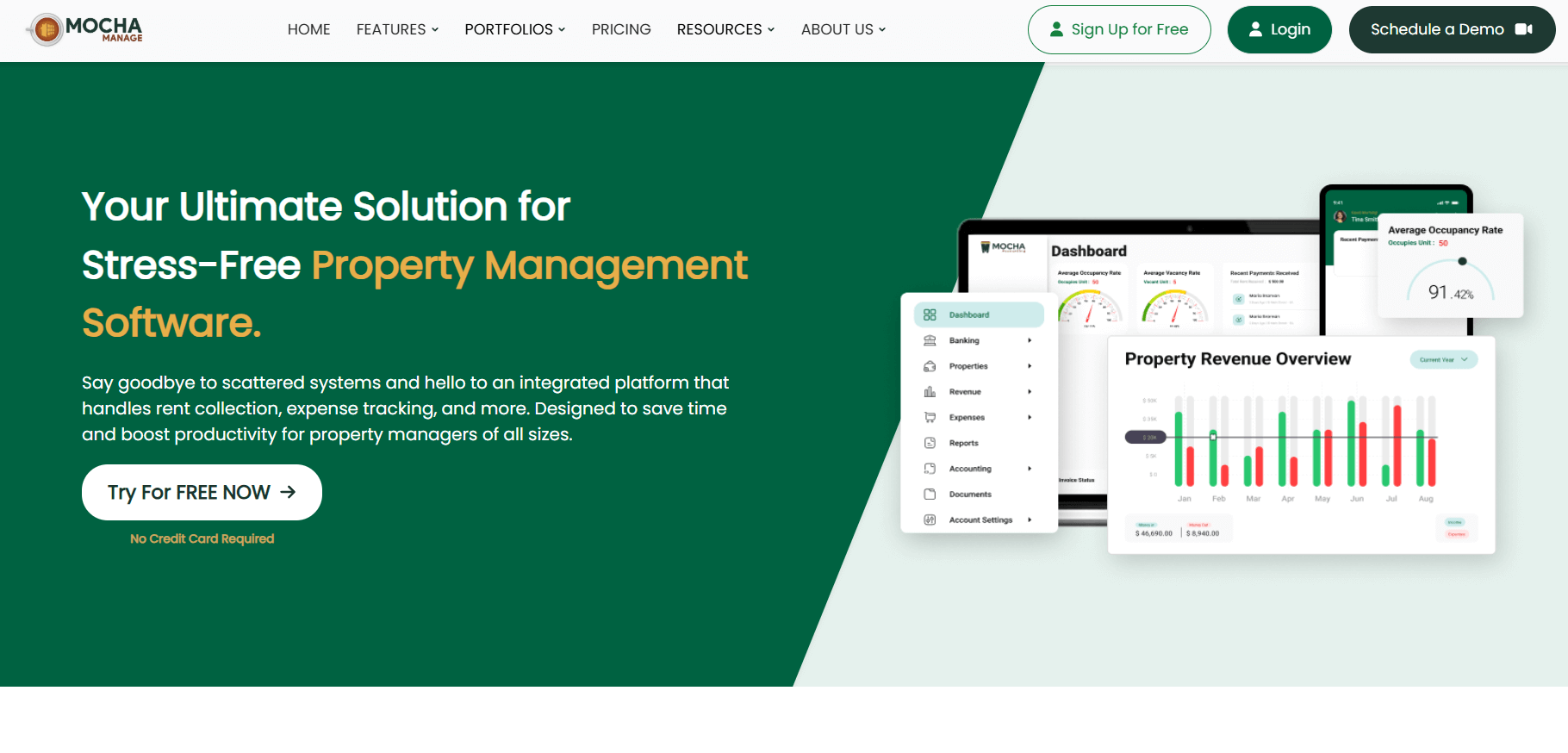
Mocha Manage was designed by seasoned CPAs and property managers to deliver an experience that handles accounting, rent collection, maintenance, leasing, and communication in one platform seamlessly, without feature bloat or an overcomplicated navigation.
With that said, the guide below is meant to be as unbiased as possible and provide the software listed in a fair light so that you have several options to choose from.
10 Best Rental Property Management Software [Updated for 2026]
Here are the 10 best rental property management software platforms, compared head-to-head.
1. Buildium – Best for Mid to Large Property Management Companies

Buildium is one of the most established names in property management software. It’s been around long enough that it’s become the default for many professional property managers.
You’d typically choose Buildium when you’re managing 50+ units and need something that handles everything from marketing vacancies to generating owner statements. Residential, commercial, HOAs—it covers all of it.
That maturity comes with depth. But it also comes with complexity that smaller landlords may not need, and the aforementioned feature bloat that users often mention makes getting simply things done harder than it should be.
Best For: Professional property managers with 20-200+ units
Key Features
- Full property management suite with tenant screening, online leasing, and listing syndication across major rental sites
- Rent collection with multiple payment methods, automated reminders, and late fee enforcement
- Maintenance management with work order tracking, vendor assignment, and resident request portals
Pros
- Industry-standard platform used by thousands of professional property managers
- Strong reporting and owner accounting capabilities
- Free website builder and listing syndication included
Cons
- Can feel complex and overwhelming for smaller landlords or self-managed properties
- Charges a $99 setup fee for each bank account used for online payments
- Phone support only included in higher-tier plans
- Higher price point that scales quickly as you add units
Pricing
Essential plan starts at $58/month for up to 20 units. Growth plan at $183/month. Premium at $375/month. Pricing scales with portfolio size.
2. AppFolio – Best for Large Portfolios with Complex Needs

AppFolio is built for property management companies running hundreds or thousands of units.
It’s powerful, feature-rich, and designed for teams—not solo landlords managing a handful of properties. The platform handles residential, commercial, student housing, and community associations, and it’s been investing heavily in AI-powered automation.
If you’re managing 50+ units and need enterprise-grade tools, AppFolio is a serious contender. If you’re managing 10 units, it’s probably overkill.
Similar to Buildium, it also has issues with feature bloat if you’re a small to medium-sized landlord.
Best For: Large property management companies with 50+ units
Key Features
- Enterprise-grade platform with advanced accounting, automated workflows, and AI-powered leasing tools
- Smart bill entry that learns from your approval patterns and automates vendor payments
- Owner and investor portals with real-time financial access and automated distribution statements
- Marketing and leasing tools including listing syndication, virtual tours, and AI leasing assistants
- Maintenance coordination with automated vendor assignment and work order tracking
Pros
- Excellent for managing large, mixed-use portfolios with complex accounting needs
- Strong automation features that reduce manual work across the board
- Modern interface with a well-reviewed mobile app
- Advanced reporting and analytics with real-time data
- AI tools (Realm-X platform) for automated workflows and decision-making
Cons
- Expensive with a minimum monthly spend that typically requires 50+ units
- May be overkill for smaller portfolios—many features go unused
- Less customizable than some competitors for unique workflows
- Annual contracts typically required
Pricing
Custom pricing (typically starts around $1.40-$3.00 per unit/month with a $250 minimum monthly spend). Contact their sales team for a quote.
3. DoorLoop – Best for Growing Property Managers

DoorLoop positions itself as the modern, easy-to-use alternative to legacy platforms like Buildium and AppFolio.
The pitch? Professional-grade features without the complexity or steep learning curve. The interface is clean. Onboarding is fast. And you get the same core functionality that larger platforms charge significantly more for.
Having said that, it’s a newer platform with a smaller user base. Some landlords report that advanced features sometimes require add-on purchases.
Best For: Property managers with 10-100 units who want professional features without complexity
Key Features
- Full property management suite with accounting, rent collection, and bank reconciliation
- Tenant screening with background checks, credit reports, and eviction history
- Maintenance management with work orders, vendor tracking, and payment processing
- Online leasing with rental applications, e-signatures, and listing syndication to Zillow, Trulia, and more
- Owner and tenant portals for self-service access to payments, documents, and communication
Pros
- User-friendly interface that’s easier to learn than Buildium or AppFolio
- All users get access to the same core capabilities regardless of plan tier
- Good customer support and onboarding process
- Regular feature updates and improvements
- Zapier integration and open API for connecting with other tools
Cons
- Newer platform with a smaller user base than established competitors
- Some advanced features may require higher-tier plans or add-ons
- Pricing can add up quickly as unit count grows
- Mixed reviews on customer response times
Pricing
Starter plan at $99/month (max 10 units). Pro at $189/month. Premium at $239/month. Pricing increases after 20 units.
4. TurboTenant – Best Free Option for Small Landlords

TurboTenant has built one of the most genuinely useful free plans in the market.
The free tier includes listing creation, tenant screening, rent collection, maintenance tracking, and lease management. That’s not a stripped-down teaser—it’s a functional property management platform at no cost.
The trade-off? Accounting features are more basic than dedicated platforms, and some landlords report slower rent deposit timelines than they’d prefer, which can be an outright dealbreaker.
Best For: DIY landlords with 1-100 units looking for free or low-cost management
Key Features
- Free plan with online listings, tenant screening (powered by TransUnion), and digital applications
- Online rent collection with automated reminders, late fee enforcement, and payment tracking
- State-specific lease agreements with e-signature capabilities
Pros
- Free plan is genuinely full-featured—not a limited trial
- Trusted by 900,000+ landlords across all 50 states
- Strong tenant screening integration with TransUnion
Cons
- Accounting features are basic compared to dedicated property accounting platforms
- Rent deposit timelines can be slower than competitors
- Phone support reserved for paying customers only
- No short-term rental or vacation property support
Pricing
Free plan available with core features. Premium plan at $149/year ($12.42/month billed annually) adds unlimited leases, e-signatures, faster payouts, and priority support.
5. TenantCloud – Best Budget All-in-One

TenantCloud offers a solid set of property management features at a price point that undercuts most competitors.
The platform covers listing, screening, leasing, rent collection, maintenance, and accounting—all in one place. It also includes separate portals for landlords, tenants, owners, and service professionals, which is a nice touch if your operation involves multiple stakeholders.
Keep in mind, though, that some of the deeper functionality (like advanced reporting or document storage) is limited on lower-tier plans.
Best For: Landlords with 1-75 units looking for affordable all-in-one management
Key Features
- Listing syndication to Apartments.com, Realtor.com, and more
- Online rent collection with automated invoicing and multiple payment methods
- Tenant screening with background, credit, and eviction checks
Pros
- Affordable pricing with a broad feature set at every tier
- Unlimited units across all plans
- Modern interface with good mobile apps for both landlords and tenants
Cons
- Lower-tier plans limit leases, document templates, and storage capacity
- Accounting and reporting not as deep as premium platforms
- Customer support can be slow during peak times
- Some features feel less polished than competitors
Pricing
Starter plan at $15.60/month (billed annually). Growth and Business plans available at higher tiers with expanded features.
6. Landlord Studio – Best Mobile-First Platform

Landlord Studio built their platform to be mobile-first.
That means the mobile app isn’t an afterthought—it’s the primary experience. If you manage properties from your phone while juggling a full-time job or traveling between units, that matters.
The platform pairs property management with strong accounting tools, including receipt scanning, automated bank feeds, and Schedule E report generation. It’s leaner than Buildium or AppFolio, but that’s intentional. Less complexity. Faster setup. Lower cost.
Best For: Landlords with 1-100 units who manage on-the-go
Key Features
- Mobile-first design with receipt scanning, mileage tracking, and expense logging on the go
- Automated bank syncing with smart transaction categorization
- Online rent collection with automated reminders, late fees, and tenant auto-pay
Pros
- Excellent mobile app—consistently rated among the best in the category
- Clean, intuitive interface with minimal learning curve
- Strong accounting and tax reporting tools for the price
Cons
- Not built for enterprise-level portfolios with complex needs
- Limited customization options for workflows and reporting
- No owner portal for third-party property management
- Maintenance management features are more basic than dedicated platforms
Pricing
GO plan: Free (limited features). Starter: $15/month. Growth: $25/month. Professional: $35/month. All plans scale with unit count.
7. Rent Manager – Best for Customization

Rent Manager is the platform for property managers who want everything built exactly the way they work.
Highly customizable. Powerful. And designed for complex portfolios. The software covers accounting, leasing, maintenance, marketing, CRM, and more—and nearly every aspect of it can be configured to match your specific workflows.
The flip side? All that power comes with complexity. Setup takes time. Training takes effort. But for operations that need precision control over how things run, Rent Manager delivers.
Best For: Property managers with 200+ units who need deep customization
Key Features
- Highly customizable platform with a complete accounting system
- Marketing and CRM tools for lead tracking, listing syndication, and prospect management
- Maintenance management with work orders, make-ready boards, and mobile tech access via rmAppSuite Pro
- Owner accounting with automated statements and distribution management
Pros
- Extremely customizable to fit specific workflows and business processes
- Powerful accounting features with full general ledger capabilities
- Scales well for large, complex portfolios across multiple property types
Cons
- Complex setup process that requires significant time and training
- Steeper learning curve than simpler alternatives
- Expensive for small portfolios—built for professional management companies
- Custom pricing requires contacting sales
Pricing
Custom pricing based on portfolio size and feature requirements. Contact their sales team for a quote.
8. Rentec Direct – Best for Self-Managing Landlords

Rentec Direct is built for landlords who self-manage their properties and need straightforward tools without enterprise complexity.
The platform handles accounting, rent collection, tenant screening, lease management, and maintenance tracking. It’s not flashy, and the interface feels a bit dated compared to newer competitors. But it gets the job done reliably and at a fair price.
If you want professional-grade tools without the overhead of platforms designed for large management companies, Rentec Direct hits a solid middle ground.
Best For: Self-managing landlords with 5-50 units
Key Features
- Property accounting with income and expense tracking by property and unit
- Online rent collection with ACH and credit card processing
- Tenant screening with credit, criminal, and eviction reports
- Lease tracking and document management
Pros
- Designed specifically for landlords, not large property management companies
- Good balance of features without overwhelming complexity
- Affordable pricing for small to medium portfolios
Cons
- Interface feels dated compared to newer platforms like DoorLoop or TurboTenant
- Not as full-featured as Buildium or AppFolio for professional property managers
- Limited automation and AI features
- Mobile experience not as polished as mobile-first competitors
Pricing
Rentec Pro (for landlords) starts at $55/month. Rentec PM (for property managers) starts at $65/month. Pricing scales with unit count.
9. Yardi Breeze – Best for Commercial Properties

Yardi Breeze is the simplified version of Yardi Voyager—the enterprise platform used by some of the largest commercial property management companies in the world.
It brings commercial-grade capabilities to smaller portfolios. If you manage commercial properties with complex lease structures, CAM reconciliation, and tenant billing, Yardi Breeze handles all of it. It also works for residential and mixed-use portfolios.
The Yardi name carries weight in the industry, and the platform delivers the reliability you’d expect. Having said that, it comes at a higher price point than residential-focused alternatives.
Best For: Commercial property managers with 5-100+ units
Key Features
- Commercial property management with lease tracking, CAM reconciliation, and tenant billing
- Full GL accounting with accounts payable/receivable and automated financial reporting
- Residential management features including online leasing, tenant screening, and rent collection
- Tenant and owner portals for self-service access to documents, payments, and communication
Pros
- Built for commercial properties with complex lease structures and billing
- Strong accounting capabilities with full general ledger functionality
- Backed by Yardi’s decades-long reputation in commercial property management
Cons
- More expensive than residential-focused platforms
- Can feel like overkill for straightforward residential portfolios
- Steeper learning curve than simpler alternatives
- Some features restricted to higher-tier Premier plan
Pricing
Residential Basic starts at $100/month ($1/unit additional). Residential Premier at $400/month. Commercial starts at $200/month. Affordable housing at $400/month.
10. Mocha Manage – All-in-One for Property Managers and HOAs

Mocha Manage is purpose-built for property managers and HOA boards who need a platform that actually does everything it claims to do.
Not a maintenance app with basic bookkeeping tacked on. Not QuickBooks with workarounds. A genuine all-in-one platform where accounting, rent collection, leasing, maintenance, and communication work together from the start.
Here’s the difference with Mocha: it was built by property managers and CPAs who understood what was missing from existing tools. Too many platforms in this space offer a long feature list but fall short in execution—particularly on the accounting side. Mocha was designed to fix that gap.
Best For: Property managers with 5-50+ units, HOA boards, community associations
Key Features
- Complete property accounting with real-time dashboards showing cash flow, income, and expenses broken down by property, unit, and owner. Native fields for property-specific transactions—no forcing real estate data into generic categories.
- Automated rent collection with recurring billing, late fee automation, and bank integration. Payments automatically post to the right units and sync with your accounting records in real time.
- Lease management with tenant onboarding, lease customization, administration, and renewal for residential, commercial, and HOA properties.
- Maintenance tracking is integrated with accounting so work orders, vendor invoices, and expenses are connected to the properties they belong to. No more reconciling three different systems.
- Communication tools for tenants and owners with instant notifications and request handling.
- Financial reporting designed for property owners and HOA boards—balance sheets, P&L statements, cash flow reports, budget variance analysis, all customizable by property or portfolio.
- 1099 filing automation for contractors and vendors with year-round payment tracking.
- Tenant screening through TransUnion integration for background, credit, and eviction checks.
Pros
- Purpose-built for property management and HOA accounting with features that match how you actually work
- All-in-one platform eliminates the need for QuickBooks plus separate apps for rent collection, maintenance, and communication
- Clean, intuitive interface that doesn’t require accounting training to use
- Excellent customer support with property management expertise
- Strong focus on compliance and audit-ready records
- Mobile application for tenants to track requests and receive real-time updates
Cons
- Not as deep a feature set for very large portfolios with hundreds of properties—those operations may want to look at enterprise options
Pricing

Mocha offers one of the most affordable plans on our list, coming in at just $1 per property with no minimums.
And unlike other property management tools, you get the lion’s share of features just from the basic plan.
That means you can pay as little as $1 for your first property, or even just up to $20 for a portfolio of twenty. Combined with the robust feature set comparable to long-term options, it offers the most all-around value.
How to Choose the Right Rental Property Management Software
So you’ve seen the options. Now what?
The truth is, the “best” software depends entirely on your portfolio size, your budget, and how you actually manage properties. Here’s how to think about it.
If you manage 1-5 properties and want to minimize costs
At this scale, you don’t need a ton of bells and whistles. You need basic rent collection, lease management, and expense tracking—probably not trust accounting or owner distributions.
Key features to prioritize:
- Online rent collection with automated reminders
- Basic tenant screening
- Lease management with document storage
- Simple expense tracking by property
- Mobile access for managing on the go
If you manage 5-50 units and need everything in one place
This is where all-in-one property management software becomes critical.
You’re dealing with enough complexity that cobbling together separate tools creates more work than it saves. Mocha Manage is designed specifically for this range—full-featured enough to handle accounting, leasing, and maintenance, but not so enterprise-focused that it’s overwhelming.
Key features to prioritize:
- Integrated accounting with property-level tracking
- Automated rent collection with late fee enforcement
- Maintenance management with work order tracking
- Tenant and owner portals
- Financial reporting and owner statements
- Lease management with screening and e-signatures
If you’re a professional property manager with 50-200+ units
You need industrial-strength software that can handle multiple owners, complex distributions, and detailed reporting. Look for platforms used by professional management companies with strong support and deep feature sets.
Key features to prioritize:
- Trust accounting with audit trails
- Owner portal with self-service financial access
- Advanced reporting and analytics
- Vendor management and AP automation
- Marketing and listing syndication tools
- Team collaboration with role-based permissions
If you manage 200+ units or commercial properties
At enterprise scale, you need platforms designed for teams and complex workflows. For commercial properties, look specifically for software that handles CAM reconciliation, percentage rent, and complex lease structures.
Key features to prioritize:
- Architecture that won’t slow down with volume
- Advanced automation to reduce manual work
- Full user permissions and controls
- Full GL accounting capabilities
- API access for custom integrations
- Dedicated account management and support
If you manage HOAs or community associations
HOA management has unique requirements. Assessment tracking. Violation enforcement. Reserve fund management. Board communication.
Look for platforms that handle these alongside standard property management features.
Key features to prioritize:
- Assessment and dues collection with automated billing
- Reserve fund tracking and reporting
- Communication tools for board members and homeowners
- Violation tracking and enforcement workflows
- Financial reporting for board meetings and annual disclosures
What Rental Property Management Software Should Include
Before you commit to a platform, make sure it checks these boxes.
1. Online rent collection
Collecting rent manually creates errors, delays, and unnecessary work. Your software should support ACH, credit card, and debit card payments with automated reminders and late fee enforcement. And payments should post to your accounting records automatically—no double entry.
2. Tenant screening
Finding reliable tenants is the foundation of profitable property management. Your software should integrate with credit bureaus for background checks, credit reports, and eviction history—ideally without requiring a separate subscription or third-party tool.
3. Lease management
From applications to e-signatures to renewals, your leasing workflow should live inside your management platform. Look for state-specific lease templates, document storage, and automated renewal reminders.
4. Maintenance tracking
Tenants should be able to submit maintenance requests through a portal. You should be able to create work orders, assign vendors, track progress, and connect the costs to the right property in your accounting system. Bonus if you can communicate with vendors and tenants directly from within the platform.
5. Accounting and financial reporting
Your software should track income and expenses by property and unit. It should generate P&L statements, balance sheets, cash flow reports, and owner statements. If you’re managing properties for third-party owners, trust accounting is a must.
6. Tenant and owner portals
Self-service portals cut down the back-and-forth. Tenants should be able to pay rent, view their lease, and submit requests. Owners should be able to access financial statements and property performance data without having to call you.
7. Communication tools
Whether it’s announcements, maintenance updates, or payment reminders, your platform should centralize communication. This keeps a record of all correspondence and means you’re not relying on personal email, texts, and phone calls to manage tenant relationships.
8. Listing and marketing tools
Vacancies cost money. Every month a unit sits empty, that’s lost income. Your software should help you create listings and syndicate them across major rental sites like Zillow, Apartments.com, and Realtor.com to fill units faster.
Take Control of Your Rental Property Management
The right software changes how you manage properties.
Less time on manual tasks. Tenants pay on time. Maintenance requests get handled without falling through the cracks. And your financial records are accurate and audit-ready.
But too many property management platforms have become bloated with features you’ll never use. Confusing interfaces that require extensive training. Rigid systems that don’t adapt to how you actually work.
Mocha Manage was built to fix that.
Property accounting and management in one integrated platform. Built specifically for property managers, landlords, and HOAs. Clean interface. Powerful features. No QuickBooks workarounds needed.
- Say goodbye to scattered systems. No more juggling QuickBooks for accounting, one app for rent collection, another for maintenance tracking, and spreadsheets to tie it all together. Mocha Manage is your all-in-one platform, designed specifically for property managers and landlords.
- Get a 360° view of your property portfolio. Real-time dashboards show exactly where your finances stand—property by property, unit by unit. Make informed, data-backed decisions with reporting tools that actually make sense for property management.
- Built for property managers, not adapted from business tools. Native property and tenant fields. Automated rent collection with late fee calculations. Maintenance tracking from request to resolution. Lease management and renewals. 1099 filing automation. Everything property managers actually need, without the workarounds.
- Designed to save time and boost productivity for property managers of all sizes—whether you’re managing 5 units or 500+, residential or HOA, single properties or entire portfolios.
Try Mocha Manage for free to see how it can simplify your rental property management.
Leave a Reply